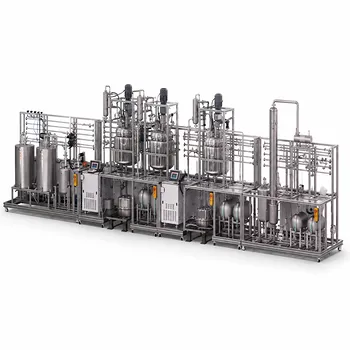
In a pilot plant with recycle, what you can't measure, you can't improve. Material balances provide that measurement. By applying conservation of mass to every component entering and leaving the reactor-separator loop, you can quantify exactly how much unreacted material is recovered, compute true conversion efficiency, and identify hidden waste streams that sap raw material value and inflate cleanup costs. This turns a pilot plant from a simple test rig into a precise diagnostic tool.
Material balances transform raw sensor data into a clear, quantitative picture of where every atom goes. They reveal whether your recycle strategy is truly boosting efficiency or simply masking losses, and they provide the hard numbers needed to forecast commercial-scale economics and waste treatment burdens—before you spend millions on scale-up.
How Material Balances Reveal Reactor Efficiency
In a recycle loop, raw conversion per pass can be misleading. A reactor that converts only 50% of feed in one pass may still achieve a near-complete overall efficiency if the unreacted material is separated and returned. The material balance is the only rigorous way to calculate this overall conversion efficiency.
The Steady‑State Equation Is Your Foundation
At steady state, with no accumulation in the system, the balance simplifies to:
Input + Generation = Output + Consumption
For a reactor with recycle, “Input” includes fresh feed plus the recycled stream. “Output” includes both product and any purge or waste streams. Writing component balances (e.g., for the key reactant) immediately shows whether measured outputs match the inputs and reaction stoichiometry.
Calculating the True Reactor Performance
With flow rates and compositions from key points—fresh feed, reactor effluent, recycle, purge, and product—you can:
- Determine conversion per pass (reactant consumed inside the reactor in one cycle).
- Calculate overall conversion across the entire loop (fresh feed that ultimately becomes product).
- Separate reaction consumption from physical losses (leaks, purge, or incomplete separation).
This distills reactor performance into an unambiguous number, enabling direct comparison between different catalyst loads, temperatures, or reactor configurations.
Locating and Quantifying Waste Streams
Waste is not just what leaves the facility in a disposal drum. A material balance exposes unreacted raw material that ends up in a purge, byproducts formed in side reactions, and even unaccounted emissions—all of which represent real economic and environmental waste.
Detecting Unaccounted Losses
Any discrepancy between measured inputs and outputs signals a problem. A consistent shortfall in a carbon balance might mean:
- An unmeasured side reaction forming an unknown byproduct.
- A leak in the gas recycle line.
- An incorrect sensor reading that hides an accumulating inert.
In pilot plants, where every data point feeds into scale‑up decisions, catching these gaps early saves enormous rework later.
Tracing Waste to Its Source
Material balances let you pinpoint which stream carries the highest waste load. For example, a component balance for a toxic byproduct will show whether it originates in the reactor (due to poor temperature control) or in the separator (due to thermal degradation). This evidence directly guides process optimization—changing a residence time rather than adding an entire new treatment unit.
The Purge Dilemma and Recycle Optimization
Recycle loops conserve valuable reactants, but they also accumulate inerts and unwanted byproducts. The material balance reveals the true cost of the purge.
How Inerts Degrade Efficiency
Inert gases (like nitrogen from air‑based feeds) or reaction byproducts (like CO₂ in ethylene oxidation) build up in the recycle loop if not purged. This dilute state lowers reactant partial pressures, slows reaction rates, and can even poison catalysts. The material balance shows the steady‑state concentration of inerts as a function of purge flow rate.
The Purge‑to‑Recycle Trade‑off
Increasing the purge removes inerts and restores reaction kinetics, but it also discards valuable unreacted material. The material balance quantifies both sides: how much reactant is lost per unit of purge versus how much product is gained from a cleaner reactor environment. The optimal ratio is the one that maximizes net economic return—a number impossible to find by guesswork.
From Pilot Data to Commercial Scale
Every gram of waste and every percent of conversion documented in a pilot plant feeds directly into the full‑scale design.
Benchmarking Raw Material Costs
Pilot‑plant material balance data (e.g., kilograms of fresh reactant per kilogram of saleable product) becomes the benchmark for the commercial process. It allows engineers to forecast annual raw material purchase volumes and estimate separation or waste treatment costs with far greater accuracy than any simulation alone.
Validating Waste Treatment Integration
A pilot plant that also demonstrates resource recovery—recycling by‑products or treating waste streams—relies on material balances to quantify how much waste is actually eliminated. These numbers are essential for environmental permitting and for proving that a process meets sustainability targets before large capital investments are made.
Understanding the Trade‑offs
Material balances provide clarity, but they also expose difficult choices that every process engineer must face.
Data Quality vs. Complexity
A rigorous balance requires reliable flow and composition measurements at multiple points. In a pilot plant, some streams (like a low‑flow purge) may be difficult to measure accurately. The resulting uncertainty forces a compromise: simplify the balance and lose precision, or invest in better instrumentation. The choice impacts how confidently you can scale up.
Purity vs. Recycle Rate
A high recycle ratio improves overall conversion but can recycle impurities that affect product quality or harm downstream equipment. The material balance shows the compositional trade‑off, but the final decision hinges on product specifications and maintenance costs—not just mass conservation.
Reactor Type Interactions
While a PFR often achieves higher per‑pass conversion and less backmixing, its integration with a recycle loop changes the residence‑time distribution. A material balance on a pilot‑scale CSTR versus PFR with recycle reveals how reactor configuration shifts the overall waste profile. One may produce less side‑product but require a larger purge, altering the total waste load.
How to Apply This in Your Pilot Plant
The material balance is not a textbook exercise; it is a live diagnostic. Use it to guide your pilot‑plant strategy.
- If your primary focus is comparing reactor designs: Perform a full component balance on the recycle loop for each configuration (e.g., PFR vs. CSTR) to quantify the yield‑to‑waste ratio under identical separation and purge conditions.
- If your primary focus is minimizing purge losses: Use the balance to calculate reactant lost per unit of purge at several purge‑to‑recycle ratios, and identify the operating point where incremental efficiency gains no longer justify the lost raw material.
- If your primary focus is preparing scale‑up economics: Compile the material balance data into a simple spreadsheet that links fresh feed consumption, waste stream volumes, and projected treatment costs—this becomes the basis of your commercial sensitivity analysis.
- If your primary focus is training or education: Have students take real‑time sensor data, close the mass balances manually, and then explain why a 5% discrepancy points to a specific instrument drift or a hidden reaction pathway.
The true value of a pilot plant is not just running the reaction, but in learning to read what the mass flows are telling you. Master the material balance, and you hold the master key to reactor efficiency and waste reduction.
Summary Table:
| Key Parameter | Role in Recycle Loop | Process Benefit |
|---|---|---|
| Overall Conversion | Measures reactant converted across the entire loop | Evaluates true process performance beyond single-pass limits |
| Purge Ratio | Balances inert accumulation against reactant loss | Optimizes kinetics and prevents loop degradation |
| Component Balance | Tracks specific reactants, products, and byproducts | Pinpoints physical losses, leaks, and side reactions |
| Data Reconciliation | Compares total measured inputs versus outputs | Identifies sensor calibration errors and process anomalies |
Optimize Your Process Scale-Up with LABPARK
Are you looking to bridge the gap between laboratory research and industrial production? LABPARK designs and manufactures premium Educational and Vocational Unit Operations Pilot Plants in chemical engineering, bioprocess & biotech, and environmental & water treatment.
Specially engineered for universities, research institutes, and enterprises, our pilot plants provide the precise instrumentation and reliable data control required to accurately calculate material balances, evaluate reactor efficiency, and minimize waste.
Bring hands-on precision to your facility—contact us today to explore our custom pilot plant solutions!
Related Products
- Residence Time Distribution and Reactor Flow Characteristics Determination Educational Pilot Plant
- Carbon Dioxide Hydrogen Methanol Synthesis Educational Unit Operations Pilot Plant
- Ethyl Acetate Synthesis Unit Operations Pilot Plant for Practical Training
- Natural Product Extraction Unit Operations Training Pilot Plant
- Green Anhydrous Ethanol Refining Practical Training Pilot Plant
People Also Ask
- Why is temperature regulation via a cooling jacket a critical feature in CSTR pilot plants used for laboratory training?
- What parameters to monitor transitioning from Batch to CSTR? Master Pilot Plant Setup
- How does steady-state multiplicity affect the operation and safety of exothermic reactions within a CSTR pilot plant? - Guide
- What role do customizable reactor pilot plants play in evaluating heat and catalyst performance? Scale-up Guide
- How Does Backmixing Affect 1st vs 2nd-Order Reaction Conversions in Pilot Plants?