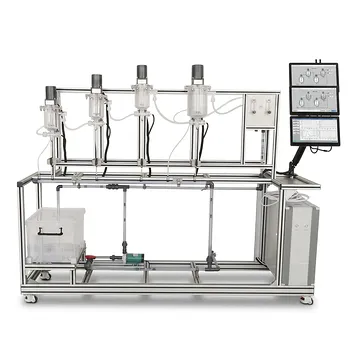
Surface area and electronic structure are two of the most fundamental levers for controlling reaction outcomes. In a chemical engineering educational pilot plant, a catalyst’s high surface area furnishes more active sites, directly accelerating the reaction rate, while its electronic structure provides alternative, lower-energy reaction pathways that can dramatically improve selectivity and conversion. Understanding how these atomic-scale properties translate to measurable changes in pilot-scale kinetics bridges the gap between textbook theory and industrial reactor design.
The core insight for students and researchers is that catalyst surface area governs how many active sites are available for reaction, dictating the overall rate, while electronic structure controls the activation energy and reaction pathway, shaping selectivity. In a pilot plant, observing the practical impact of these properties—and their inevitable trade-offs—transforms abstract catalysis science into a predictive engineering skill.
How Surface Area Governs Kinetic Activity
In heterogeneous catalysis, the reaction occurs at the catalyst surface. Therefore, the accessibility and number of surface atoms directly define the reaction’s kinetic potential.
More Active Sites Mean Faster Kinetics
A larger surface area simply means more active sites. Each available site can adsorb a reactant molecule, so increasing surface area multiplies the number of simultaneous reactions.
In a pilot plant, a high-surface-area catalyst (often achieved through porous structures) yields a measurably higher reaction rate under identical temperature and concentration conditions. This is why students see a direct, proportional link between BET surface area and the calculated rate constant.
Impact on Adsorption and Desorption Energetics
Surface area also changes how strongly molecules bind. High-surface-area materials often expose a distribution of crystal facets with slightly different adsorption energies.
This heterogeneity can alter both the heat of adsorption and the activation energy for desorption, shifting the overall thermodynamic equilibrium. In the pilot plant, this may appear as a change in the optimal operating temperature or a shift in the limiting step from reaction control to desorption control.
How Electronic Structure Redirects Reaction Pathways
While surface area dictates “how many,” electronic structure dictates “how easy.” It determines the catalyst’s ability to donate or accept electron density, fundamentally altering the reaction’s energy landscape.
Lowering Activation Energy
Electronic structure provides an alternative route with a lower activation energy. The d-band center of a transition metal, for example, dictates how strongly it bonds with intermediates.
If the bonding is too weak, activation barriers remain high; too strong, and the surface poisons itself. A well-tuned electronic state stabilizes the transition complex just enough to lower the energetic hurdle. In a pilot plant, this translates to the same conversion achieved at a much lower temperature—a critical observation when students calculate Arrhenius parameters.
Steering Selectivity Toward Desired Products
Different reaction pathways often have different electron-transfer requirements. A catalyst’s electronic structure can favor one mechanism over another.
For example, in partial oxidation reactions, a catalyst that easily donates electrons might promote complete combustion, while one with a moderate work function favors the valuable partial oxidation product. In an educational pilot plant, students witness this firsthand by swapping catalysts of similar surface area but different electronic properties, and then analyzing the product distribution shift—moving from a conceptual selectivity equation to a tangible, quantified outcome.
Practical Realities in an Educational Pilot Plant
Catalyst properties never act in isolation. The pilot plant reveals how atomic-scale choices cascade into system-level challenges.
The Silver Content Lesson: Activity vs. Selectivity
A classic pilot plant exercise uses a silver-based catalyst. The primary reference highlights that increasing silver content up to ~33.2% improves activity, but careful balance is needed to maintain selectivity.
Electronic structure effects are at play: too much silver on the surface may create continuous electron-rich domains that over-stabilize intermediates, leading to side products. Students see that the “best” catalyst is not necessarily the most active one, but the one that optimizes the activity-selectivity balance within the reactor’s residence time.
Carrier Properties: Why Ultra-Low Surface Area Can Win
The support material is not inert background. For highly exothermic reactions, a low-surface-area, macroporous carrier like α-Al₂O₃ (with <1 m²/g) is preferred.
The primary reason is to minimize mass transfer resistance and avoid deep penetration of reactants into micropores, which would trap intermediates and promote secondary reactions. In a pilot plant packed bed, this choice dramatically reduces hot-spot formation and improves temperature control—a perfect demonstration that “more surface area” is not a universal good.
Catalyst Size, Shape, and Reactor Engineering
Pilot plant experiments inextricably link particle design to reactor performance. Smaller catalyst particles increase the external surface-to-volume ratio and shorten diffusion paths, pushing the effectiveness factor toward 1.
However, in a tubular reactor, they also dramatically increase pressure drop. Shaped catalysts (trilobes, rings) are used to balance these forces. The pilot plant allows students to measure pressure drop versus conversion, making the Ergun equation a lived experience rather than a dry calculation.
Fluidization: When Particle Density Dictates Quality
For fluidized bed reactors, the catalyst’s envelope density—including internal pore volume—determines the minimum fluidization velocity. Underestimating this leads to incorrect operational settings.
Non-spherical particles like needles or plates fluidize poorly, causing gas channeling and slugging. In an educational setting, students directly observe that a high-surface-area powder might be useless if it cannot be properly contacted with the gas phase.
Understanding the Trade-offs
No single catalyst property is optimized in a vacuum. The educational pilot plant is designed to expose these conflicts.
High Surface Area vs. Pressure Drop and Attrition
Small, porous particles maximize surface area but also maximize ΔP across a packed bed, risking catalyst crushing and high pumping costs. In fluidized beds, they may attrite into fine dust that clogs downstream sensors. The pilot plant forces a choice: accept a larger particle with lower effectiveness factor to maintain a viable operating window.
Electronic Activity vs. Thermal Stability
Promoters (like alkali metals) are added to modify electronic structure—often to reduce poisoning or sintering. But they can also lower the melting point of surface phases or increase the rate of carbon deposition.
The pilot plant’s long-run stability tests show that a catalyst with spectacular initial activity due to its electronic promotion can deactivate rapidly, while a less electronically tuned but robust catalyst delivers superior lifetime performance.
Intrinsic Kinetics vs. Mass Transfer Limitations
A high-surface-area catalyst with micropores can shift the rate-limiting step from surface reaction to pore diffusion. The pilot plant demonstrates this when a temperature increase fails to proportionally increase rate, signaling the onset of diffusion control. This forces students to decouple intrinsic kinetics from apparent kinetics using the Thiele modulus—a core learning objective.
Making the Right Choice for Your Educational Goal
The catalyst properties you prioritize should directly reflect the learning objective of your pilot plant session.
- If your primary focus is demonstrating fundamental kinetics: Choose catalysts with distinct surface areas but identical chemical composition. This isolates the effect of active site count, allowing clean calculation of rate constants and activation energies.
- If your primary focus is reaction engineering and reactor design: Probe the impact of particle size, shape, and carrier porosity. Collect pressure drop and effectiveness factor data to understand how transport limitations dominate at scale.
- If your primary focus is advanced selectivity and pathway control: Experiment with catalysts of different electronic structures—varying active metal loading, oxidation states, or promoters—while keeping surface area constant. Use online analytics to map the shift in product distribution.
- If your primary focus is industrial troubleshooting and scale-up: Run life-cycle tests that combine all factors. Track how both surface area (via sintering) and electronic structure (via poisoning) decay over time, and correlate this to lost yield and increased operational costs.
By designing pilot plant experiments that intentionally surface these trade-offs, you transform atomic-scale properties into the engineering intuition needed to design, operate, and troubleshoot real catalytic reactors.
Summary Table:
| Catalyst Property | Primary Kinetic Impact | Pilot Plant Observation | Key Engineering Trade-off |
|---|---|---|---|
| Surface Area | Dictates active site availability and reaction rate | Proportional change in rate constants ($k$); shift to desorption control | High pressure drop ($|Delta P$), catalyst attrition, pore diffusion limits |
| Electronic Structure | Alters activation energy ($E_a$) and reaction pathways | Shift in selectivity, change in optimal operating temperatures | Thermal instability, potential catalyst poisoning, complex promoter balance |
Bring Chemical Engineering Kinetics to Life with LABPARK
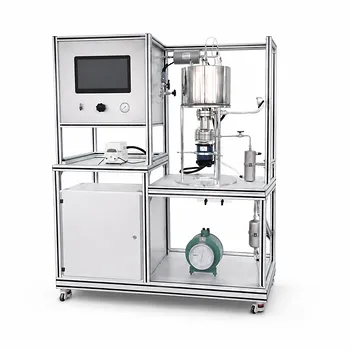
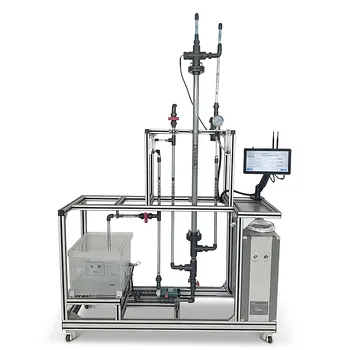
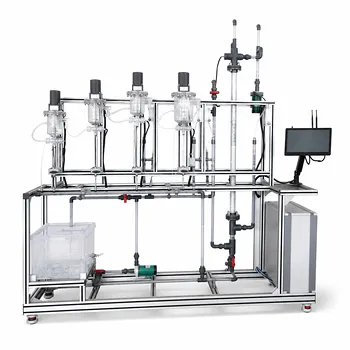
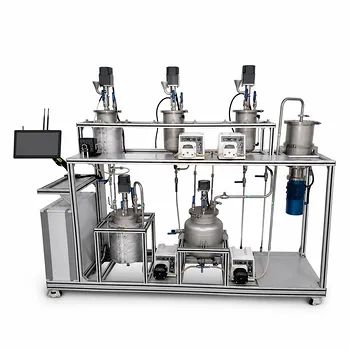
Bridging the gap between atomic-scale catalysis and macro-scale reactor engineering requires hands-on, high-fidelity equipment. LABPARK provides premium Educational and Vocational Unit Operations Pilot Plants in chemical engineering, bioprocess & biotech, and environmental & water treatment.
Designed specifically for universities, research institutes, and enterprises, our pilot plants empower students and researchers to master real-world reactor kinetics, pressure drop dynamics, and mass transfer limitations.
Ready to elevate your laboratory’s educational and research capabilities? Contact us today to request a custom pilot plant proposal!
Related Products
- Educational Unit Operations Pilot Plant for Intraparticle Diffusion Effective Factor Measurement
- Multi Functional Catalytic Reaction and Reactor Evaluation Educational Unit Operations Pilot Plant
- Multi-Reactor Educational Pilot Plant for Reaction Engineering Unit Operations
- Fixed-Bed Chemical Reaction and Gas Dust Tar Removal Unit Operations Pilot Plant
- Fixed Bed Gas Solid Catalytic Reaction Educational Pilot Plant
People Also Ask
- How do educational unit operations pilot plants bridge theory and design? Bridge the Engineering Gap
- How do educational unit operations pilot plants address safety and waste management when scaling up?
- Why is the chemical plant startup schedule crucial? De-risk scale-up with pilot plants.
- How do deviations in estimating latent heat impact pilot plant thermal systems? Avoid hardware mis-sizing.
- Why Use PTFE & Hastelloy in Chemical Pilot Plants? Prevent Corrosion & Ensure Safety