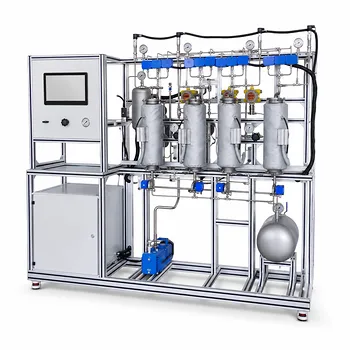
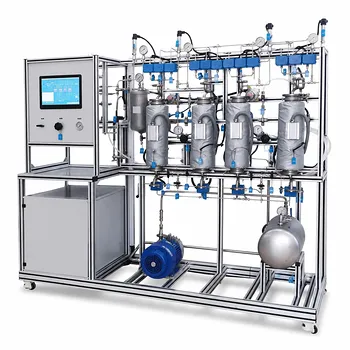
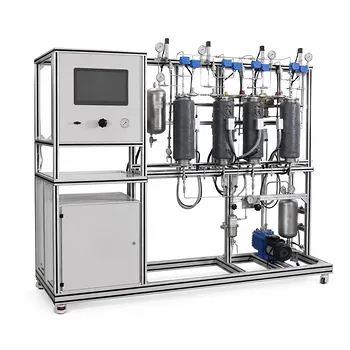
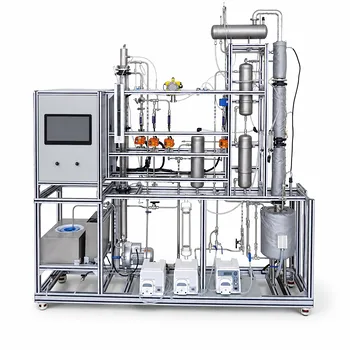
Your operational difference in a pilot plant boils down to speed versus economy when removing VOCs from a gas stream. While both granular activated carbon (GAC) and activated carbon fiber (ACF) work through the same fundamental principle of surface adsorption, ACF acts like a high-performance, short sprint sprinter, whereas GAC is a long-distance marathon runner. In practice, this means ACF will saturate and regenerate far faster due to its superficial micropores, while GAC offers a much more forgiving and cost-effective bulk removal process despite its slower internal diffusion.
Operating an adsorption pilot plant with GAC versus ACF isn't just a material swap; it fundamentally changes the dynamics of your breakthrough curves, pressure drop profiles, and energy budgets. ACF's near-instant kinetics make it ideal for demonstrating rapid cycling and polishing, but GAC's heterogeneous pore structure provides the industrial realism of slow, deep diffusion and lower upfront material costs.
The Bed Dynamics: Mass Transfer and Breakthrough Curves
The core operational difference lies in how the VOC molecule moves from the gas stream to the adsorption site. With ACF, this journey is almost instantaneous; with GAC, it is a rate-limiting step that dictates your column design.
Why Intraparticle Diffusion Dictates Your Flow Rates
In a GAC bed, the adsorbate must navigate a complex network of macropores and mesopores before locking into a micropore. This intraparticle diffusion resistance is the slowest step in the process. You will observe a slumping, gradual breakthrough curve because the VOCs take time to travel deep into the granule. In ACF, the 1.5–3 nm micropores are directly exposed on the fiber surface, eliminating this tortuous path. The result is a sharp, vertical breakthrough curve, meaning you are utilizing the bed's capacity much more efficiently right up until the moment of saturation.
Column Sizing and Superficial Velocity
Because ACF kinetics are so fast, you can run a column with a much higher superficial velocity (shorter residence time) and a thinner bed depth while still achieving complete removal. With GAC, you need a deeper bed and a longer residence time to allow the slow diffusion process to complete. In a pilot plant setting, switching from GAC to an ACF cartridge with a similar footprint will immediately show a higher treatment capacity for the same removal efficiency.
Pressure Drop and Physical Handling
The physical geometry of fiber versus granule creates distinct operational burdens on your pumps and maintenance schedules.
The Fiber Advantage in Aerodynamics
ACF can be manufactured as thin cloths, felts, or honeycomb matrices. These structured forms create highly uniform flow channels with significantly lower pressure drop compared to a randomly packed bed of irregular GAC granules. In your pilot plant, the blower or pump energy consumption will be markedly lower on the ACF line, a critical operational cost factor when scaling up.
Particulate and Fouling Challenges
A deep bed of GAC often doubles as a decent depth filter, trapping particulate matter within the voids between the granules. ACF, with its tight fiber weave or monolithic structure, acts as a surface filter. If your simulated VOC stream contains dust or mist, the ACF module will blind off and spike in pressure drop much faster than the GAC column, which can store solids in its interstitial spaces. For VOC removal only, ACF is superior; for dirty streams, GAC offers operational robustness.
Regeneration and Energy Cycles
You cannot ignore the back-end process. Regeneration is where the operating budget is won or lost, especially when demonstrating thermal or vacuum swing adsorption.
Rapid Electrically Conductive Regeneration
ACF's fibrous structure allows for uniform electrical conductivity and rapid heat transfer. In a pilot plant electrothermal swing adsorption (ESA) cycle, you can fully regenerate a saturated ACF bed in a matter of minutes by passing a low-voltage current directly through it. Desorbing GAC requires heating the granules indirectly through a hot gas purge, creating a long thermal lag that wastes energy and time. The ACF system allows you to run many more adsorption/desorption cycles in a single lab session.
Desorption Concentration Ratios
Because ACF desorbs so rapidly and at lower temperatures, the resulting desorbate stream is highly concentrated. For solvent recovery applications, this is a massive operational win. GAC regeneration often "tails"—slowly bleeding out VOCs at a low concentration over a long period—making recovery uneconomical and requiring longer purge gas burns. If your pilot plant is teaching industrial hygiene or resource recovery, ACF closes the loop much cleaner.
Understanding the Trade-offs
Objectively, ACF is not a universal replacement for GAC, and pilot plant operators must weigh these technical mismatches carefully.
The Cost and Fragility Paradox
GAC is cheap and mechanically robust. You can backwash a fouled GAC bed, and the granules tolerate significant attrition. ACF, while high-performance, is a specialty material. It is significantly more expensive per kilogram and thermally stable only to a lower temperature ceiling. Over-repeated aggressive steam regenerations, ACF can lose structural integrity or shed fibers, creating a secondary contamination risk that GAC avoids through sheer thermal mass and robustness.
The Molecular Weight Mismatch
The ultra-narrow micropores of ACF (1.5–3 nm) are finally sized for small, volatile molecules. If your pilot study involves heavier VOCs or semi-volatile organic compounds (SVOCs) that condense in mesopores, ACF offers no internal storage volume. GAC’s heterogeneous 10–100 nm mesopores act as highways and holding tanks for larger molecules, preventing surface pore blocking and providing more usable capacity for complex mixtures.
Making the Right Choice for Your Pilot Plant
Your selection between GAC and ACF should be dictated by the engineering principle you aim to demonstrate.
- If your primary focus is industrial realism and cost sensitivity: Integrate GAC columns to illustrate the practical challenges of mass transfer zones, deep bed attrition, and high-temperature thermal steam regeneration. This best mimics large-scale municipal water or gas treatment plants.
- If your primary focus is advanced kinetics and resource recovery: Install the ACF module to showcase rapid cycling, low-pressure drop operation, and high-purity solvent recovery via electrothermal swing adsorption. It highlights the efficiency of next-generation pollution control devices.
- If your primary focus is student experimentation and data contrast: Run both systems in parallel with a common waste stream. The stark contrast between GAC's gradual slope and ACF's sharp cliff in the breakthrough curve will make the mass transfer zone concept unforgettable.
By mapping the diffusion path length onto your operational strategy, you transform the pilot plant from a simple filtration test into a clear lesson in the economics and physics of surface chemistry.
Summary Table:
| Operational Feature | Granular Activated Carbon (GAC) | Activated Carbon Fiber (ACF) |
|---|---|---|
| Adsorption Kinetics | Slow intraparticle diffusion (gradual breakthrough) | Near-instant surface adsorption (sharp breakthrough) |
| Pressure Drop | Higher (irregular random packing) | Lower (structured fiber/matrix channels) |
| Regeneration Method | Slow, energy-intensive thermal gas purge | Rapid, efficient electrothermal swing adsorption |
| Cost & Robustness | Low cost, high durability, handles heavy SVOCs | High cost, fragile structure, best for light VOCs |
Scale Up Your Adsorption Research with LABPARK
Looking to demonstrate advanced VOC removal processes or train the next generation of environmental engineers?
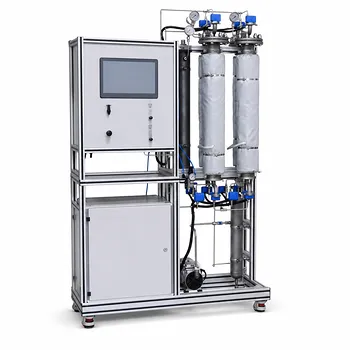
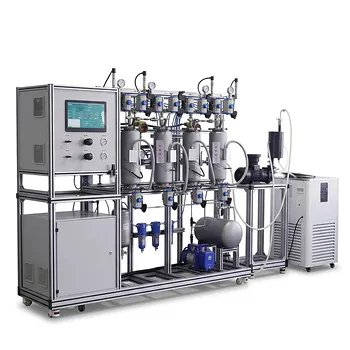
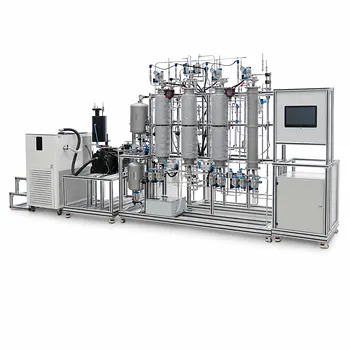
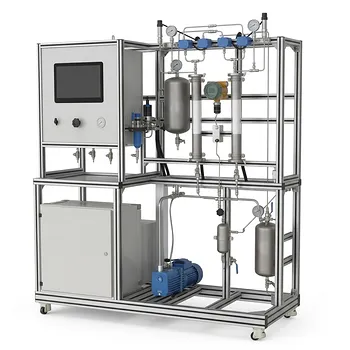
LABPARK designs and manufactures premium Educational and Vocational Unit Operations Pilot Plants across chemical engineering, bioprocess & biotech, and environmental & water treatment sectors. We empower universities, research institutes, and enterprises with robust, highly configurable systems tailored for precise data collection and hands-on learning.
Contact LABPARK today to discuss your laboratory's pilot plant requirements!
Related Products
- Carbon Dioxide Adsorption and Capture Educational Unit Operations Pilot Plant
- Carbon Dioxide Capture and Utilization Educational Pilot Plant for Unit Operations
- Bench Scale Carbon Dioxide Capture Educational Unit Operations Pilot Plant
- Dual-Mode Gas Absorption and Desorption Unit Operations Training Pilot Plant
- Absorption and Desorption Educational Unit Operations Pilot Plant
People Also Ask
- How does operating pressure influence the transition between absorption and desorption in a CO2 pilot plant?
- How do physical vs chemical adsorption impact pilot plant design? Key operational & regeneration strategies.
- How is moisture removal managed in an adsorption unit operations pilot plant? Dew Point Control Guide
- What are the key differences between PSA and TSA? Choosing the Right Adsorption Pilot Plant
- What unit operations are critical for CCUS training pilot plants? Build hands-on engineering expertise.