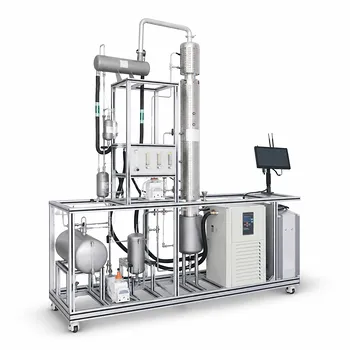
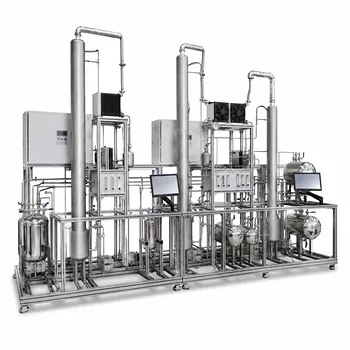
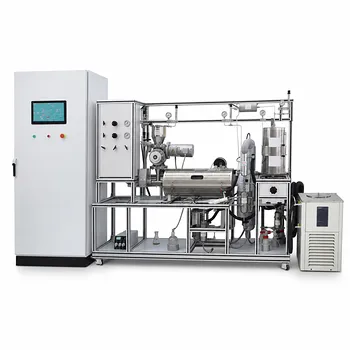
The promise of a pilot plant lies in understanding how units work together—a reality that makes optimizing any single subsystem in isolation a risky endeavor. In a setup where a reactor feeds a distillation column, and the column recovers unreacted material for recycle, tuning the reactor or the column independently almost guarantees a globally suboptimal process. The reason is simple: the distillation column’s design directly alters the composition and flow rate of the recycle stream, which in turn changes the reactor’s feed, conversion, and selectivity. An “optimized” reflux ratio that reduces column steam consumption can inadvertently starve the reactor of a critical reactant, tanking overall yield.
Designing a pilot plant’s reaction and separation train in silos is like tuning a musical duet by letting each musician practice alone in a soundproof room. While subunits can be analyzed independently as a learning exercise, achieving true process performance demands that you coordinate their sub‑problems so that you’re not sacrificing the performance of one unit operation for the sake of another.
The Connected Nature of Pilot Plant Units
The Recycle Loop Is the Integration Point
The defining feature of a coupled reaction–separation pilot plant is the material that leaves the reactor, passes through the distillation column, and returns.
That recycle stream carries unreacted feedstock—and its flow rate and purity are set by the column’s operating policy.
Any change in the column’s separation sharpness or throughput directly affects the reactor’s feed composition, which influences reaction rate, equilibrium, and heat generation.
How an Isolated Optimization Backfires
Consider a classic case: You decide to lower the column’s reflux ratio to cut energy use.
The column’s separation becomes sloppier. Unreacted reactant now returns to the reactor diluted with by‑products or inert material.
The reactor must then process a larger volume of lower‑quality feed, often reducing conversion per pass. To maintain production, you might raise temperature—worsening selectivity and creating more heavies that foul the column later.
The net result is a higher overall energy bill and a lower yield, despite the column’s “optimization” having been a local success.
The Domino Effect on Column Performance
The supplementary references highlight an important nuance: distillation columns in pilot plants are themselves sensitive systems.
In extractive distillation, for example, a high solvent flow rate causes the liquid‑to‑vapor ratio to spike, slashing tray efficiency to just 50% of a conventional column. Minor fluctuations in solvent feed temperature can create massive internal disturbances.
If an upstream reactor adjustment shifts the composition or flow of that solvent stream—even slightly—the column’s performance can collapse entirely. Local optimization that ignores this fragility will trigger instability across the whole plant.
Trade-offs and Common Pitfalls
The Allure of Local Efficiency
Breaking a complex plant into manageable optimization blocks is tempting. It simplifies the math and lets you use standard unit‑operation models.
But that simplification comes at a cost: you build an optimization landscape littered with false peaks. Each unit can reach its own local optimum while the global process wallows in mediocrity.
Students often fall into this trap because textbooks present distillation and reactor design as separate chapters. In a real pilot plant, that separation doesn’t exist.
The Hidden Cost of Disrupted Recycles
Pilot plants are especially vulnerable because they operate at smaller scales, where recycle streams can be large relative to fresh feed.
If your column “optimization” forces a higher recycle ratio, you raise the total flow through the reactor. This might push the reactor into a different hydrodynamic regime, change residence time, or overburden the heat‑exchange system.
Suddenly you’re troubleshooting a problem you created by “improving” the distillation step.
When Sequencing Logic Collides with Integration
The supplementary heuristics for column sequencing remind us that removing a high‑volume component early is wise because it reduces loading on downstream columns.
However, in an integrated plant, plucking out that high‑volume component might alter the recycle composition so profoundly that the reactor no longer sees its optimal feed ratio. An expert process designer coordinates the sequence choice with the recycle implications—something a simple heuristic cannot capture on its own.
How to Approach Subsystem Adjustments Safely
Start with a Global Sensitivity Map
Before touching any controller setpoint, map how a change in one unit’s outlet propagates to the other unit’s inlet.
Identify the critical recycle streams and the key performance indicators (KPIs) that measure overall plant health: product purity, yield, energy per kilogram of product, and operational stability.
Only then can you evaluate whether a column’s reflux tweak truly moves the plant toward a better state.
Use Coordinated, Simultaneous Optimization
Modern flowsheet simulators allow you to set a global objective function—like maximizing annual profit—and vary both reactor and column parameters together.
This naturally respects the fact that the distillation design directly affects the reactor’s feed composition and recycle loop load. The result is a set of operating conditions that balance the costs and benefits across unit boundaries.
Design Control Structures That Respect Interaction
A pilot plant’s control strategy must also be integrated. Instead of two separate temperature controllers for the reactor and the column, consider cascade or model‑predictive architectures that adjust the column’s boil‑up rate based on the reactor’s conversion signal.
This prevents the column from “optimizing” itself into a state that starves the reactor of recycled reactant.
Making the Right Choice for Your Goal
The caution is not that you should never tune a single unit; it’s that you must always view that tuning through a plant‑wide lens. Choose your approach based on what you are trying to achieve.
- If your primary focus is maximizing overall pilot plant yield: Coordinate reactor temperature, residence time, and column reflux ratio simultaneously to avoid recycle‑induced dilution.
- If your primary focus is minimizing energy consumption: Perform a whole‑process heat integration study rather than targeting the column’s steam usage alone; a small penalty in column reflux may unlock a much larger savings in reactor preheat.
- If your primary focus is operational stability: Map the dominant time constants and make sure your solvent or feed temperature control loops dampen disturbances before they reach the interconnected units.
- If your primary focus is rapid experimental learning: Temporarily decouple the units for individual characterization, but always validate your findings against an integrated run—the real plant performance never equals the sum of its individually optimized parts.
Resist the lure of the “perfect” column or the “ideal” reactor in isolation. In a connected pilot plant, the only optimization that matters is the one that serves the entire system.
Summary Table:
| Aspect | Local Subsystem Optimization | Global System Optimization |
|---|---|---|
| Focus | Individual unit efficiency (e.g., column steam) | Entire process yield, stability, and utility usage |
| Recycle Loop | Ignored; causes reactor feed dilution | Coordinated; maintains optimal reactant ratios |
| Process Yield | Often lower due to reactant starvation | Maximized through coordinated parameter tuning |
| Control Strategy | Isolated loop controllers | Cascade or model-predictive integrated control |
Optimize Your Entire Process with LABPARK
Designing and operating integrated pilot plants requires a holistic system approach to avoid the pitfalls of local optimization. At LABPARK, we provide state-of-the-art Educational and Vocational Unit Operations Pilot Plants in chemical engineering, bioprocess & biotech, and environmental & water treatment. Designed specifically for universities, research institutes, and enterprises, our systems feature integrated controls to help you master global process optimization.
Ready to elevate your research and training? Contact our experts today to find the perfect integrated pilot plant solution for your lab!
Related Products
- Continuous Sieve-Plate Distillation Pilot Plant for Unit Operations Laboratory Education
- Multi-Modal Distillation Unit Operations Training Pilot Plant
- Green Anhydrous Ethanol Purification Extractive Distillation Unit Operations Training Pilot Plant
- Multi-Reactor Educational Pilot Plant for Reaction Engineering Unit Operations
- Ethyl Acetate Synthesis Unit Operations Pilot Plant for Practical Training
People Also Ask
- Why is vacuum operation capability an essential feature for a distillation unit operations pilot plant? Unlock Efficiency
- How can real-time carbon number prediction improve distillation pilot plants? Optimize control.
- What are the primary reflux ratio control strategies? Master Distillation Unit Operations
- How does catalyst water concentration affect distillation pilot plant design? Key separation train choices.
- How to select the right activity coefficient model (Wilson, NRTL, UNIQUAC) for distillation pilot plants?