For low-pressure separations involving polar or hydrogen-bonded mixtures, the most reliable and physically grounded approach is the truncated virial equation of state paired with the Tsonopoulos correlation. This method directly ties vapor-phase non-ideality to intermolecular forces—accounting for dipole interactions and hydrogen bonds—without the need for arbitrary mixing rules. When strong dimerization is present (as with organic acids), a chemical equilibrium treatment must be layered on to avoid significant errors in fugacity coefficients.
While ideal gas assumptions may be tempting in low-pressure pilot‑plant work, polar and hydrogen‑bonded vapors exhibit measurable deviations. The truncated virial equation, using second virial coefficients from the Tsonopoulos method, captures these effects with a firm foundation in molecular physics. For associating vapors, a chemical equilibrium correction for dimerization is essential to prevent dangerous design or data‑interpretation errors.
Why a Special Approach is Necessary at Low Pressure
Pilot‑plant separations often operate near atmospheric pressure, yet the presence of large, polar, or hydrogen‑bonded molecules introduces non‑idealities that cannot be ignored. Even at low densities, these effects shift the fugacity coefficient away from unity, altering equilibrium predictions.
The Role of Fugacity in Phase Equilibrium
Phase equilibrium calculations in pilot plants (distillation, absorption) rely on fugacity, not partial pressure. The vapor-phase fugacity coefficient φᵢ corrects for intermolecular forces: a value of 1.0 indicates ideal gas behavior, while deviations from 1.0 must be accurately modeled to predict separation efficiency.
Low-Pressure Polar Systems Are Not Ideal
Simple rules like ideal gas or ideal solution behavior break down when polar or hydrogen‑bonded groups are present. Dipole‑dipole and hydrogen‑bonding interactions can cause fugacity coefficients to deviate significantly even at 1 bar, making a rigorous estimation method necessary for reliable pilot‑plant data.
The Truncated Virial Equation: A Mechanistic Foundation
The virial equation of state provides a rigorous link between macroscopic properties and molecular interactions. Its truncated form is particularly suited to the low‑density conditions typical of pilot‑plant vapor streams.
A Direct Link to Intermolecular Forces
The second virial coefficient, B, reflects pairwise molecular interactions. Unlike cubic equations of state, the virial coefficients have a clear molecular interpretation—they can be predicted from potential functions—and their extension to mixtures requires no arbitrary mixing rules, only quadratic composition dependence.
Valid Density Range for Pilot‑Plant Conditions
The truncated form (neglecting the third and higher virial coefficients) is accurate only at low to moderate densities, corresponding to the low‑pressure region where compressibility factors are near unity. This makes it ideal for the vapor phase in atmospheric and sub‑atmospheric separations commonly run in pilot plants.
The Tsonopoulos Correlation for Polar and Associating Mixtures
Estimating the second virial coefficient for polar molecules demands a correlation that moves beyond simple acentricity. The Tsonopoulos method adds terms specifically for polarity and hydrogen bonding, delivering accurate B values for ketones, alcohols, water, and other polar‑organic mixtures.
How the Correlation Extends Pitzer’s Approach
Building on the Pitzer‑type expansion, Tsonopoulos introduces additional reduced‑temperature‑dependent contributions. A polar term captures dipole‑dipole effects, while a hydrogen‑bonding term accounts for the directional, short‑range attractions that strongly influence fugacity coefficients of associating fluids.
Practical Implementation in Pilot‑Plant Calculations
With the second virial coefficient from Tsonopoulos, the fugacity coefficient is computed directly from φᵢ = exp[(Bᵢᵢ + ∑ ∑ yⱼyₖ (2Bᵢⱼ − Bⱼₖ)) P / (RT)] (or an equivalent rigorous expression). This closed‑form calculation integrates easily into spreadsheets or process simulators, enabling real‑time equilibrium stage analysis for column design and troubleshooting.
Special Considerations: Chemical Treatment for Dimerizing Vapors
When strong association occurs—most famously in carboxylic acids—a purely physical virial approach fails. The vapor phase contains both monomers and dimers, and the apparent fugacity coefficient is heavily distorted by the equilibrium between them.
The Chemical Equilibrium Correction
For strongly dimerizing species (e.g., formic acid, acetic acid), a chemical treatment must be applied. This involves solving the dimerization equilibrium constant, Kd, alongside the phase equilibrium equations. The true fugacity coefficient of the monomer is then calculated, while the total apparent fugacity coefficient reflects the mixture of species, preventing severe over‑estimates of vapor phase fugacity.
Recognising When the Chemical Treatment Is Mandatory
If vapor‑phase compressibility deviates dramatically from predictions using standard Tsonopoulos parameters, or if additional species (dimers) are detected spectroscopically, the chemical treatment is necessary. Pilot‑plant studies with organic acids, especially in azeotropic distillations or reactive separations, demand this extra step to avoid catastrophic scale‑up errors.
Understanding the Trade‑offs and Limitations
While the truncated virial/Tsonopoulos method is the go‑to solution for low‑pressure polar mixtures, it has clear boundaries. Overstepping them leads to inaccurate results.
Density and Pressure Ceiling
The method is strictly valid only where the density is low enough that three‑body interactions are negligible. If the pilot plant operates below about 2–3 bar for most polar mixtures, the approach is safe. At higher pressures, a cubic equation of state with advanced mixing rules (e.g., Predictive Soave‑Redlich‑Kwong) or an activity coefficient method for the liquid phase becomes necessary.
Parameter Availability and Complexity
The Tsonopoulos method requires compound‑specific parameters (critical properties, acentricity, dipole moment, and an association parameter). For novel or poorly characterised molecules, these may be unavailable, necessitating estimation methods that inject uncertainty. This can limit rapid application in early‑stage process development.
Making the Right Choice for Your Pilot‑Plant Separation
Your decision hinges on the nature of the mixture and the kind of data you need from the pilot plant. Match the method to your system’s chemical personality.
- If your vapor phase is dominated by strongly associating molecules like organic acids: Use the truncated virial equation with the Tsonopoulos correlation and a chemical equilibrium treatment for dimerization. Skipping this step will invalidate your fugacity coefficients and VLE predictions.
- If your mixture is polar or hydrogen‑bonded but does not dimerize appreciably (alcohols, ketones, water): Rely on the truncated virial with Tsonopoulos alone. It provides an accurate, physics‑based fugacity correction at low pressures without the complexity of an activity coefficient model for the vapor.
- If your pilot‑plant experiments are educational and designed to demonstrate phase equilibrium fundamentals: Leverage this method to show how molecular interactions translate directly into measurable deviations from ideality, linking laboratory observations to thermodynamic theory.
Armed with the correct fugacity coefficient estimation, you transform your pilot‑plant from a trial‑and‑error exercise into a precise, predictive tool for scale‑up.
Summary Table:
| System/Mixture Type | Recommended Estimation Method | Key Interactions Captured |
|---|---|---|
| Polar & H-Bonded (Non-Dimerizing) (e.g., Alcohols, Ketones) | Truncated Virial Equation + Tsonopoulos Correlation | Dipole-dipole & hydrogen-bonding interactions |
| Strongly Dimerizing Vapors (e.g., Acetic Acid, Formic Acid) | Tsonopoulos Correlation + Chemical Equilibrium Model | Monomer-dimer chemical association |
| Standard Low-Pressure Systems (Non-Polar) | Truncated Virial Equation or Ideal Gas (if error is negligible) | Weak dispersion forces only |
Scale Up with Confidence using LABPARK
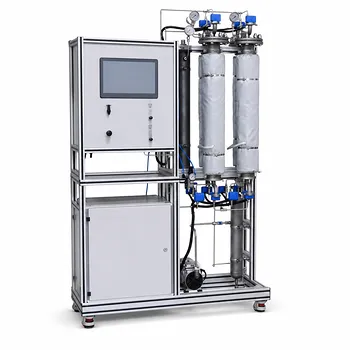
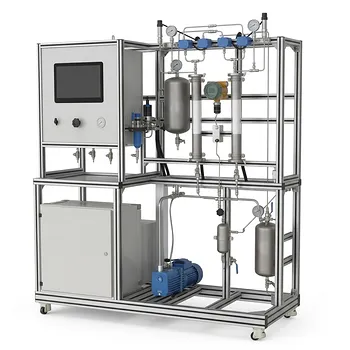
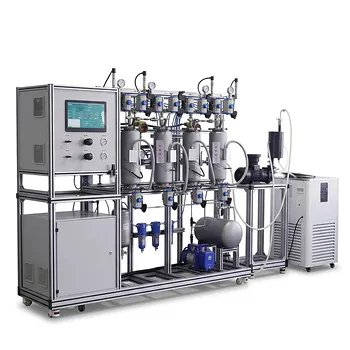
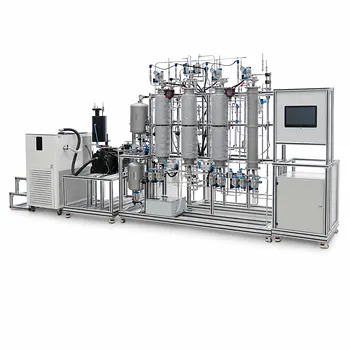
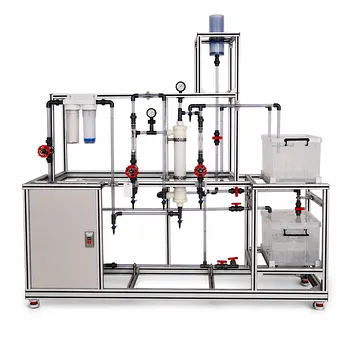
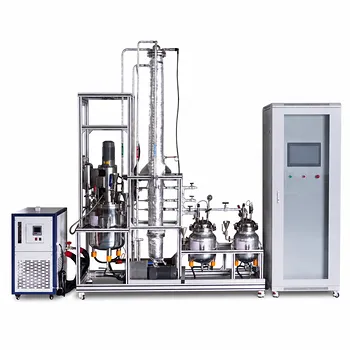
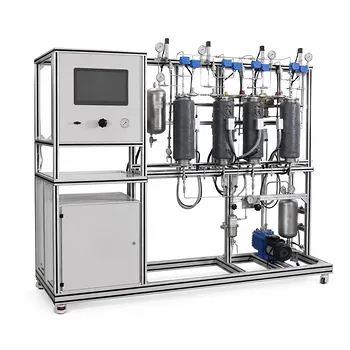
Accurate thermodynamic modeling is only as good as your physical validation. LABPARK provides premium Educational and Vocational Unit Operations Pilot Plants in chemical engineering, bioprocess & biotech, and environmental & water treatment. Designed to meet the rigorous demands of universities, research institutes, and enterprises, our pilot plants help you bridge the gap between molecular theory and real-world separation performance.
Ready to equip your laboratory with industry-leading pilot systems? Contact LABPARK today to request a custom consultation!
Related Products
- Low Concentration Carbon Dioxide Capture Pressure Swing Adsorption Educational Pilot Plant
- Pressure Swing Adsorption Educational Unit Operations Pilot Plant
- Multi-Component Gas Pressure Swing Adsorption Pilot Plant for Unit Operations Education
- Educational Pressure Swing Adsorption Ethylene Capture Unit Operations Pilot Plant
- Ultrafiltration Membrane Separation Educational Pilot Plant
People Also Ask
- How does operating pressure influence the transition between absorption and desorption in a CO2 pilot plant?
- What unit operations are critical for CCUS training pilot plants? Build hands-on engineering expertise.
- How can pilot plants show tail gas vs flue gas CO2 capture differences? Key educational insights.
- What are the differences between post- and pre-combustion carbon capture training pilot plants?
- How do temperature variations affect CO2 transport models in pilot plants? Model vs Reality