Knowledge Applied Chemistry Education How to manage silver ion oxidation in pilot plant training? Master process control and scale analysis.
Author avatar

Tech Team · LABPARK

Updated 2 months ago

How to manage silver ion oxidation in pilot plant training? Master process control and scale analysis.


The core answer is a two-stage process: catalyzing the oxidation, then methodically removing the catalyst. The chemical oxidation step is managed by first introducing silver ions to catalyze the reaction between chromium and persulfate. Once the oxidation is complete and excess persulfate is boiled away, you must add hydrochloric acid to precipitate the remaining silver as silver chloride, which is then filtered out to prevent interference in subsequent scale analysis.

This procedure is a powerful, self-contained lesson in industrial chemistry. The true skill for students lies not just in adding reagents, but in understanding the logical sequence of using a catalyst to solve one problem and then systematically eliminating it to prevent creating another. It transforms a routine scale analysis into a masterclass in process control and industrial water management.

The Deeper Pedagogical Goal of this Procedure

The primary reference defines a clear sequence, but your role as an instructor is to frame this not as a simple recipe, but as a miniature industrial process flow. The deep need is to instill an intuitive understanding of sequential chemical logic and operational discipline.

Moving Beyond a Recipe to a Process Mindset

Students often fixate on the "what" of adding chemicals. Your job is to force them to confront the "why now" and the "what next."

The addition of silver is the solution to a specific kinetic problem: persulfate alone oxidizes chromium too slowly at an acceptable temperature. The subsequent addition of hydrochloric acid is the solution to a secondary contamination problem: leftover silver ions will ruin the analysis. This cause-and-effect chain is the heart of process engineering.

Building an Intuition for Interference Management

Every step in an analytical procedure is a potential source of interference for the next. This protocol is a perfect, teachable model of that universal truth.

The catalyst is indispensable, but it becomes a poison if left unchecked. Teaching students to predict and mitigate this sequential contamination is more valuable than the scale analysis result itself. It builds the core competency of analytical foresight.

Deconstructing the Procedure: A Step-by-Step Training Guide

Training must be anchored in the chemical logic of each action. The process breaks down into three distinct operational phases, each with a specific student learning objective.

Phase 1: The Catalyzed Oxidation

The objective here is to teach the function of a catalyst in a tangible, observable way. The reaction speed is a direct indicator of the catalyst's effect.

Introduce the silver ions after the persulfate. Have students note the oxidation state change of chromium visually, if possible, or through timed sampling. This concrete demonstration cements the abstract concept that a catalyst is not a reactant but an accelerator that remains chemically unchanged until you, the engineer, decide its fate.

Phase 2: Terminating the Primary Reaction

The boiling step is not about the catalyst; it's about destroying the excess primary oxidizing agent, persulfate.

Explain that this is a critical endpoint control. If persulfate remains, it will continue to oxidize other species unpredictably, ruining the precision of the scale quantification. This teaches the principle of quenching a reaction—a fundamental operation in chemical synthesis and water treatment.

Phase 3: Selective Precipitation and Separation

This is the most elegant and instructive step. The addition of hydrochloric acid to hot solution targets the now-unnecessary silver ions with surgical precision.

Silver chloride’s low solubility constant is the star here. The visual formation of a white, curdy precipitate makes the abstract concept of solubility product tangible. The final filtration is a physical separation based on a chemical property, closing the loop on the unit operations principle.

Understanding the Critical Trade-offs and Hazards

No training is complete without a sober assessment of what can go wrong. This procedure contains several key learning points for risk management and analytical error.

The Time and Temperature Constraint

The boiling step to destroy excess persulfate is a non-negotiable time sink. Rushing it is the most common error.

Trade-off: Insufficient boiling leaves residual oxidizer, guaranteeing inaccurate scale composition results. Using excessive heat to speed it up can cause bumping and sample loss. Train students that this wait is an active part of the method, not downtime. Patience is a process control parameter.

The Hazard Profile of Hot Acid

Adding hydrochloric acid to a boiling solution creates a significant splash and fume hazard. The primary safety lesson is the handling of hot, corrosive liquids.

The procedural discipline of slow addition with constant stirring, under a fume hood, is paramount. This reinforces the non-negotiable safety-first culture in any pilot plant, where academic demonstration meets real-world operational risk.

Completeness of Silver Removal

The entire analytical validity hinges on complete precipitation and filtration of silver chloride. Residual silver ions will wreak havoc.

Trade-off: Adding a massive excess of hydrochloric acid ensures complete precipitation but introduces a high-chloride background. The pedagogical choice is to demonstrate the stoichiometric ideal: adding just enough acid to precipitate the silver, testing for completion by adding one more drop and observing no new precipitate. This turns the step into a lesson in stoichiometry and the limits of detection.

How to Design the Training Session for Maximum Impact

Structure the session to connect this single bench-top operation to the broader industrial landscape it simulates.

  • If your primary focus is teaching industrial water chemistry: Frame the entire exercise as a microcosm of boiler water management. Link the silver-catalyzed oxidation to sensor accuracy and the prevention of scale-related heat transfer losses.
  • If your primary focus is developing operational discipline: Use this protocol as a formal assessment. Grade the student’s ability to follow the sequenced steps precisely under time and safety constraints, not just on the final numerical result for scale composition.
  • If your primary focus is bridging theory with practice: Conduct a pre-lab that calculates the required volume of hydrochloric acid based on the initial silver catalyst mass, then have students verify the effectiveness of their own calculated addition through the qualitative observation of complete precipitation.

The power of this single, elegant chemical sequence is its capacity to transform an abstract scale analysis into a visceral lesson on reaction engineering and process control.

Summary Table:

Phase Operational Step Student Learning Objective
1. Catalyzed Oxidation Introduce silver catalyst to accelerate persulfate reaction. Observe catalytic kinetics and visual reaction changes.
2. Quenching Reaction Boil solution to destroy excess persulfate. Understand endpoint control and reaction quenching.
3. Precipitation & Separation Add HCl to precipitate and filter out silver chloride (AgCl). Master stoichiometry, solubility, and physical separation.

Equip your students and researchers with hands-on process engineering skills. LABPARK designs and manufactures state-of-the-art Educational and Vocational Unit Operations Pilot Plants in chemical engineering, bioprocess & biotech, and environmental & water treatment. Tailored for universities, research institutes, and enterprises, our systems bridge the gap between chemical theory and industrial practice. Contact LABPARK today to customize a pilot plant solution for your lab!

Related Products

People Also Ask

Related Products

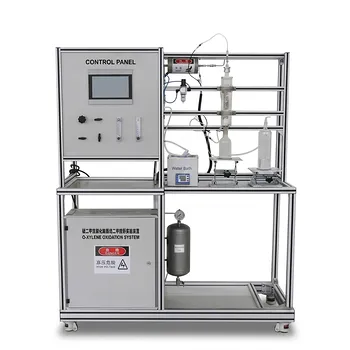
O-Xylene Oxidation to Phthalic Anhydride Educational Unit Operations Pilot Plant

O-Xylene Oxidation to Phthalic Anhydride Educational Unit Operations Pilot Plant

Explore our bench-scale educational pilot plant for o-xylene oxidation to phthalic anhydride, featuring a fixed-bed tubular reactor with visual observation, precise temperature control, and safety systems, ideal for chemical engineering hands-on training and industrial simulation, designed for university unit operations.

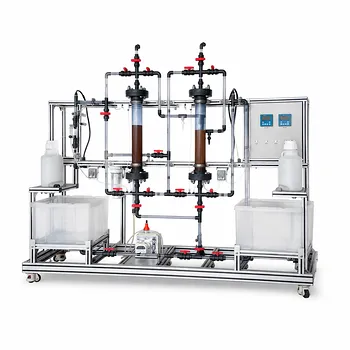
Ion Exchange Water Purification Educational Pilot Plant for Engineering Unit Operations

Ion Exchange Water Purification Educational Pilot Plant for Engineering Unit Operations

This bench-scale ion exchange pilot plant trains engineering students in water purification. Dual transparent columns simulate industrial softening and demineralization. Students observe fluid dynamics, perform resin regeneration, and analyze breakthrough curves. The corrosion-resistant frame ensures durability in unit operations experiments.

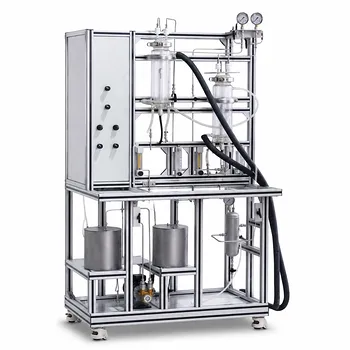
Multi-Reactor Educational Pilot Plant for Reaction Engineering Unit Operations

Multi-Reactor Educational Pilot Plant for Reaction Engineering Unit Operations

Integrated bench-scale educational pilot plant for chemical engineering teaching featuring fixed bed fluidized bed and stirred tank reactors with web-based digital twin controls and safety interlocks for hands-on unit operations and reaction engineering comparative studies in one compact system.

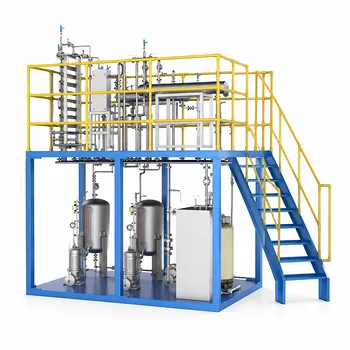
Solid Waste Pyrolysis and Refining Educational Pilot Plant for Unit Operations

Solid Waste Pyrolysis and Refining Educational Pilot Plant for Unit Operations

This pilot plant for solid waste pyrolysis and refining integrates pyrolysis, separation, distillation, and catalytic hydrogenation into one educational unit. It provides visual process observation, smart data logging, and industrial safety for hands-on learning of engineering unit operations.

Multi-Modal Distillation Unit Operations Training Pilot Plant

Multi-Modal Distillation Unit Operations Training Pilot Plant

Multi-modal distillation pilot plant for practical unit operations training in chemical engineering education. Features real, analog, and semi-physical simulation modes, industrial construction, customizable for university labs. Hands-on fractionation columns, SCADA control, safety systems. Includes sight glasses, sampling ports, closed-loop recycling.

Dual-Mode Rectification Pilot Plant for Practical Training Unit Operations

Dual-Mode Rectification Pilot Plant for Practical Training Unit Operations

Industrial-scale dual-mode rectification pilot plant for chemical engineering practical training. Features real-material and simulated-material operation modes, sieve-plate column with sight glasses for visual observation of hydrodynamics, and customizable SCADA control for safe, hands-on learning of unit operations and mass transfer.

Photocatalytic Membrane Separation and Degradation Unit Operations Pilot Plant

Photocatalytic Membrane Separation and Degradation Unit Operations Pilot Plant

Bench-scale pilot plant integrating photocatalytic degradation with membrane separation for engineering education. Study advanced oxidation, microfiltration, and hybrid processes using industrial sensors. Features safety light-blocking curtain, low-noise compressor, and durable stainless-steel construction.

Natural Product Extraction Unit Operations Training Pilot Plant

Natural Product Extraction Unit Operations Training Pilot Plant

Integrated natural product extraction pilot plant for chemical engineering training bridges theory and industrial practice with modular extraction and evaporation/concentration units, hybrid touchscreen and manual control, realistic process simulation, and self-contained softened water and vacuum utilities.

Educational Unit Operations Pilot Plant for Intraparticle Diffusion Effective Factor Measurement

Educational Unit Operations Pilot Plant for Intraparticle Diffusion Effective Factor Measurement

Designed for chemical engineering university labs, this pilot plant allows hands-on determination of catalyst particle intraparticle diffusion effective factors and gas-solid reaction kinetics using a fixed-bed tubular reactor with industrial touchscreen control, bridging theory and practical reactor design.

Dual Mode Heat Transfer Pilot Plant for Unit Operations Training

Dual Mode Heat Transfer Pilot Plant for Unit Operations Training

Engineering-scale dual-mode heat transfer pilot plant for hands-on unit operations training in chemical engineering. Features real and simulated modes, multiple heat exchanger types, comprehensive coefficient determination, and advanced process control with data acquisition for engineering students and researchers.

Fixed-Bed Chemical Reaction and Gas Dust Tar Removal Unit Operations Pilot Plant

Fixed-Bed Chemical Reaction and Gas Dust Tar Removal Unit Operations Pilot Plant

Integrated educational pilot plant for studying catalytic gas-solid reactions and downstream gas purification. Features dual fixed-bed reactor, three-stage heating, and touchscreen control for hands-on engineering training. Ideal for chemical and environmental engineering curricula.

Multi Functional Catalytic Reaction and Reactor Evaluation Educational Unit Operations Pilot Plant

Multi Functional Catalytic Reaction and Reactor Evaluation Educational Unit Operations Pilot Plant

Bench-scale educational pilot plant for catalytic reaction and reactor evaluation, integrating fixed bed, fluidized bed, and stirred tank reactors. Students compare reactor designs, evaluate catalysts, and study reaction kinetics and hydrodynamics. Perfect for unit operations labs in chemical engineering curricula.

Dual-Mode Gas Absorption and Desorption Unit Operations Training Pilot Plant

Dual-Mode Gas Absorption and Desorption Unit Operations Training Pilot Plant

Industrial-scale pilot plant for gas absorption and desorption training in chemical engineering. Features dual-mode operation with real and simulated materials, transparent columns for flow visualization, and customizable design. Supports independent or combined loops for hands-on unit operations experiments.

Electrochemical Water Treatment Educational Unit Operations Pilot Plant

Electrochemical Water Treatment Educational Unit Operations Pilot Plant

Enhance engineering education with this pilot-scale electrochemical water treatment plant. Designed for hands-on learning of efficient salt removal, electrolytic reactions, and real-time data acquisition. Features multi-mode control, corrosion-resistant PVC, low-voltage safety, and wireless connectivity for modern teaching labs.

Multi-Functional Special Distillation Educational Pilot Plant

Multi-Functional Special Distillation Educational Pilot Plant

Versatile multi-functional special distillation pilot plant for chemical engineering education. Supports continuous, vacuum, azeotropic, reactive, extractive distillation. Transparent glass columns enable real-time visual observation of hydrodynamics and separation processes.

Methanol Synthesis and Catalyst Performance Evaluation Educational Unit Operations Pilot Plant

Methanol Synthesis and Catalyst Performance Evaluation Educational Unit Operations Pilot Plant

Bench-scale methanol synthesis and catalyst evaluation educational pilot plant for chemical engineering labs to study catalytic kinetics, high-pressure operations, process control, and unit operations under realistic conditions with industrial safety features, precision gas delivery, data acquisition, and intelligent monitoring.

Multi-Functional Drying Educational Unit Operations Pilot Plant

Multi-Functional Drying Educational Unit Operations Pilot Plant

Versatile multi-functional drying educational unit operations pilot plant integrating tunnel, fluidized bed, and spray drying. Enables hands-on study of drying curves, psychrometry, and gas-solid separation for chemical engineering curriculum in higher education labs.

Carbon Dioxide Hydrogen Methanol Synthesis Educational Unit Operations Pilot Plant

Carbon Dioxide Hydrogen Methanol Synthesis Educational Unit Operations Pilot Plant

Hands-on educational pilot plant for methanol synthesis from carbon dioxide and hydrogen. Enables practical study of high-pressure catalysis, unit operations, and process control. Features real-time data acquisition, safety systems, and customizable experiment modules for undergraduate and graduate chemical engineering laboratories.

100L Continuous Loop Hydrogenation Educational Unit Operations Pilot Plant

100L Continuous Loop Hydrogenation Educational Unit Operations Pilot Plant

This 100L continuous loop hydrogenation pilot plant is designed for chemical engineering education, featuring 316 stainless steel construction, advanced gas-liquid mass transfer components, explosion-proof safety systems, and a 15.6-inch touchscreen with 5G connectivity, cloud data logging, bridging theory and industry.

Aspirin API Synthesis Unit Operations Training Pilot Plant

Aspirin API Synthesis Unit Operations Training Pilot Plant

An integrated pilot plant for aspirin API synthesis training, featuring batch reaction, recrystallization, and packed distillation modules. Offers dual-control operation, transparent vessels, and public utility simulation for safe, hands-on chemical engineering unit operations education. Ideal for university labs.


Leave Your Message