Knowledge Chemical Engineering Education How is Whitman's double-film theory used to model mass transfer resistance in gas absorption pilot plants? Explained
Author avatar

Tech Team · LABPARK

Updated 1 month ago

How is Whitman's double-film theory used to model mass transfer resistance in gas absorption pilot plants? Explained


For a gas absorption pilot plant, Whitman’s double-film theory provides the fundamental diagnostic tool. It models mass transfer resistance by postulating that the entire resistance to absorption resides in two hypothetical stagnant fluid films—one on the gas side and one on the liquid side—at the gas-liquid interface. By assuming steady-state molecular diffusion through these films, the theory allows operators to quantify how easily a solute moves from the bulk gas to the bulk liquid, turning the complex fluid dynamics of a pilot column into a solvable engineering problem.

The core insight is that Whitman's theory transforms an invisible bottleneck—mass transfer resistance—into a visible set of operational levers. It tells you whether to crank up the gas flow or improve the liquid distribution to boost absorption, acting as a compass for pilot plant studies aimed at scaling up to industrial columns.

Deconstructing the Resistance with the Double-Film Model

The double-film theory isn't just a description; it's a workflow for diagnosing and optimizing a gas absorption column. Its power in a pilot plant lies in breaking down the total mass transfer resistance into two manageable, phase-specific components.

The Core Mechanism: A Diffusion Bottleneck

Whitman’s model ignores the complex turbulence of the bulk fluids. Instead, it focuses on the interface.

All resistance is concentrated in a stagnant gas film of thickness ($z_G$) and a stagnant liquid film of thickness ($z_L$). Mass transfer across these films happens solely through slow molecular diffusion. At the interface itself, the theory assumes perfect equilibrium, governed by Henry's Law.

Quantifying Performance: The Individual Film Coefficients

This physical model translates directly into mathematical terms. The model uses individual mass transfer coefficients that are inversely proportional to film thickness.

A thinner gas film ($z_G$) means a higher gas-side mass transfer coefficient ($k_G$), signifying lower resistance. Similarly, a thinner liquid film ($z_L$) means a higher liquid-side coefficient ($k_L$), also signifying lower resistance. The overall flux ($N_A$) of the absorbing solute is driven by the difference between the bulk concentration and the interface concentration, divided by this film resistance.

How Operation Parameters Become Control Knobs

This is where the theory becomes practical. It links macroscale actions you take on the plant's control panel to microscale changes at the interface.

Reducing Film Thickness through Turbulence

The effective thicknesses ($z_G$ and $z_L$) are not static; they shrink as turbulence increases.

Increasing the gas velocity in the column directly thins the gas film ($z_G$), reducing the gas-phase resistance. Increasing the liquid flow rate or improving the packing’s ability to spread the liquid thins the liquid film ($z_L$), reducing the liquid-phase resistance. A pilot plant with variable flow controllers lets you see this relationship in real-time, confirming that a higher pressure drop buys you less mass transfer resistance.

The Solubility Dictates the Target

The Henry’s law constant ($H$) is the theory’s critical gatekeeper, telling you which film to focus on.

For highly soluble gases (large $H$): The liquid absorbs the gas so readily that the solute's struggle is getting to the liquid in the first place. The process is gas-film controlled, meaning you must focus on increasing gas turbulence. For sparingly soluble gases (small $H$): The gas molecule arrives at the interface easily but struggles to dissolve. The process is liquid-film controlled, directing your efforts to optimizing liquid distribution and flow rate.

Understanding the Trade-offs and Limitations

Using the double-film theory as your only lens can also mislead you. A good technical advisor must point out its structural blind spots.

The Steady-State Assumption Gap

The model’s primary weakness is its assumption of a stable, steady-state diffusion process. Real pilot plants are dynamic.

In turbulent, packed columns, liquid constantly mixes and fresh surfaces are exposed. This conflicts with theories like Higbie's penetration theory, which models unsteady-state diffusion into a fluid element for a short contact time. This is why the double-film theory predicts $k \propto D$, while penetration theory predicts $k \propto \sqrt{D}$. A pilot plant experiment that varies contact time can reveal which model better describes your specific random packing.

Identifying the Controlling Step Practically

To avoid optimizing the wrong phase, you must compare the relative magnitudes of resistance.

A practical method involves comparing gas-film resistance ($1/k_G$) to liquid-film resistance ($1/(H \cdot k_L)$). If the liquid-film term is orders of magnitude larger, the concentration of solute at the interface is almost identical to the bulk gas concentration. This signifies a liquid-film controlled system. In this state, increasing gas flow will do almost nothing to improve the absorption rate, a classic pitfall you can experimentally verify by watching for no change in overall mass transfer coefficient ($K_G a$) when gas velocity is increased.

Making the Right Choice for Your Pilot Plant Goal

Your experimental objective dictates how you should wield this theory.

  • If your primary focus is teaching core fundamentals: Use the double-film theory's simplicity to let students calculate $k_G$ and $k_L$ directly and visually grasp how the concentration profile bends at the interface during a gas-film vs. liquid-film controlled experiment.
  • If your primary focus is scale-up design and kinetic data accuracy: Critically compare results of the double-film analysis with a penetration or surface-renewal model at varying flow rates to ensure your calculated $K_L a$ values aren't skewed by a false steady-state assumption, as this directly impacts the design height of an industrial column.
  • If your primary focus is troubleshooting or process optimization: Start by assuming a controlling film based on the gas's solubility, then vary that phase's flow rate to see if $K_G a$ responds as predicted, allowing you to isolate the true bottleneck quickly without complex modeling.

By using the double-film theory as a diagnostic framework rather than a literal physical picture, you turn a pilot plant from a simple flow system into a precision instrument for measuring and mastering the hidden resistances that limit industrial absorption.

Summary Table:

Controlling Film Solute Solubility Key Resistance Operational Action
Gas-Film Controlled Highly Soluble (Large H) Gas-side interface Increase gas flow velocity
Liquid-Film Controlled Sparingly Soluble (Small H) Liquid-side interface Optimize liquid flow rate & distribution

Optimize Your Chemical Engineering Labs with LABPARK

Looking to bring mass transfer theories to life with hands-on learning and research? LABPARK provides state-of-the-art Educational and Vocational Unit Operations Pilot Plants in chemical engineering, bioprocess & biotech, and environmental & water treatment. Designed specifically for universities, research institutes, and enterprises, our pilot plants enable precise modeling of absorption columns, fluid dynamics, and thermodynamics.

Ready to upgrade your laboratory capabilities? Contact us today to discuss your pilot plant requirements!

Related Products

People Also Ask

Related Products

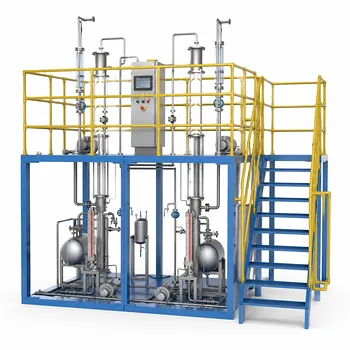
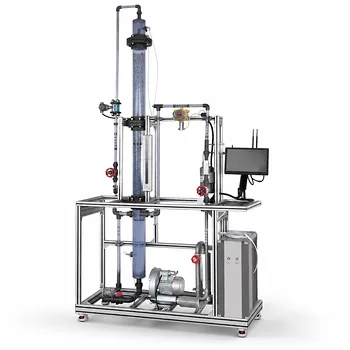
Dual-Mode Gas Absorption and Desorption Unit Operations Training Pilot Plant

Dual-Mode Gas Absorption and Desorption Unit Operations Training Pilot Plant

Industrial-scale pilot plant for gas absorption and desorption training in chemical engineering. Features dual-mode operation with real and simulated materials, transparent columns for flow visualization, and customizable design. Supports independent or combined loops for hands-on unit operations experiments.

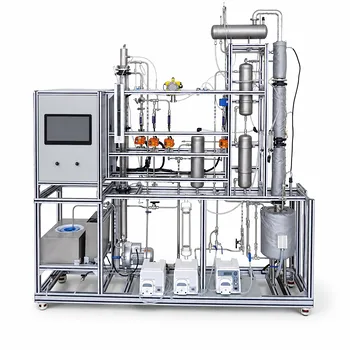
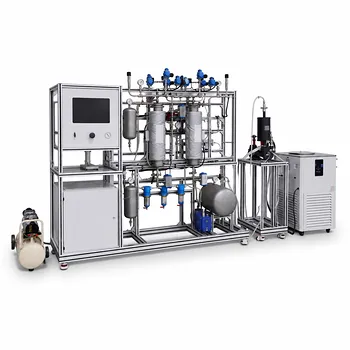
Carbon Dioxide Absorption and Desorption Educational Pilot Plant for Carbon Capture Studies

Carbon Dioxide Absorption and Desorption Educational Pilot Plant for Carbon Capture Studies

Explore carbon dioxide absorption and desorption with this educational pilot plant. Transparent columns visualize mass transfer; electric heating simulates industrial solvent regeneration; touchscreen interface enables data monitoring. Ideal for chemical engineering, bridging theory and practice.

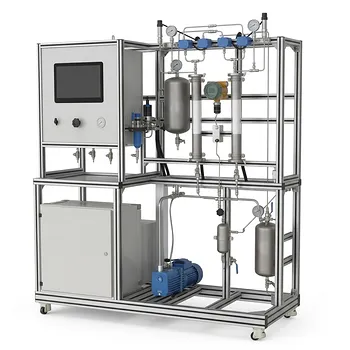
Absorption and Desorption Educational Unit Operations Pilot Plant

Absorption and Desorption Educational Unit Operations Pilot Plant

Dual packed column absorption and desorption pilot plant for chemical engineering education, offering real-time mass transfer coefficient measurement, durable mobile frame, industrial touch-screen interface, and customizable design for varied laboratory curricula, enabling hands-on study of gas absorption and stripping.

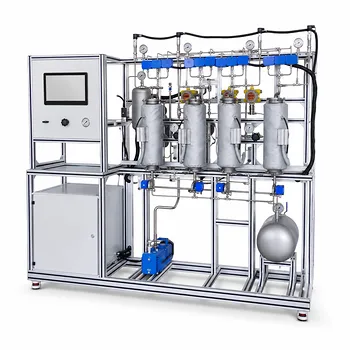
Carbon Dioxide Adsorption and Capture Educational Unit Operations Pilot Plant

Carbon Dioxide Adsorption and Capture Educational Unit Operations Pilot Plant

Advanced laboratory pilot plant for teaching carbon dioxide adsorption and capture unit operations. Features four-tower adsorption system with 400°C heating jackets, high-precision CO2 and O2 sensors, and 15.6-inch touchscreen with wireless data logging. Ideal for chemical engineering education.

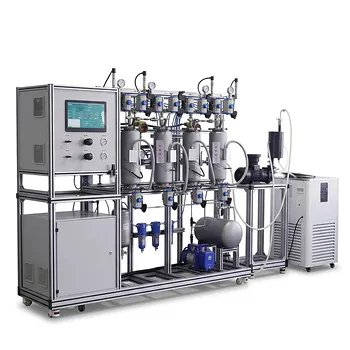
Multi-Component Gas Pressure Swing Adsorption Pilot Plant for Unit Operations Education

Multi-Component Gas Pressure Swing Adsorption Pilot Plant for Unit Operations Education

Multi-component gas pressure swing adsorption pilot plant designed for unit operations education. Features four-tower configuration, IoT touchscreen control, dual regeneration, and real-time breakthrough curve analysis for engineering training with safety interlocks and mobile frame simulates industrial PSA processes.

Packed Bed Absorption Educational Unit Operations Pilot Plant

Packed Bed Absorption Educational Unit Operations Pilot Plant

Study gas-liquid absorption, pressure drop, flooding, and mass transfer coefficients with this pilot plant. Transparent packed column, industrial touchscreen, real-time sensor data, automated analysis. Investigate two-phase flow, loading points, column efficiency. Comprehensive data logging and assessment software included.

Bench Scale Dual Column Gas Separation and Capture Educational Pilot Plant

Bench Scale Dual Column Gas Separation and Capture Educational Pilot Plant

This dual-column educational pilot plant provides hands-on teaching of gas adsorption, separation, and capture processes. It features stainless steel columns, regeneration up to 400°C, and a 15.6-inch touchscreen PLC for TSA and PSA studies in chemical engineering curricula, process simulation.

Pressure Swing Adsorption Educational Unit Operations Pilot Plant

Pressure Swing Adsorption Educational Unit Operations Pilot Plant

Integrated bench-scale pressure swing adsorption pilot plant for hands-on teaching of gas-solid separation, mass transfer, and process optimization using nitrogen-oxygen model, featuring dual-column design, industrial touchscreen control, digital assessment suite, and customizable hardware and software configurations for educational laboratories.

Thermal Desorption Exhaust Gas and Tail Water Treatment Educational Pilot Plant

Thermal Desorption Exhaust Gas and Tail Water Treatment Educational Pilot Plant

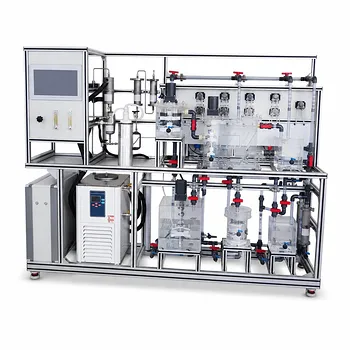
Bench-scale educational pilot plant for treating thermal desorption exhaust gas and tail water integrates condensation, Fenton oxidation, precipitation, filtration, and carbon adsorption. Ideal for chemical engineering and environmental labs, teaching unit operations, process control, and real-time data analysis.

Bench Scale Carbon Dioxide Capture Educational Unit Operations Pilot Plant

Bench Scale Carbon Dioxide Capture Educational Unit Operations Pilot Plant

This bench-scale educational pilot plant simulates industrial CO₂ separation using a multi-tower adsorption system for hands-on engineering training. Students achieve ≥90% CO₂ purity while studying pressure swing adsorption, desorption kinetics, and process control in gas purification experiments.

Educational Pressure Swing Adsorption Ethylene Capture Unit Operations Pilot Plant

Educational Pressure Swing Adsorption Ethylene Capture Unit Operations Pilot Plant

Advanced educational pilot plant for pressure swing adsorption ethylene capture provides comprehensive hands-on training in industrial gas separation processes, featuring an eight-column PSA system, real-time data acquisition, and fully customizable design for chemical engineering unit operations laboratories and research.

Multimodal Absorption and Desorption Pilot Plant for Unit Operations Training

Multimodal Absorption and Desorption Pilot Plant for Unit Operations Training

Multimodal absorption and desorption pilot plant for higher education labs. Bridges theory and industrial practice with transparent packed columns, three operational modes (real-material, simulated, semi-physical), and SCADA control. Students explore mass transfer, column hydraulics, and process control. Customizable.

Low Concentration Carbon Dioxide Capture Pressure Swing Adsorption Educational Pilot Plant

Low Concentration Carbon Dioxide Capture Pressure Swing Adsorption Educational Pilot Plant

Low-concentration CO2 capture pilot plant using Pressure Swing Adsorption for engineering education. Students gain practical experience in breakthrough curve measurement, adsorption dynamics, and variable analysis in a hands-on lab setting. Ideal for unit operations, mass transfer, and chemical engineering labs.

Fixed-Bed Chemical Reaction and Gas Dust Tar Removal Unit Operations Pilot Plant

Fixed-Bed Chemical Reaction and Gas Dust Tar Removal Unit Operations Pilot Plant

Integrated educational pilot plant for studying catalytic gas-solid reactions and downstream gas purification. Features dual fixed-bed reactor, three-stage heating, and touchscreen control for hands-on engineering training. Ideal for chemical and environmental engineering curricula.

Fluidized Bed Gas Solid Catalytic Reaction Educational Pilot Plant

Fluidized Bed Gas Solid Catalytic Reaction Educational Pilot Plant

Our educational fluidized bed gas-solid catalytic reaction pilot plant is ideal for chemical engineering labs. Students study fluidization dynamics, catalyst evaluation, and process control hands-on. Features include a customizable reactor, touchscreen HMI, and safety interlocks for safe, curriculum-aligned experiments.

Micro-Scale Gas-Solid Catalytic Reaction Educational Pilot Plant

Micro-Scale Gas-Solid Catalytic Reaction Educational Pilot Plant

Explore heterogeneous catalysis with this micro-scale gas-solid catalytic reaction educational pilot plant. Designed for university labs, it enables hands-on study of reaction kinetics and transport phenomena in a benchtop packed bed reactor with high-precision flow control and touchscreen automation.

Gas-Solid Heterogeneous Separation Demonstration Educational Unit Operations Pilot Plant

Gas-Solid Heterogeneous Separation Demonstration Educational Unit Operations Pilot Plant

Comprehensive visual transparent gas-solid separation pilot plant for chemical engineering labs. Demonstrates gravity settling inertial settling cyclone and bag filter technologies. Enables real-time analysis of fluid-particle mechanics pressure drop and collection efficiency. Ideal for undergraduate unit operations courses.

Gas Phase Mixing and Residence Time Distribution Determination Educational Unit Operations Pilot Plant

Gas Phase Mixing and Residence Time Distribution Determination Educational Unit Operations Pilot Plant

Integrated lab system for gas-phase mixing and RTD determination. Supports pulse and step tracer methods with dual CSTR and PFR reactors, industrial components, and PC data logging. Provides hands-on study of non-ideal flow and reactor behavior for university students.

Educational Unit Operations Pilot Plant for Intraparticle Diffusion Effective Factor Measurement

Educational Unit Operations Pilot Plant for Intraparticle Diffusion Effective Factor Measurement

Designed for chemical engineering university labs, this pilot plant allows hands-on determination of catalyst particle intraparticle diffusion effective factors and gas-solid reaction kinetics using a fixed-bed tubular reactor with industrial touchscreen control, bridging theory and practical reactor design.

Throttling Effect Determination Educational Unit Operations Pilot Plant

Throttling Effect Determination Educational Unit Operations Pilot Plant

Investigate the Joule-Thomson throttling effect with this educational unit operations pilot plant. Designed for engineering students, it enables hands-on comparative analysis of adiabatic gas expansion using precise process control, interactive digital interface, and eco-friendly operation, ensuring safe repeatable thermodynamic experiments.


Leave Your Message