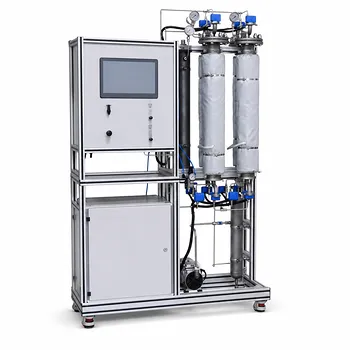
The equivalent diameter of packing materials is a calculated hydraulic diameter, not a physical measurement of a single packing element. For a gas absorption pilot plant column, it is computed using the formula $d_e = 4 \frac{\varepsilon}{\sigma}$, where $\varepsilon$ is the packing void fraction and $\sigma$ is its specific surface area. This single number captures the average size of the tortuous flow channels through the packed bed, making it the essential characteristic length for the Reynolds number. Without it, you cannot properly classify the flow regime or apply the correct mass transfer and pressure drop correlations in your unit operations experiments.
Accurately calculating the equivalent diameter is the linchpin for meaningful packed-bed Reynolds numbers. The formula $d_e = 4\varepsilon / \sigma$ flows directly from the universal definition of hydraulic diameter—four times the flow area divided by the wetted perimeter—applied to a unit volume of packing. Its real purpose is to give you a reliable dimensionless group that lets you scale up and compare pilot plant data with confidence.
Breaking Down the Formula $d_e = 4\varepsilon / \sigma$
How the Definition Arises from Basic Principles
The equivalent diameter in any non-circular flow passage is defined as $d_e = 4 r_H$, where $r_H$ is the hydraulic radius.
The hydraulic radius is the ratio of the flow cross-sectional area to the wetted perimeter. For a packed bed, consider one cubic meter of packing.
The flow area available for the fluid is the void volume fraction, $\varepsilon$. This is the space not occupied by solid packing.
The wetted perimeter per unit volume is the total packing surface area that contacts the fluid, $\sigma$. This assumes the packing is completely wetted, which is a key idealization.
Substituting these into the hydraulic radius gives $r_H = \varepsilon / \sigma$. Multiplying by 4 yields the equivalent diameter $d_e = 4\varepsilon / \sigma$. This directly links a geometric property of the packing to a single length scale.
What Each Parameter Really Means
Voidage ($\varepsilon$) is dimensionless and typically ranges from 0.6 to 0.95. A higher voidage means more open space for gas flow, which reduces pressure drop but also lowers the amount of active wetted surface per column volume.
Specific surface area ($\sigma$) has units of $\text{m}^2/\text{m}^3$. It quantifies the packing’s density of available surface. Structured packings often provide high surface area with lower pressure drop, while random packings like Raschig rings offer a different trade-off.
The ratio $4\varepsilon/\sigma$ therefore has units of length. It is not the size of one ring or saddle; it is an average flow channel dimension that emerges from the whole bed geometry.
Why This One Number Dictates Your Reynolds Number
The Reynolds Number Needs a Characteristic Length
For flow inside a pipe, the Reynolds number is $\text{Re} = \rho u d / \mu$, where $d$ is the pipe’s inner diameter. But a packed bed has no single pipe.
The equivalent diameter $d_e$ steps in as the substitute for $d$. It provides the missing geometric scale that, together with the fluid’s superficial or interstitial velocity, tells you whether the flow is laminar, transitional, or turbulent.
When you write $\text{Re} = \rho u d_e / \mu$ for a packed bed, you are comparing inertial forces to viscous forces at the scale of the pore channels. Without $d_e$, the Reynolds number would be meaningless because the length scale would be arbitrary.
Linking Flow Regime to Mass Transfer and Pressure Drop
In a gas absorption pilot plant, the gas-side mass transfer coefficient often correlates as a function of $\text{Re}$ and the Schmidt number. Getting the Reynolds number right is the first step to predicting how fast your solute will absorb.
If you use an incorrect characteristic length, you shift the entire correlation. Your calculated mass transfer rates could be off by 30% or more, leading to flawed scale-up decisions.
Pressure drop predictions also depend on $\text{Re}$. The Ergun equation, for example, explicitly uses the Reynolds number based on particle diameter—and for non-spherical, complex packing, $d_e$ is that diameter.
The Subtlety of Velocity Choice
The Reynolds number can be defined using superficial velocity (based on empty column cross-section) or interstitial velocity (actual velocity through the voids). Whichever you choose, the equivalent diameter must be paired with it consistently.
When you use the interstitial velocity $u_i = u_s / \varepsilon$, the Reynolds number becomes $\text{Re} = \rho (u_s/\varepsilon) d_e / \mu$. Combining this with $d_e = 4\varepsilon/\sigma$ shows how the voidage cancels or remains, depending on your definition. This consistency is what makes the final correlation universal.
Common Pitfalls and Limitations
The Assumption of Complete Wetting
The derivation assumes the entire packing surface area $\sigma$ is wetted. In reality, especially with plastic packings or low liquid loads, a significant fraction of the packing may be dry.
The true wetted area $a_w$ is often much smaller than $\sigma$. This means the effective equivalent diameter for mass transfer is larger than $4\varepsilon/\sigma$, potentially pushing your calculated Reynolds number into a different regime.
Heterogeneity in Real Packed Beds
Pilot plant columns show variation in voidage near the wall, where channels can form. The average $\varepsilon$ and $\sigma$ you use from manufacturer data may not reflect these local effects.
Your Reynolds number will then be an average that masks local maldistribution. In a tall pilot column, gas channels might cause early breakthrough, an effect not captured by a single $d_e$.
Sensitivity to Packing Orientation and Damage
Random packings can settle or break, altering both voidage and surface area. If you reuse the same $d_e$ from fresh packing data, your Reynolds number calculations will drift over time.
Always measure the actual bed height and pressure drop to back-calculate if the flow characteristics have changed. This lets you detect shifts in effective equivalent diameter before they ruin your data.
Making the Right Choice for Your Pilot Plant Analysis
- If your primary focus is comparing packing types for absorption efficiency: Calculate $d_e$ from the manufacturer’s reported $\varepsilon$ and $\sigma$, then compute $\text{Re}$ using the interstitial velocity. This gives you a fair, geometry-normalized comparison that accounts for different void fractions.
- If your primary focus is predicting pressure drop with the Ergun equation: Use the superficial-velocity-based Reynolds number, but ensure you input the correct $d_e$ derived from $4\varepsilon/\sigma$. Validate against a few experimental pressure drop points to confirm the packing data is still accurate.
- If your primary focus is scale-up from pilot to full-scale column: Keep the same equivalent diameter definition and Reynolds number correlation pair used in your pilot tests. Inconsistently switching definitions between scales will introduce systematic errors that are hard to trace.
- If you suspect incomplete wetting with low-surface-tension liquids on plastic packing: Estimate the effective wetted area using a correlation like Onda’s, then compute an adjusted $d_e = 4\varepsilon / a_w$. This gives a more realistic Reynolds number for your mass transfer calculations, even if it differs from the nominal value.
By grounding your Reynolds number in a correctly calculated equivalent diameter, you transform a simple dimensionless group into a powerful, predictive tool for your gas absorption work.
Summary Table:
| Parameter / Term | Formula / Unit | Key Definition & Role |
|---|---|---|
| Equivalent Diameter ($d_e$) | $d_e = 4 \frac{\varepsilon}{\sigma}$ (m) | Hydraulic diameter representing average flow channel size. |
| Void Fraction (Voidage, $\varepsilon$) | Dimensionless (0.6 - 0.95) | Ratio of open space (void volume) to total column volume. |
| Specific Surface Area ($\sigma$) | $\text{m}^2/\text{m}^3$ | Total packing surface area contacting the fluid per unit volume. |
| Reynolds Number ($\text{Re}$) | $\text{Re} = \rho u d_e / \mu$ | Dimensionless group used to classify flow regime and scale up. |
Optimize Your Unit Operations Pilot Plants with LABPARK
Are you looking to achieve precise scale-up data and reliable mass transfer correlations in your academic or industrial research? LABPARK provides high-quality Educational and Vocational Unit Operations Pilot Plants in chemical engineering, bioprocess & biotech, and environmental & water treatment.
Designed for universities, research institutes, and enterprises, our pilot columns ensure accurate data collection for gas absorption, fluid dynamics, and thermodynamic studies.
Contact LABPARK today to discuss your pilot plant requirements and discover how our equipment can elevate your research and training programs!
Related Products
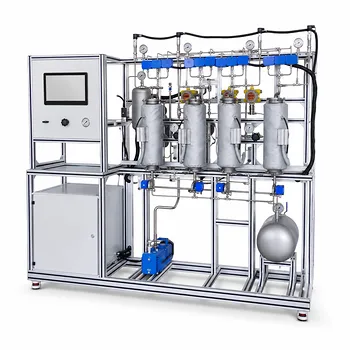
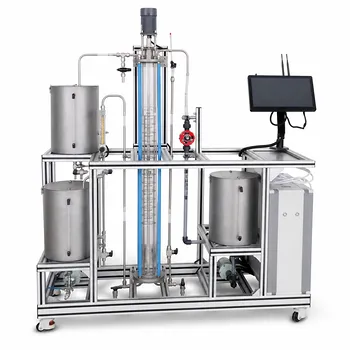
- Packed Bed Absorption Educational Unit Operations Pilot Plant
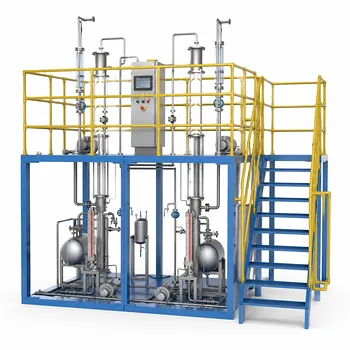
- Absorption and Desorption Educational Unit Operations Pilot Plant
- Bench Scale Dual Column Gas Separation and Capture Educational Pilot Plant
- Pressure Swing Adsorption Educational Unit Operations Pilot Plant
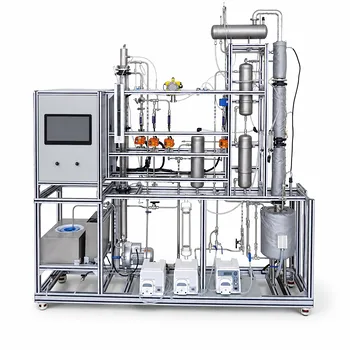
- Multimodal Absorption and Desorption Pilot Plant for Unit Operations Training
People Also Ask
- How Do Flow Regimes Transition in Packed Bed Pilot Plants? Key Scale-up Insights
- How does reactant concentration determine absorption column control? Gas-film vs. dual-film.
- How is the packing height of an absorption column calculated? Master HTU & NTU Concepts
- How does static vs. operating holdup affect pilot plant calibration? Avoid Critical Scale-Up Errors
- Why is counter-current flow selected for gas absorption? Maximize Pilot Plant Efficiency