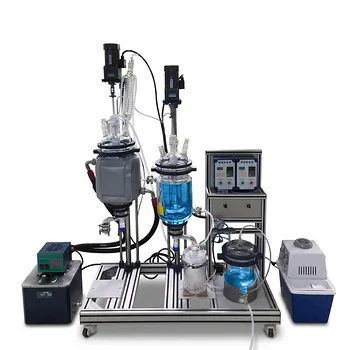
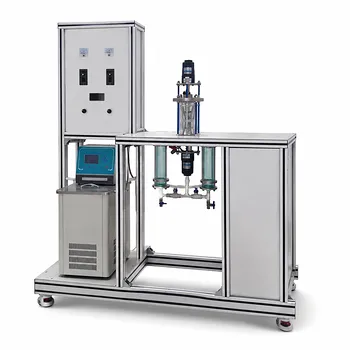
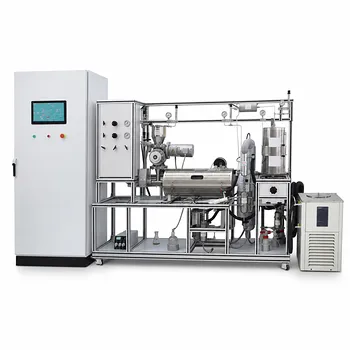
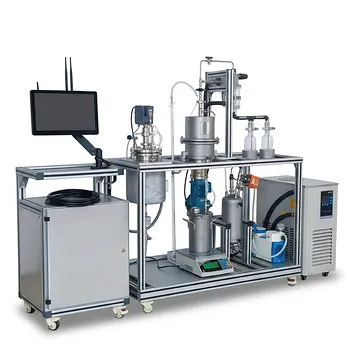
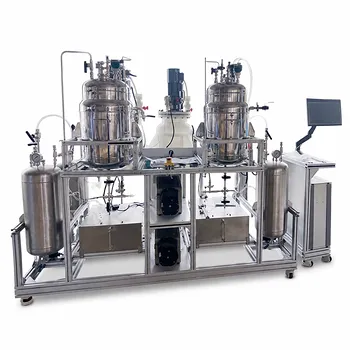
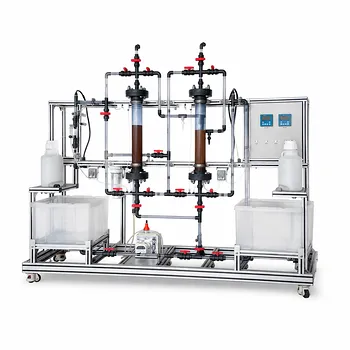
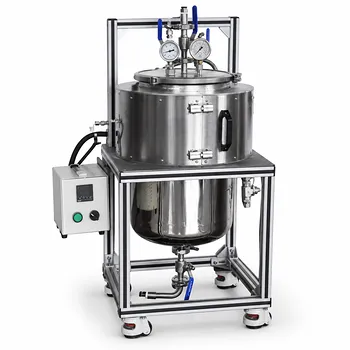
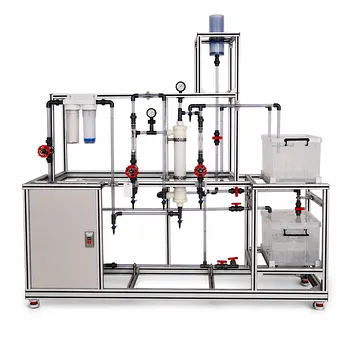
The direct laser scattering method answers the “when” of crystallization with pinpoint accuracy. In a pilot-scale crystallizer, a continuous Helium-Neon laser beam passes through the supersaturated solution. Before nucleation, the clear solution barely scatters the light, and the detector records a stable, high power level. The instant the first crystal nuclei form, they intensely scatter and diffract the beam, triggering a sharp drop in received power. By logging that exact signal plunge against temperature or time, operators directly measure the metastable zone limit and calculate the MSZW.
The direct laser scattering technique detects the very first crystal nuclei the moment they appear, converting a subtle physical event into an unambiguous optical drop. This gives you a precise, real-time boundary for the metastable zone and anchors your entire crystallization control strategy.
How Direct Laser Scattering Works in a Pilot Crystallizer
A Window into the Solution’s True State
A focused He-Ne laser is aligned to pass straight through a representative volume of the crystallizing solution. A photodetector on the opposite side continuously records the transmitted laser power. Before crystals appear, light travels with minimal obstruction, and the signal hovers near 100%.
The method relies on the physics of light scattering. As long as the solution contains only dissolved molecules, the laser beam remains largely undeviated. The moment an ordered arrangement of ions or molecules forms into a tiny solid nucleus, that particle becomes a scattering center.
Nucleation Becomes an Instantaneous Optical Event
Nucleation is nearly invisible to the naked eye in its earliest stages. The direct laser scattering method bypasses that limitation. Even a nanometer‑sized nucleus causes a measurable diffraction and scatter of the coherent laser light, pulling energy out of the direct beam.
The photodetector catches this as a steep, unmistakable drop in transmitted power. That real‑time voltage or power reading is the precise crystallization onset point. By synchronizing this signal with a temperature probe or a process timer, the pilot‑plant data system stamps the exact temperature and time at which the solution crossed from the metastable to the labile zone.
From Sudden Signal Crash to the Metastable Zone Limit
The sharp decline in transmitted power is not a trend—it’s a discrete event. In a cooling crystallization run, the solution’s temperature is slowly lowered at a known cooling rate. Up to a certain temperature, the laser power remains flat. When the temperature reaches the supersolubility curve, the signal collapses.
That critical temperature, read at the moment of the signal drop, directly defines the supersaturation limit for that cooling rate. By repeating the experiment at progressively lower cooling rates and extrapolating to a zero‑rate limit, pilot operators obtain the true thermodynamic metastable zone width, independent of kinetic effects. The laser simply becomes the ultimate nucleation detector.
Why Measuring MSZW Matters in Every Pilot Run
The Metastable Zone Determines Crystal Quality
The region between the solubility curve and the supersolubility curve is the only space where you can grow crystals predictably. Inside this metastable zone, the solution is supersaturated enough to feed crystal growth, but not so highly supersaturated that it triggers spontaneous, uncontrolled nucleation.
If the pilot plant drifts into the labile region, an avalanche of fine crystals appears within seconds. That “nucleation burst” ruins the crystal size distribution, traps impurities, and makes filtration a nightmare. Knowing exactly where that boundary sits, via direct laser scattering, keeps the process safely inside the controlled growth window.
Traditional Methods Benefit from a Laser’s Direct Proof
Typical pilot plants often rely on turbidity meters or conductivity probes to infer the onset of crystals. These detectors need a mass of particles to change the bulk solution properties, creating a slight delay and a softer transition. Direct laser scattering eliminates that ambiguity.
With a laser, you detect the literal birth of the solid phase. This turns an inferential measurement into a physical proof. It’s especially valuable when teaching crystallization fundamentals, where students must see a clear, one‑to‑one correlation between supersaturation and the moment of phase change.
Comparing Direct Laser Scattering with Other Detection Methods
Cooling Rate Method with Laser Detection
In the conventional cooling rate method, a saturated solution is cooled at constant rates, and the crystallization temperature is recorded. Direct laser scattering serves as the primary nucleation detector, replacing the slower‑response bulk turbidity probe. The laser signal’s sharp transition eliminates the subjective judgement of “when the solution goes cloudy.”
You collect a set of (cooling rate, crystallization temperature) data points with unprecedented repeatability. Fitting these points to a linear trend and extrapolating to a cooling rate of zero yields the metastable limit. The laser makes the extrapolation more reliable because each data point is a sharply defined physical event, not a gradual slope.
Nucleation Induction Time Method with Laser Monitoring
When the pilot transitions to an antisolvent or reactive crystallization mode, the induction time method becomes essential. The solution is rapidly brought to a target supersaturation and held isothermally. The time until the first cluster of nuclei appears is the induction time.
A laser beam traversing the vessel records that induction time without any operator bias. You plot induction time against supersaturation to reveal an asymptote—the metastable zone boundary. The laser gives you the earliest possible detection, which is critical because induction times can be as short as a few seconds at high supersaturations.
What Sets Laser Scattering Apart from Turbidity Probes
A turbidity probe measures scattered light at a fixed angle or the attenuation of a broad light source. It responds to the cumulative effect of many particles. Direct laser scattering, in contrast, captures the single‑event birth of crystals because the coherent beam is highly sensitive to any local change in refractive index.
The result: a faster, sharper signal that is less influenced by stirring speed and bubble entrainment. While turbidity gives a good average nucleation point, laser scattering gives you the first nucleus. This difference can shift the measured MSZW by a few tenths of a degree, which matters when designing a seeded cooling profile.
Understanding the Trade-offs and Practical Limitations
Alignment and Stability Demand Care
A He-Ne laser beam is narrow. Any vibration, thermal expansion of vessel walls, or change in refractive index with temperature can slightly steer the beam and cause a false power drop. Pilot‑scale rigs must use rigid optical mounts and vibration isolation to keep the alignment stable throughout a run.
Additionally, large‑volume vessels can produce thermal gradients that bend the laser path. You may need to place the laser and detector close together or use a short path‑length flow cell pulled from a recirculation loop. This adds complexity but preserves signal integrity.
Sensitivity Can Become a Double-Edged Sword
The laser detects any particulate, not just product crystals. A stray dust particle, a gas bubble, or an oil droplet from an antifeedant can also cause an abrupt scattering event. In industrial‑like pilot environments, this demands rigorous cleaning protocols and, ideally, software signal filtering to ignore transient spikes shorter than a known time threshold.
Furthermore, the method only reveals the onset of the first nucleation event. If the goal is to understand the full nucleation kinetics, a laser alone won’t give you particle size information or secondary nucleation data. Pairing it with focused beam reflectance measurement (FBRM) or imaging probes gives a complete picture while keeping the laser as your precise timing source.
Not a Direct Substitute for Thermodynamic Equilibrium
The MSZW measured by any method, including laser scattering, depends on the cooling rate, hydrodynamics, and impurity profile. The recorded boundary is a kinetic boundary, not the pure thermodynamic solubility curve. Extrapolating laser‑based data to zero cooling rate helps, but it still requires careful control of stirrer speed and heat transfer rates to avoid systematic errors.
This means you must calibrate your laser scattering setup under the same hydrodynamic conditions you intend to use in production. The numbers you get are valid for that specific vessel configuration, not a universal constant.
Making the Right Choice for Your Pilot System
When and how to deploy direct laser scattering depends on your pilot plant’s mission—whether you’re teaching fundamentals, developing a new crystallization process, or optimizing a scale‑up recipe. Use the following goal‑based guidance to decide.
- If your primary focus is teaching and demonstration: Embed a direct laser scattering probe in a small teaching crystallizer. The immediate, binary signal makes the MSZW concept tangible, and students can visually confirm the laser power drop against a chart recorder.
- If your primary focus is precise metastable zone mapping for process design: Use the laser as the detection element within the cooling rate extrapolation protocol. The sharp nucleation point gives you the highest‑confidence data set for determining the supersaturation limit, which feeds directly into your crystallization model.
- If your primary focus is real‑time pilot‑scale control without excessive maintenance: Pair a laser‑scattering flow cell in a recycle loop with a robust turbidity probe. The laser sets the benchmark nucleation point during development runs, while the turbidity probe handles day‑to‑day monitoring under industrial‑like conditions.
- If your primary focus is studying nucleation kinetics beyond simple detection: Combine laser scattering with FBRM or particle vision microscopy. Let the laser trigger the accurate time‑zero, and let the other probes analyze particle size and morphology evolution from that moment onward.
No single sensor dominates every crystallization pilot system. Direct laser scattering excels when the question is simply “Did nucleation happen, and exactly when?” Knowing that answer with confidence puts you in full control of the metastable zone and ensures your crystals grow exactly the way you designed them to grow.
Summary Table:
| Feature | Direct Laser Scattering | Turbidity Probes |
|---|---|---|
| Detection Principle | Captures single-event birth of first nuclei via beam scattering | Measures cumulative light attenuation of bulk cloudy solutions |
| Response Speed | Instantaneous, high-precision trigger | Delayed, gradual transition as particle mass increases |
| Sensitivity | High (detects nanometer-sized nuclei & minor changes) | Moderate (requires bulk concentration change) |
| Primary Application | MSZW boundary mapping and kinetics study | Day-to-day pilot control and routine monitoring |
Bring Precision to Your Crystallization Research with LABPARK
Are you looking to equip your laboratory or facility with advanced crystallization and chemical process capabilities? LABPARK provides premium Educational and Vocational Unit Operations Pilot Plants in chemical engineering, bioprocess & biotech, and environmental & water treatment for universities, research institutes, and enterprises.
Our pilot systems are engineered to help you achieve precise thermodynamic control, accurate MSZW measurement, and reliable process scale-up. Let us help you design the ideal pilot setup for your research and training needs—contact our engineering experts today for a tailored solution!
Related Products
- Multi Functional Membrane Crystallization Educational Unit Operations Pilot Plant
- Potassium Salt Thermal Dissolution and Crystallization Separation Educational Unit Operations Pilot Plant
- Multi-Functional Special Distillation Educational Pilot Plant
- Multi-Modal Distillation Unit Operations Training Pilot Plant
- Liquid-Liquid Mass Transfer Coefficient Determination Educational Pilot Plant
People Also Ask
- Control Crystallization Pilot Plant Secondary Nucleation: 4 Key Adjustments
- Why is precise temperature control critical in crystallization pilot plants? Key to Scale-Up Success
- What key factors should be considered when configuring a crystallization unit operations pilot plant?
- What are the benefits of integrating online PAT tools like ATR-FTIR into crystallization unit operations pilot plants?
- How to use crystallization pilot plant agitation speed to identify diffusion vs reaction growth?