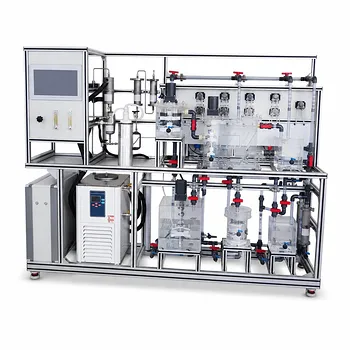
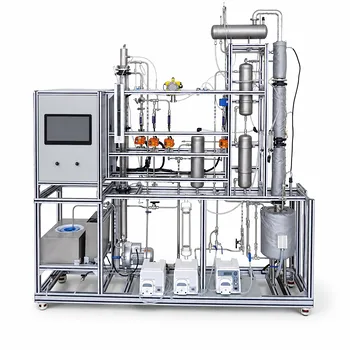
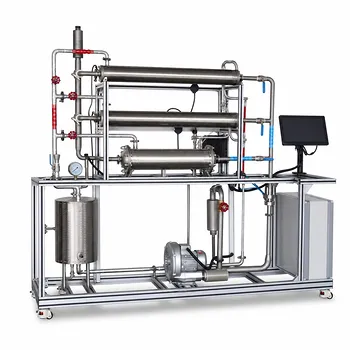
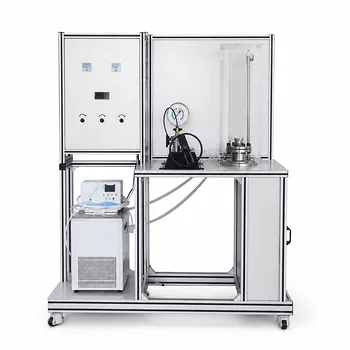
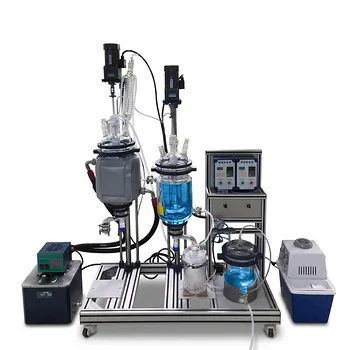
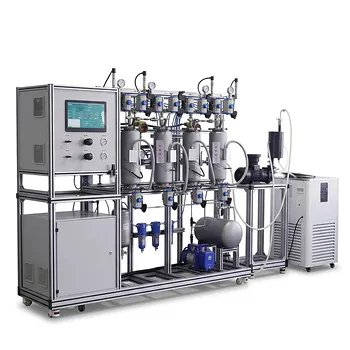
Temperature Programmed Desorption (TPD) is a foundational analytical technique for directly investigating a catalyst's surface, which is the true arena where chemical reactions occur. In a pilot plant setting, it bridges the gap between fundamental surface science and practical reactor engineering. You use it by saturating a catalyst bed with a carefully chosen probe gas, then linearly ramping its temperature to drive desorption. By analyzing the resulting desorption spectrum, you can map the strength and population of active sites on a working catalyst and calculate the activation energy required for desorption—a key parameter directly related to catalytic activity and reaction kinetics.
Understanding TPD means seeing it not just as a measurement, but as a direct chemical interrogation of a catalyst's surface energy landscape. Its core power in a pilot plant is to connect the microscopic environment of an active site to the macroscopic performance of the reactor, enabling a predictive understanding of activity, selectivity, and deactivation.
The Core Principle: Adsorb, Ramp, and Detect
TPD is an elegant experiment built on a simple thermodynamic principle. The strength with which a molecule binds to a surface dictates the thermal energy it needs to break free.
Probing the Active Site Landscape
The process begins with adsorption. A probe gas—often carbon monoxide, ammonia, or hydrogen—is pulsed over the catalyst bed until all accessible surface sites are saturated.
The choice of probe gas is critical. It chemically interrogates specific types of sites. For example, ammonia can distinguish between weak Brønsted and strong Lewis acid sites on a solid acid catalyst. You are essentially painting a functional map of the surface.
The Kinetic Fingerprint in the Desorption Spectrum
Once saturated, a continuous flow of inert carrier gas sweeps away any weakly bound or physisorbed molecules, leaving only the chemisorbed species. The temperature is then increased linearly.
Molecules with weaker bonds to the surface will desorb at lower temperatures, while those strongly bound require more thermal energy. The detector downstream—a thermal conductivity detector (TCD) or a mass spectrometer—records a peak for each distinct binding state. Each peak in the resulting desorption spectrum is a direct kinetic signature, revealing both the number of sites (peak area) and the activation energy of desorption (peak temperature).
Integrating TPD into the Pilot Plant Ecosystem
A pilot plant elevates TPD from a small-scale laboratory experiment to a realistic process-development tool. This requires precise hardware integration to ensure the data is meaningful for the catalyst's real-world performance.
The Hardware Triad: Flow, Heat, and Detection
A successful pilot-scale TPD configuration relies on three critical components working in perfect sync.
First, a carrier gas purification system is non-negotiable to remove trace moisture or oxygen that would contaminate the surface. Second, a furnace with a programmable controller must execute a flawless linear temperature ramp, with the temperature measured not at the furnace wall, but by a thermocouple placed directly inside the catalyst bed. Finally, the detector must be positioned for minimum transit volume to preserve peak resolution. A micro-volume thermal conductivity detector (TCD) is standard, but a quadrupole mass spectrometer is the definitive tool for identifying multiple desorbing species simultaneously.
From Atmospheric Reaction to Vacuum Analysis
The most sophisticated analytical detector, the mass spectrometer, introduces a unique engineering challenge. It requires a high-vacuum environment, yet the pilot-plant reactor operates at atmospheric pressure.
This is bridged by a carefully engineered heated capillary inlet system. It siphons a minuscule, representative sample of the reactor effluent and introduces it into the spectrometer's ionization chamber. This setup allows for real-time, multi-component analysis, turning a simple desorption signal into a detailed chemical narrative of what leaves the surface and when.
From Desorption Data to Reaction Kinetics
The ultimate value of TPD in a pilot plant lies in its power to directly inform our understanding of reaction mechanisms and catalyst longevity, far beyond just surface characterization.
Bridging Surface Science to Macro-Scale Engineering
TPD provides the fundamental kinetic parameters—the activation energy and pre-exponential factor for desorption—that are often the rate-limiting steps in a catalytic cycle.
In a pilot plant, you can run a TPD experiment before and after a 50-hour continuous reaction run. The shift in the desorption spectrum directly quantifies how the active sites have changed. This transforms classroom theory into tangible engineering insight: you are not just seeing that catalyst activity has declined; you are seeing why, by observing the loss of specific binding sites.
Diagnosing Deactivation Mechanisms
Catalyst deactivation is a complex phenomenon, but TPD helps deconvolute it into manageable categories. The technique is exceptionally good at distinguishing reversible from irreversible deactivation.
For example, in a platinum catalyst for CO oxidation, a decrease in CO-binding sites after a reaction run might indicate platinum oxidation. A subsequent reduction treatment followed by another TPD scan can then reveal if the original site population returns. If the site count is restored, the deactivation was reversible. If a portion of the sites is permanently lost, it strongly suggests irreversible sintering, where active metal particles have agglomerated, reducing the active surface area. This diagnostic protocol is essential for designing effective regeneration strategies.
Understanding the Practical Trade-offs
No technique is without its limitations, and recognizing them is critical for generating reliable data. TPD is a powerful but delicate probe that must be used with a full awareness of its constraints.
It is an Ex-Situ Characterization in Disguise
A standard TPD experiment using an inert carrier gas does not occur under reaction conditions. The information you gain is about a surface in a vacuum-like environment, not one under the high-pressure turnover of a catalytic cycle.
This means the active site structure you measure may not perfectly represent the dynamic state of the working catalyst. The data is most powerful when it is part of a broader suite of experiments, including in-situ spectroscopies, that can correlate high-pressure activity with the fundamental surface properties TPD reveals.
The Pitfall of Readsorption and Diffusion
A clean, textbook TPD spectrum assumes that once a molecule desorbs, it instantly reaches the detector. In a porous catalyst pellet, this is a significant simplification. A desorbed molecule can diffuse deeper into the pore network and readsorb on a different site before finally escaping the particle.
This effect broadens the desorption peaks and shifts them to higher temperatures, causing an overestimation of the binding energy. This is a physical transport artifact, not a chemical property, and it must be carefully accounted for, often by varying the carrier gas flow rate or catalyst particle size to diagnose its influence.
Making the Right Choice for Your Goal
Your specific research or educational objective dictates how you should implement and interpret TPD in your pilot plant. The technique's value is directly proportional to the clarity of the question you are asking it.
- If your primary focus is characterizing a new catalyst formulation: Use a simple probe molecule like CO or H₂ to directly titrate the active metal surface area and map the energetic distribution of binding sites. This gives you a fundamental, reproducible signature of your material's surface, apart from any complex reaction.
- If your primary focus is diagnosing a deactivation problem: Run the exact same TPD protocol before and after the reaction cycle, then again after a regeneration step. The difference between the three spectra will unambiguously reveal the nature of the deactivation—whether it is due to poisoning, coking, or sintering—and the effectiveness of your regeneration process.
- If your primary focus is studying reaction kinetics: Use the activation energy of desorption from TPD as a critical constraint in your microkinetic model. This ensures your model is grounded in experimental reality at the molecular level, not just a collection of fitted parameters that happen to match the overall conversion data.
A well-executed TPD experiment does more than just produce a plot; it provides a direct thermodynamic and kinetic voice for the catalyst surface itself, allowing you to listen in on its molecular conversations.
Summary Table:
| TPD Phase / Component | Operational Function | Key Engineering Insight |
|---|---|---|
| Probe Gas Adsorption | Pulsing selective gases (CO, NH₃, H₂) over the catalyst | Maps the type, strength, and population of active sites |
| Linear Temperature Ramp | Thermally desorbs chemisorbed species linearly | Determines desorption activation energy and kinetic fingerprints |
| Mass Spectrometry Inlet | Capillary interface from atmospheric reactor to vacuum | Real-time, multi-component analysis of desorbing species |
| Deactivation Diagnosis | Comparative TPD runs before and after reaction cycles | Distinguishes between reversible poisoning and irreversible sintering |
Optimize Your Chemical Engineering Research with LABPARK
Are you looking to bridge the gap between laboratory surface science and macro-scale industrial performance?
LABPARK provides state-of-the-art Educational and Vocational Unit Operations Pilot Plants in chemical engineering, bioprocess & biotech, and environmental & water treatment. Specifically tailored for universities, research institutes, and enterprises, our pilot plants are engineered to support advanced diagnostics like TPD, enabling you to master catalyst activity, reaction kinetics, and deactivation mechanisms.
Contact our experts today to discover how LABPARK can elevate your research and training programs!
Related Products
- Thermal Desorption Exhaust Gas and Tail Water Treatment Educational Pilot Plant
- Multimodal Absorption and Desorption Pilot Plant for Unit Operations Training
- Absorption and Desorption Educational Unit Operations Pilot Plant
- Dual-Mode Gas Absorption and Desorption Unit Operations Training Pilot Plant
- Carbon Dioxide Absorption and Desorption Educational Pilot Plant for Carbon Capture Studies
People Also Ask
- How is iron concentration monitored to evaluate corrosion and filtration efficiency in water treatment pilot plants?
- How is P, M, and B alkalinity applied in pilot plants? Prevent Boiler Scaling & Corrosion
- Lime-Soda vs. Cation Exchange Softening: How Do Effluent Characteristics Compare in Pilot Plants?
- How do anodic & cathodic inhibitors protect heat exchangers? Optimize Your Water Treatment Pilot Plant
- What are inline fluorescence sensor risks, and how can they be managed? Key Strategies