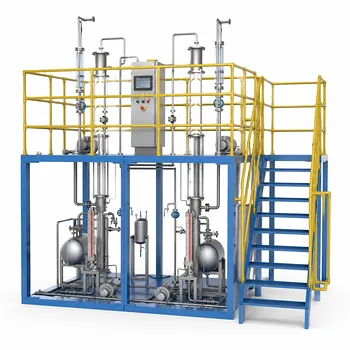
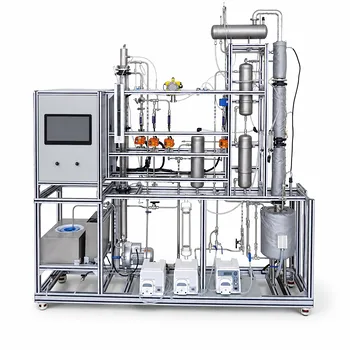
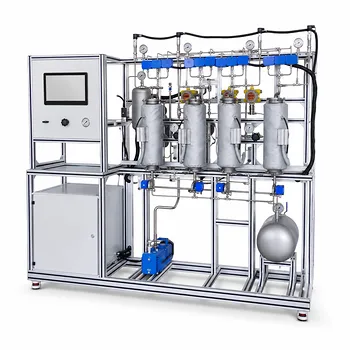
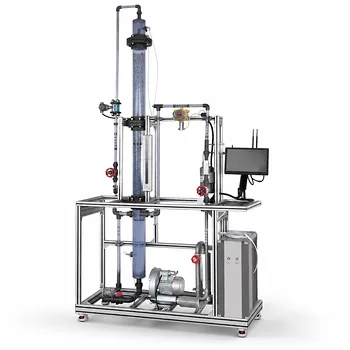
The invisible hand guiding every gas-phase pilot plant is Dalton’s Law of Partial Pressures. In gas absorption or separation pilot plants, you apply it to calculate the exact driving force for mass transfer, determine equilibrium limits, size columns and vessels, and set safe operating pressures. It’s the foundational tool that converts a gas mixture’s composition into actionable pressure values for both design calculations and real-time operational control.
Dalton’s Law is not just a textbook concept—it’s your pilot plant’s operational compass. It defines the maximum achievable separation, drives the Height of Transfer Unit (HTU) calculations that size your column, and dictates how you manipulate temperature and pressure to shift equilibrium. Without it, you’re flying blind.
The Law as the Mass Transfer Driving Force
Defining the Absorption or Stripping Limit
In a pilot column, absorption of a solute gas from a mixture into a liquid solvent happens because the gas phase’s partial pressure is higher than its equilibrium partial pressure at the liquid interface. Dalton’s Law gives you that gas-phase partial pressure directly: ( p_i = p_{\text{total}} \times y_i ). By measuring the total column pressure and the gas composition (via an on-line analyzer or even a selective membrane sensor), you calculate the exact “push” available for mass transfer. When that driving force vanishes, the system hits equilibrium and separation stops—you’ve found the thermodynamic ceiling.
Sizing the Column: Height of Transfer Units (HTU)
The driving force isn’t constant; it changes along the column as the solute is absorbed. To calculate the HTU—and thus the required packed height—you must integrate the inverse of this driving force over the column’s length. Inaccurate partial pressure values due to unaccounted temperature gradients or pressure drops lead to incorrect HTU estimates. Pilot plants therefore demand consistent unit conversions (Kelvin, kPa, and the appropriate gas constant, ( R = 8.31 \text{ kPa·dm}^3\text{·mol}^{-1}\text{·K}^{-1} )) when converting mole fractions, molar flow rates, and total pressures into the local partial pressures needed for each integration step.
Using Dalton’s Law for Process Design and Control
Experimental Validation and Dynamic Measurement
A pilot plant is also a testing ground. You can directly validate Dalton’s Law by using semi-permeable materials—such as a palladium tube that selectively passes hydrogen while blocking argon. Inserting such a probe lets you dynamically measure the partial pressure of a single component in a flowing mixture. This transforms abstract theory into tangible data, enabling students and researchers to confirm that the sum of individually measured partial pressures equals the system’s total pressure, and to directly observe how altering feed composition shifts those numbers.
Coupling with Thermodynamic Models
Dalton’s Law tells you what the gas phase offers; the solvent’s equilibrium partial pressure tells you what the liquid can accept. In pilot plants studying acid gas removal, you combine Dalton’s Law with thermodynamic models like Edwards’ correlation or Pitzer’s equation. These models predict how the equilibrium partial pressure of CO₂ or H₂S over the solvent changes with temperature and loading. By setting ( p_{\text{gas}} > p_{\text{equilibrium}} ), you guarantee absorption; by heating or depressurizing until ( p_{\text{gas}} < p_{\text{equilibrium}} ), you drive desorption. The pilot plant’s thermal jackets and back-pressure regulators are there to let you precisely control this inequality.
Safety and Vessel Sizing
Every storage cylinder, feed tank, and reactor in your pilot plant is sized using the Ideal Gas Law, which relies on the total pressure predicted by Dalton’s Law. When a cylinder’s pressure drops, you compute the remaining moles—and thus the remaining mass—from its volume, temperature, and total pressure. For a multi-component cylinder, you must know that the total pressure reading directly represents the sum of partial pressures. This ensures you never overestimate reactant supply or exceed the vessel’s pressure rating, a critical safety check during dynamic pilot operations.
Understanding the Trade-offs
The Assumption of Ideal Gas Behavior
Dalton’s Law assumes ideal gases. At pilot-plant pressures above 300–400 psig, intermolecular forces become significant enough that partial pressures no longer follow mole fractions linearly, and gas viscosity—which heavily influences separator vessel diameter—must be corrected. A mere 10% error in gas viscosity can drastically alter calculated vessel size and separation efficiency. If your pilot plant targets high-pressure absorption (e.g., pre-combustion carbon capture), you must incorporate compressibility factors into your partial pressure calculations to avoid severely undersizing equipment.
Sensitivity to Temperature and Pressure Control
A small drift in temperature can ripple into large errors. Partial pressure depends on the total pressure and mole fraction, but the equilibrium partial pressure is exponentially sensitive to temperature. Poor thermal regulation at the liquid-gas interface means your measured driving force may be fiction. Similarly, if the column pressure isn’t uniform due to packing-induced drops, the local total pressure used in Dalton’s Law differs from the vessel’s gauge reading, leading to inaccurate local driving forces and misleading mass transfer coefficients.
The Limits of Physical vs. Chemical Absorption
Dalton’s Law applies to the gas phase, but the absorption mechanism changes the equilibrium line. In physical absorption (e.g., water for CO₂), the equilibrium partial pressure follows Henry’s law and rises quickly with concentration. In chemical absorption (e.g., amine solutions), the reaction pulls the equilibrium partial pressure dramatically lower. The driving force is thus far larger, but the reaction exotherm creates local temperature hot spots that can alter gas-phase partial pressures and even shift the reaction equilibrium. Pilot plants exploring chemical absorption need meticulous solvent dosing and heat removal to keep the driving force predictable.
Making the Right Choice for Your Pilot Plant Goal
The application of Dalton’s Law must be tailored to the aim of your pilot study. Here’s how to align your approach with your primary objective:
- If your primary focus is educational validation of gas separation principles: Equip your columns with selective membrane probes or direct on-line gas analyzers to let students measure individual partial pressures in real time. Design experiments where they alter total pressure and gas composition to see the direct effect on absorption rates and demonstrate the governing mass-transfer equation.
- If your primary focus is optimizing absorption efficiency: Use continuous composition monitoring to calculate local partial pressures, then dynamically adjust the liquid flow rate to keep the minimum driving force at the column’s pinch point. This ensures you operate at the economic optimum between solvent use and removal efficiency.
- If your primary focus is high-pressure gas separation: Move beyond the ideal gas assumption early. Implement pressure-corrected viscosity and compressibility factors in your sizing calculations, and install redundant temperature and pressure sensors along the column to generate accurate local partial pressure profiles for reliable HTU and vessel diameter determination.
By treating Dalton’s Law not as a passive formula but as an active control philosophy, you transform your pilot plant into a precision instrument that reliably connects gas-phase thermodynamics to real-world separation performance.
Summary Table:
| Application | How Dalton's Law is Applied | Operational Impact |
|---|---|---|
| Mass Transfer | Calculates gas-phase partial pressure ($p_i = p_{\text{total}} \times y_i$) | Defines the equilibrium limit and calculates HTU for column sizing. |
| Process Control | Coupled with thermodynamic models (e.g., Pitzer, Edwards) | Guides temperature and pressure adjustments to drive absorption/desorption. |
| Safety & Sizing | Sums partial pressures to predict total vessel pressure | Ensures safe vessel pressure ratings and accurate reactant mass calculations. |
| High-Pressure Correction | Incorporates compressibility factors ($Z$) above 300–400 psig | Corrects gas viscosity to prevent equipment undersizing. |
Bring Thermodynamic Principles to Life with LABPARK
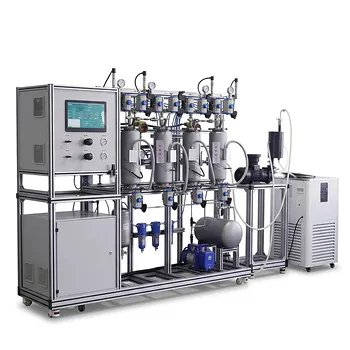
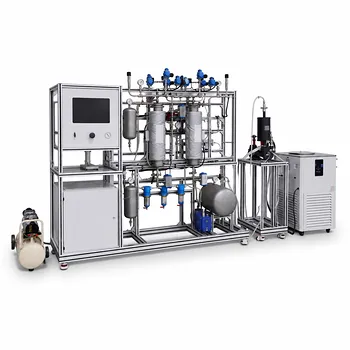
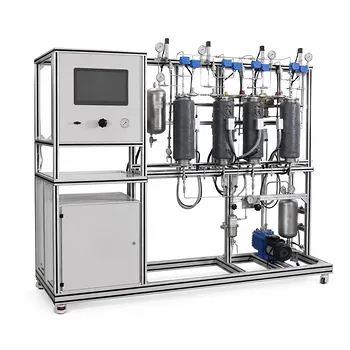
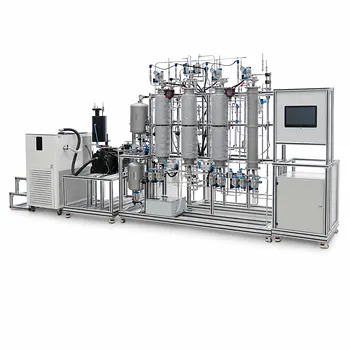
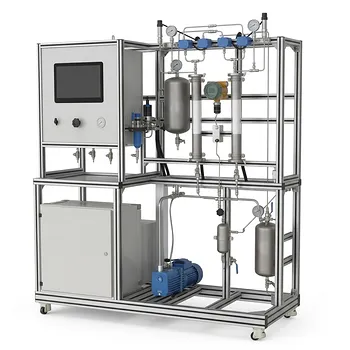
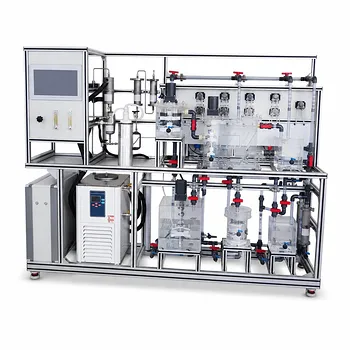
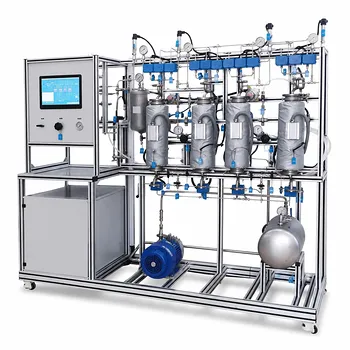
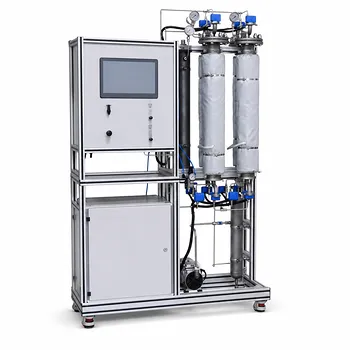
Need to optimize gas separation processes or enhance hands-on learning? LABPARK provides state-of-the-art Educational and Vocational Unit Operations Pilot Plants in chemical engineering, bioprocess & biotech, and environmental & water treatment. Designed specifically for universities, research institutes, and enterprises, our pilot plants bridge the gap between textbook physics—like Dalton's Law—and real-world industrial operations.
Ready to elevate your research and training capabilities? Contact LABPARK today to discuss a custom pilot plant solution tailored to your exact technical specifications.
Related Products
- Dual-Mode Gas Absorption and Desorption Unit Operations Training Pilot Plant
- Carbon Dioxide Absorption and Desorption Educational Pilot Plant for Carbon Capture Studies
- Carbon Dioxide Adsorption and Capture Educational Unit Operations Pilot Plant
- Absorption and Desorption Educational Unit Operations Pilot Plant
- Packed Bed Absorption Educational Unit Operations Pilot Plant
People Also Ask
- How do two-film & penetration theories apply to gas absorption pilot plant teaching? Key pedagogical insights.
- How does partial pressure behavior influence gas absorption pilot plants? Master Mass Transfer
- How is the direction and driving force of mass transfer determined in a gas absorption unit operations pilot plant?
- Why does increasing flow fail to enhance absorption in fast chemical reactions? Pilot Plant Insights
- How to model chemical absorption as physical absorption? The pilot plant simplification criterion.