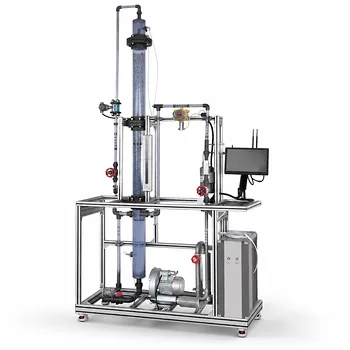
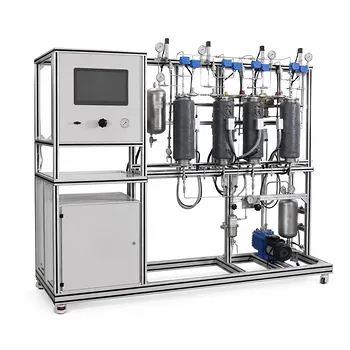
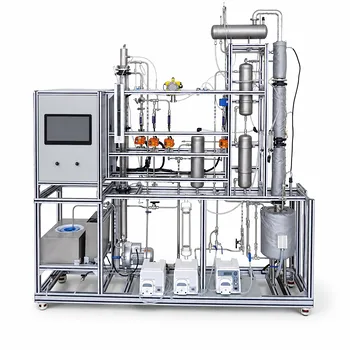
Sorption of heavy hydrocarbons directly sabotages light gas separation by clogging the very pathways those smaller molecules need to travel. In membrane pilot systems, condensable heavy hydrocarbons preferentially sorb into the polymer matrix, occupying its free volume and physically blocking the permeation of fast light gases like hydrogen or helium. This drastically reduces flux and selectivity, and it is the central phenomenon that pilot-scale research uses to teach critical lessons about feed pre-treatment and vapor recovery.
Heavy hydrocarbon sorption reduces membrane performance by occupying free volume and blocking light gas transport, but pilot-scale research turns this challenge into a diagnostic tool. By deliberately manipulating feed composition and tracking permeate flux, students and researchers gain hands-on insight into competitive sorption, pre-treatment requirements, and the sensitivity of separation processes to even trace amounts of heavy species.
Why Heavy Hydrocarbons Cripple Light Gas Separation
Light gases rely on free-volume pathways in the polymer to permeate quickly. Heavy hydrocarbons disrupt this mechanism at a molecular level, with consequences that are amplified in pilot systems designed to mirror real-world feeds.
Competitive Sorption and Free-Volume Blocking
Heavy hydrocarbons have a much stronger thermodynamic affinity for the polymer matrix than permanent gases. They sorb onto the membrane surface, then occupy the void spaces between polymer chains—the very free-volume elements that give light gases their high mobility.
Once a significant fraction of that free volume is filled, the transport of light gases is severely impeded. In extreme cases, the sorbed layer can completely block permeation, causing permeate flux to collapse even if the feed pressure remains constant.
The Amplified Impact of Trace Components
What makes this effect particularly insidious is that even minute concentrations of heavy hydrocarbons can cause a disproportionate performance loss. Research pilot plants that handle hydrocarbon separation have shown that a heavy fraction below 0.5 mol % can alter species recovery by several percentage points if it is mischaracterized.
This sensitivity is not a laboratory curiosity—it is a direct warning. The nature of the heavy species (whether naphthenic, aromatic, or n‑paraffin) dictates how strongly it will sorb and block light gases. Incorrect characterization leads to experimental data that cannot be reconciled with process simulations, undermining the entire research effort.
The Pilot System as an Investigative Tool
Membrane pilot systems are not merely small-scale units; they are controlled environments where the sorption effect can be observed, measured, and linked directly to fundamental principles.
Controlled Experimentation with Feed Composition
Students and researchers can intentionally spike a feed stream with known heavy hydrocarbons while keeping all other parameters fixed. By switching from a clean methane‑hydrogen mixture to one containing C₇⁺ aromatics, they create a living experiment in competitive sorption.
This manipulation turns an abstract textbook concept into a tangible, measurable event. The resulting drop in permeate flux becomes a direct readout of how much free volume has been occupied.
Monitoring Permeate Flux as a Diagnostic
In a pilot system, permeate flow rate and composition are tracked in real time. A declining flux for light gases under constant driving force is the classic signature of heavy hydrocarbon sorption.
Researchers use this signal to quantify the blocking effect and to determine the threshold concentration at which pre-treatment becomes economically mandatory. The data collected answers not just “what happens” but “when does it become impossible to ignore.”
Linking Experimental Data to Simulation
A key objective in vocational training and research is to close the gap between experimental results and software predictions. When heavy hydrocarbons are present, simulations often fail unless the researcher specifies a sorption model and accurate heavy‑fraction pseudocomponents.
Pilot studies that carefully document the feed’s heavy‑end composition—and then observe the exact magnitude of flux decline—provide the validation data needed to refine those models. This is the bridge that turns a pilot plant into a knowledge generator for scale‑up.
Addressing the Challenge: Pre-Treatment and Characterization
Research does not stop at observing the problem. The learned lesson is that heavy hydrocarbon sorption must be managed proactively, and pilot systems are the proving ground for those management strategies.
The Imperative of Pre-Treatment
The most direct solution is to remove condensable hydrocarbons before the membrane. Pilot studies demonstrate that a guard bed, knockout drum, or micro‑turboexpander placed upstream can dramatically preserve light gas permeance.
Students who compare a run with no pre‑treatment to one with an activated carbon guard bed see the recovery in flux immediately. This teaches a non‑negotiable industrial lesson: membranes and heavy hydrocarbons do not mix well unless the heavy ends are removed first.
Accurate Heavy Fraction Characterization
Even when pre‑treatment is used, a small residual heavy fraction may still slip through. The research highlighted in hydrocarbon pilot plants is clear: you must characterize what remains. Knowing whether the trace heavies are naphthenic, aromatic, or paraffinic determines how aggressively they will sorb.
An inaccurate characterization—say, treating the entire C₇⁺ fraction as a single pseudocomponent with an average boiling point—can lead to a calculated ethane recovery that is off by several percent. Research-grade pilot work therefore couples gas chromatography with detailed hydrocarbon typing to feed the correct parameters into simulations.
Material and Process Innovations
Beyond pre‑treatment, membrane research explores materials with reduced heavy hydrocarbon affinity. Pilots test novel membrane chemistries—glassy polymers with high‑fractional free volume, or mixed‑matrix membranes—to see if they can maintain light gas permeance even in the presence of trace condensables.
Process‑side innovations, like periodic membrane sweeping or temperature‑swing regeneration protocols, are also developed and de‑risked at pilot scale before they ever reach a commercial unit.
Understanding the Trade-offs
Using a membrane pilot system to study heavy hydrocarbon sorption is an incredibly powerful teaching tool, but it comes with inherent tensions that researchers must navigate honestly.
- Simplicity versus realism. A clean binary gas mixture keeps variables under control, but it hides the blocking effect entirely. Realistic multi‑component feeds reveal the sorption problem but make it harder to isolate individual mechanisms.
- Data richness versus simulation alignment. Detailed heavy‑fraction characterization yields better simulation matches, yet it demands sophisticated analytical equipment and time. Skimping on analysis saves money but produces data that stubbornly refuses to align with predictive models.
- Performance loss versus educational gain. The very failure of light gas separation is what makes the pilot study valuable as a teaching moment. Researchers accept temporarily depressed flux because it teaches more than a perfectly clean system ever could.
- Material durability versus investigation depth. Aggressive spiking with aromatics can permanently alter some membrane samples, turning a single‑use experiment into a costly replacement issue. Pilot studies balance scientific depth with the practical reality of consumable costs.
How to Apply This to Your Research Goal
The right approach depends entirely on what you are trying to achieve with your membrane pilot system. Use these goal‑based paths to guide your experimental design.
- If your primary focus is fundamental transport phenomena: Spike a clean light‑gas feed with a single, well‑characterized heavy hydrocarbon (e.g., toluene) and track the time‑dependent flux decline. This isolates the sorption mechanism without extraneous variables.
- If your primary focus is industrial process scale‑up: Use a realistic multi‑component feed containing a true C₇⁺ fraction. Characterize that fraction by hydrocarbon type—not just boiling point—and benchmark your pre‑treatment strategy against flux recovery.
- If your primary focus is membrane material development: Expose candidate membranes to a standard heavy‑hydrocarbon challenge at pilot scale and measure both the initial flux loss and the regeneration efficiency after cleaning. This yields a realistic comparative ranking.
- If your primary focus is simulation validation: Document every heavy‑species concentration and type, then systematically compare experimental permeate compositions against your simulator’s predictions. The mismatch data is your most valuable output.
By treating heavy hydrocarbon sorption not as an experimental failure but as a deliberate, measurable variable, membrane pilot systems deliver the kind of hands‑on insight that no textbook can provide—transforming a performance‑killing problem into a lasting engineering lesson.
Summary Table:
| Aspect | Effect of Heavy Hydrocarbons | Research & Mitigation Strategy |
|---|---|---|
| Mechanism | Competitive sorption blocks polymer free-volume pathways | Detailed characterization of C7+ fractions |
| Performance Impact | Severe reduction in light gas flux and selectivity | Installing upstream guard beds or knockout drums |
| Pilot Utility | Serves as a diagnostic tool for competitive transport | Validating simulation models with real-world data |
| Innovation Focus | Causes membrane performance degradation | Testing novel materials with low hydrocarbon affinity |
Optimize Your Membrane Research with LABPARK
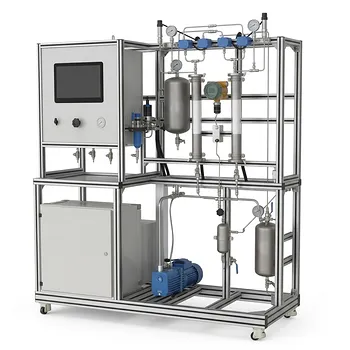
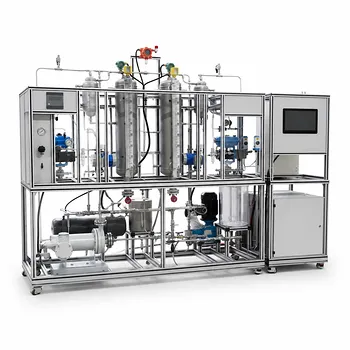
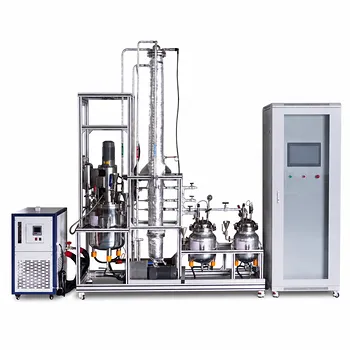
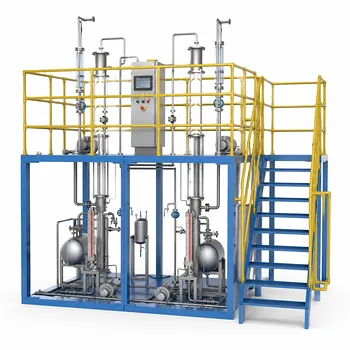
Are you looking to bridge the gap between process simulation and experimental reality? LABPARK provides state-of-the-art Educational and Vocational Unit Operations Pilot Plants in chemical engineering, bioprocess & biotech, and environmental & water treatment.
Designed specifically for universities, research institutes, and enterprises, our pilot systems enable hands-on study of complex phenomena like competitive sorption and pre-treatment optimization.
Contact LABPARK today to equip your facility with advanced pilot solutions that turn engineering challenges into valuable learning opportunities!
Related Products
- Ultrafiltration Membrane Separation Educational Pilot Plant
- Multifunctional Membrane Separation Educational Pilot Plant with Ultrafiltration, Nanofiltration, Reverse Osmosis
- Multi-Functional Membrane Separation Educational Pilot Plant for Unit Operations Lab
- Hollow Fiber Ultrafiltration Membrane Separation Educational Pilot Plant
- Photocatalytic Membrane Separation and Degradation Unit Operations Pilot Plant
People Also Ask
- How do PEI, PVDF, and PSU membranes compare in pilot plants? Find the best fit.
- Pervaporation vs. Vapor Permeation: Handling Suspended Solids in Membrane Pilot Plants
- Why Use a Membrane Separation Pilot Plant vs. Lab Testing? Avoid Costly Scale-Up Failures
- Isotropic vs. Anisotropic Membranes: How to Choose the Best Pilot Plant Modules
- How do membrane pilot plants demonstrate synthetic vs biological membrane advantages?