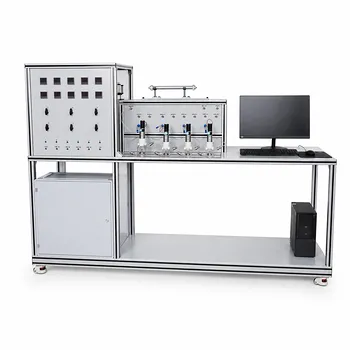
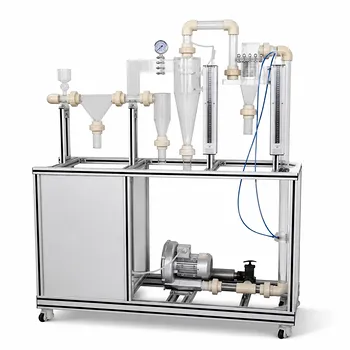
The equilibrium behavior of gas absorption pivots entirely on whether the dissolved gas merely dissolves or undergoes a chemical transformation. In physical absorption, the equilibrium partial pressure of the solute follows Henry’s Law, scaling linearly with its liquid‑phase concentration. When a chemical reaction accompanies absorption, the free, unreacted solute concentration drops sharply, causing the equilibrium partial pressure to plummet far below that of a purely physical system at the same total loading. For anyone operating a gas absorption pilot plant, this means you observe—and can exploit—a massively enlarged driving force, higher solvent capacity, and entirely different regeneration, thermal, and material requirements.
Chemical absorption rewrites the equilibrium rules: by consuming free solute through reaction, it effectively reduces the apparent Henry’s constant by a factor that can exceed an order of magnitude. In a pilot plant, this translates into demonstrations of dramatically superior mass transfer performance and teaches the critical process trade‑offs that separate lab‑scale curiosity from industrial reality.
The Equilibrium Difference: Henry’s Law vs. Chemical Suppression
Physical Absorption: A Straightforward Solubility Limit
In physical absorption, the solute dissolves without any chemical change. The equilibrium fugacity or partial pressure of the solute (p_A) in the gas phase is directly proportional to its concentration (c_A) in the liquid, as described by Henry’s Law:
[ p_A = H \cdot c_A ]
Here, (H) is the Henry’s Law constant. This linear relationship constrains capacity: the only way to dissolve more gas is to operate at a higher partial pressure or lower temperature.
Chemical Absorption: The Apparent Henry’s Constant Drops
When a reactive solvent is used, the dissolved solute (A) chemically combines with an active component (B) to form a non‑volatile product (N). The reaction equilibrium, governed by its equilibrium constant (K'), lowers the concentration of free, physically dissolved (A). The resulting equilibrium partial pressure becomes:
[ p_A = \frac{H}{1 + K' c_B^0} \cdot c_{A,\text{total}} ]
The denominator ((1 + K' c_B^0)) drastically reduces the effective Henry’s constant. This means that at the same total concentration of solute in the liquid (free plus reacted), the gas‑phase partial pressure can be so low that absorption continues far beyond what physical solubility would allow. The equilibrium curve is no longer a simple straight line—it is heavily suppressed, enabling deep gas cleaning even at modest operating pressures.
Why This Matters at Pilot Scale
A Magnified Driving Force for Mass Transfer
Chemical absorption continuously consumes free gas molecules inside the liquid, maintaining a steep concentration gradient across the gas‑liquid interface. This sustains a high driving force throughout the column, whereas in physical absorption the driving force decays as the solvent approaches equilibrium. In the pilot plant, you will measure outlet gas concentrations that are an order of magnitude lower than those predicted by physical solubility alone.
Elevated Solvent Capacity and Column Performance
Because the reaction stores much of the solute in a chemically bound form, the liquid phase can hold significantly more total solute. Your pilot column achieves higher removal efficiency per unit of solvent circulation and can operate with a smaller solvent flow rate or a shorter packing height for the same purification target. This is the practical demonstration of “reaction‑enhanced capacity” that makes chemical absorption the workhorse for acid‑gas removal.
Thermal Signatures and Reaction Heat
Physical absorption is largely isothermal aside from minor heats of solution. Chemical absorption, however, releases reaction heat. In your pilot plant, you will see a measurable temperature rise along the column, especially near the gas inlet where reaction rates are highest. This non‑isothermal behavior must be monitored and managed to avoid solvent degradation or reduced reaction kinetics.
Understanding the Trade‑offs
Regeneration: Pressure Release vs. Thermal Stripping
Regeneration methods expose the core cost. Physical solvents—like those used in Rectisol or Selexol processes—release the dissolved gas simply by lowering the pressure. The pilot plant demonstrates that no external heat is needed. Chemical solvents, by contrast, require thermal energy to reverse the chemical bonds, typically in a separate stripper column operating above 100 °C. This means higher utility consumption, steam systems, and complex energy integration, all of which become tangible when running a chemical absorption pilot plant.
Corrosion and Material Selection
Reactive solvents and elevated temperatures can induce corrosion, an invisible variable that a pilot plant makes visible through routine inspections. Carbon steel may be insufficient; you will need to evaluate stainless‑steel packings, gaskets, and piping. The selection of amine type (MEA, MDEA) and concentration directly influences the corrosion risk you must manage.
When You Can Simplify: Neglecting the Chemical Reaction
In some pilot‑plant experiments, you might operate at conditions where the reaction is so slow or the liquid residence time so short that the chemical contribution is negligible. The condition (k_i^ \tau \ll 1)*—where (k_i^*) is the pseudo‑first‑order reaction rate constant and (\tau) is the liquid residence time—allows you to treat the system as purely physical. This simplification is invaluable when you need to decouple mass transfer fundamentals from reaction kinetics, and your pilot plant must be flexible enough to span both regimes.
Making the Right Choice for Your Pilot‑Plant Objectives
Your choice of absorption system must align with what you need to demonstrate, measure, and teach.
- If your primary focus is educational illustration of equilibrium enhancement: Use an amine‑based chemical absorption system (e.g., MEA absorbing CO₂) because it operates at ambient pressure and 20–40 °C, making the thermodynamic and kinetic advantages immediately apparent without the safety complexity of high‑pressure or cryogenic equipment.
- If your primary focus is physical solubility fundamentals and low‑energy regeneration: Choose a physical solvent system like water or a pressurized Selexol loop, demonstrating Henry’s Law directly and allowing solvent regeneration solely through depressurization.
- If your primary focus is industrial‑process realism under reactive conditions: Equip the pilot plant with a thermal stripper, corrosion‑resistant materials, and online temperature and composition sensors to capture the full energy‑intensive, non‑isothermal nature of chemical gas cleaning.
- If your primary focus is isolating mass‑transfer resistances: Run a fast, irreversible reaction (e.g., CO₂ in concentrated NaOH) to completely eliminate the liquid‑phase resistance, allowing you to study gas‑film controlled absorption alone.
Understanding the equilibrium shift from physical to chemical absorption is not just textbook theory—it is the operational compass that tells you how hard the pilot plant must work, what it will cost to regenerate, and which process insights are genuinely within reach.
Summary Table:
| Parameter | Physical Absorption | Chemical Absorption |
|---|---|---|
| Equilibrium Behavior | Linear solubility limit (Henry's Law) | Suppressed equilibrium partial pressure (Non-linear) |
| Solvent Capacity | Limited by pressure and temperature | Significantly enhanced via chemical binding |
| Mass Transfer Driving Force | Decays as solvent approaches saturation | Sustained high driving force due to reaction consumption |
| Thermal Profile | Mostly isothermal | Non-isothermal (noticeable temperature rise) |
| Regeneration Method | Simple pressure reduction (low energy) | Thermal stripping at high temperatures (high energy) |
| Material Requirements | Standard materials (low corrosion risk) | Corrosion-resistant materials (e.g., stainless steel) |
Scale Up Your Engineering Training with LABPARK
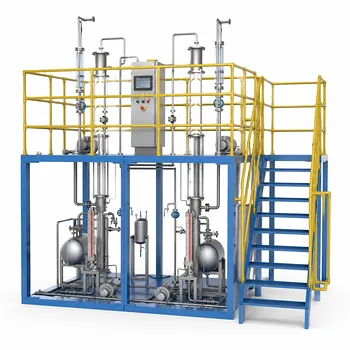
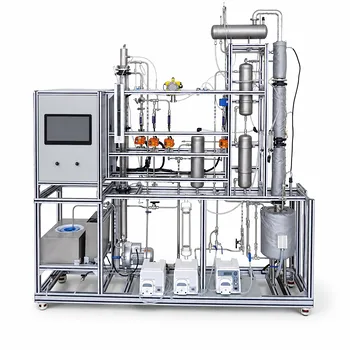
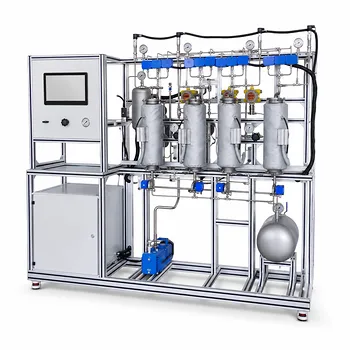
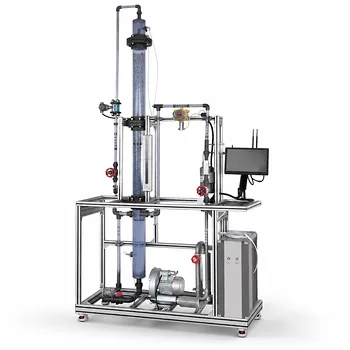
To effectively teach or research these complex thermodynamic behaviors, students and engineers need hands-on experience with real-world equipment. LABPARK provides state-of-the-art Educational and Vocational Unit Operations Pilot Plants in chemical engineering, bioprocess & biotech, and environmental & water treatment.
Specially designed for universities, research institutes, and enterprises, our pilot plants feature flexible configurations, precise process control, and industrial-grade monitoring.
Ready to elevate your laboratory capabilities? Contact us today to discuss your pilot plant needs!
Related Products
- Dual-Mode Gas Absorption and Desorption Unit Operations Training Pilot Plant
- Carbon Dioxide Absorption and Desorption Educational Pilot Plant for Carbon Capture Studies
- Carbon Dioxide Adsorption and Capture Educational Unit Operations Pilot Plant
- Absorption and Desorption Educational Unit Operations Pilot Plant
- Packed Bed Absorption Educational Unit Operations Pilot Plant
People Also Ask
- How do two-film & penetration theories apply to gas absorption pilot plant teaching? Key pedagogical insights.
- How is the direction and driving force of mass transfer determined in a gas absorption unit operations pilot plant?
- How does partial pressure behavior influence gas absorption pilot plants? Master Mass Transfer
- How to model chemical absorption as physical absorption? The pilot plant simplification criterion.
- Why does increasing flow fail to enhance absorption in fast chemical reactions? Pilot Plant Insights