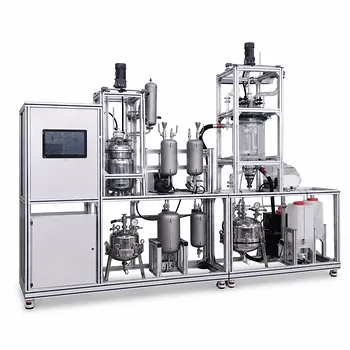
The key to quantifying oxygen in gas mixtures inside an educational pilot plant is a simple, striking color change.
The oxidation of a colorless copper(I)-ammine complex ([Cu(NH₃)₂]⁺) to a deep‑blue copper(II)-ammine complex ([Cu(NH₃)₄]²⁺) by molecular oxygen provides a direct colorimetric measure of the oxygen absorbed from a gas stream. The intensity of the resulting blue color, measured spectrophotometrically, is directly proportional to the amount of oxygen that has undergone reactive absorption, enabling a quantitative determination of oxygen concentration in the original gas mixture.
At its core, this method turns a classic coordination‑chemistry redox reaction into a quantitative analytical tool. The oxidation of the Cu(I) complex by O₂ produces a colored product whose absorbance is a direct proxy for the oxygen content — demonstrating how fundamental chemical principles (redox, coordination, and spectrophotometry) can be seamlessly integrated into a pilot‑plant mass‑transfer experiment.
The Chemistry Behind the Color Change
The Two Key Copper‑Ammine Complexes
The starting material is a colorless copper(I)‑diammine complex, [Cu(NH₃)₂]⁺.
Copper(I) in an ammonia environment is a soft Lewis acid that readily accepts two ammonia ligands, forming a linear, colorless cation.
When this solution is contacted with a gas containing oxygen, the Cu(I) center is oxidized.
The final product is the familiar deep‑blue copper(II)‑tetrammine complex, [Cu(NH₃)₄]²⁺, a square‑planar species that strongly absorbs light in the orange‑red region of the visible spectrum.
A Redox Reaction That Consumes Oxygen
The overall transformation is a four‑electron oxidation of Cu(I) by O₂ in the presence of ammonia.
Each O₂ molecule oxidizes four Cu(I) centers, converting them to Cu(II) while the diatomic oxygen is reduced to water or hydroxide, depending on the pH.
The consumption of oxygen is stoichiometric, which means that the amount of blue complex formed is directly tied to the quantity of oxygen that transferred from the gas phase into the liquid.
The Role of Coordination Chemistry in Driving the Reaction
The strong ligation of ammonia to Cu(II) provides a thermodynamic driving force.
Cu(II) forms a particularly stable tetrammine complex, which shifts the redox equilibrium in favor of oxidation.
Thus, the reaction is both a gas‑liquid mass‑transfer event and a coordination‑driven redox process — a dual demonstration that makes it a powerful teaching module in unit operations laboratories.
From Color to Concentration: Spectrophotometric Quantification
The Beer‑Lambert Law as a Measurement Bridge
Once the blue complex forms, its concentration is determined by measuring absorbance at a characteristic wavelength (typically around 600 nm).
The Beer‑Lambert law (A = ε · l · c) links the measured absorbance to the complex concentration, and from the reaction stoichiometry that concentration is converted to the moles of oxygen absorbed.
Calibration Enables Absolute Quantification
A calibration curve is built using solutions of the Cu(II)−ammine complex at known concentrations.
By measuring the absorbance of the unknown sample after absorption, the corresponding oxygen‑derived Cu(II) concentration is read directly from the curve.
This approach transforms a visual color change into a reliable numerical measurement of gas‑phase composition.
Real‑Time Monitoring in an Educational Setting
Spectrophotometric probes or simple benchtop colorimeters can be integrated into the absorption column’s liquid side.
Students can track the rise in absorbance over time, which reflects the rate of oxygen absorption and gives a direct, quantitative picture of the mass‑transfer kinetics occurring inside the pilot plant.
Integrating the Reaction into a Gas‑Liquid Absorption Pilot Plant
The Measurement Loop In Practice
A slipstream of the liquid absorbent (ammoniacal Cu(I) solution) is circulated through a gas‑liquid contactor, such as a packed column or a bubble column.
As gas containing oxygen flows counter‑currently, O₂ dissolves and reacts with the Cu(I) complex.
The deepening blue color of the liquid leaving the column is a real‑time indicator of oxygen uptake; a spectrophotometer quantifies this change.
Why This Demonstrates Core Mass‑Transfer Principles
The rate of color development is governed by both the gas‑side mass‑transfer coefficient and the reaction kinetics in the liquid phase.
When the reaction is fast relative to diffusion, the absorption rate becomes purely mass‑transfer‑limited — a regime that makes the module ideal for exploring the differences between physical and chemical absorption.
Bridging Molecular‑Level Chemistry with Macro‑Scale Process Engineering
Students see how a simple coordination‑chemistry reaction can be harnessed to solve a real engineering measurement problem.
The experiment concretely links topics like redox potentials, ligand field stabilization, and spectrophotometry with large‑scale concepts of gas‑liquid mass transfer, residence time distribution, and process instrumentation.
Understanding the Trade‑Offs and Limitations
Specificity to Oxygen
The Cu(I)−ammine method is highly selective for molecular oxygen under the right conditions, but it cannot directly measure other gases like CO₂ or N₂.
It is, therefore, not a universal gas‑composition analyzer but a targeted oxygen‑sensing technique.
Sensitivity to Air and Handling
The colorless Cu(I) complex is air‑sensitive and can be prematurely oxidized by trace oxygen during storage or transfer.
Preparing the solution under an inert atmosphere and maintaining a closed system are essential to ensure only the oxygen from the sample gas contributes to the final color.
Reaction Stoichiometry Must Be Verifiably Constant
Side reactions — for example, disproportionation of Cu(I) to Cu(0) and Cu(II) in certain conditions — can alter the stoichiometric relationship between O₂ and the blue complex.
Careful control of ammonia concentration, pH, and temperature is needed to guarantee that the 1 O₂ : 4 Cu ratio holds exactly.
Need for Precise Gas‑Volume Measurement
The spectrophotometric reading gives the amount of oxygen absorbed, but to express the result as a gas‑phase composition (e.g., mole percent), the total gas volume (or flow rate) must be known accurately.
This brings in essential supporting techniques — the very principles highlighted in classical gas‑burette and liquid‑displacement methods.
Best Practices for Accurate Gas Composition Measurement
Applying Foundational Volume‑Measurement Principles
Whenever a gas volume needs to be quantified — as in establishing the total gas throughput for a composition measurement — the following rules must be observed:
- Displacement‑liquid selection: The liquid used in any volumetric measurement (e.g., a burette) must not dissolve or react with the target gas; saturated brine, for instance, is often used in place of water for chlorine or oxygen‑sensitive systems.
- Pressure equilibration: Before reading a gas volume, the levels in the measurement and reference tubes must be aligned so that internal pressure equals atmospheric pressure.
- Thermal equilibrium and vapor pressure correction: The system must reach ambient temperature, and the vapor pressure of the displacement liquid must be subtracted from the total pressure to obtain the dry gas volume.
Ensuring the Spectrophotometric Readout Reflects True Oxygen Uptake
To avoid measurement artifacts, the absorption liquid’s absorbance must be measured against a blank taken from the same batch of Cu(I) solution before exposure to the gas.
Constant flow conditions and a known liquid residence time allow the calculated oxygen‑uptake rate to be matched with the gas‑phase composition.
Making the Right Choice for Your Educational or Measurement Goal
After considering the chemistry, the integration steps, and the inherent trade‑offs, your approach should depend on the primary objective of the pilot‑plant exercise.
- If your primary focus is teaching redox‑coordination chemistry and reactive absorption: The Cu(I)‑to‑Cu(II) oxidation provides a visually compelling, stoichiometrically clear demonstration. The color change makes the abstract concepts of mass transfer with chemical reaction tangible for students.
- If your primary focus is achieving a precise, quantitative oxygen concentration: Couple the spectrophotometric calibration with rigorous control of gas flow and liquid volume. Employ inert‑atmosphere handling and verify the stoichiometric ratio under your exact operating conditions to maximize accuracy.
- If your primary focus is demonstrating full‑plant gas‑composition analysis: Combine the copper‑amine method for oxygen with appropriate volumetric techniques for total gas measurement and correction for pressure, temperature, and humidity. This teaches the complete measurement chain — from molecular reaction to macro‑scale engineering calculation.
A single, elegantly designed redox reaction can thus become the heart of a measurement system that is both chemically instructive and analytically robust — exactly the kind of bridge that makes educational pilot plants so powerful.
Summary Table:
| Parameter | Copper(I) Complex | Copper(II) Complex |
|---|---|---|
| Formula | [Cu(NH₃)₂]⁺ | [Cu(NH₃)₄]²⁺ |
| Oxidation State | +1 (Reduced) | +2 (Oxidized) |
| Color | Colorless | Deep-Blue |
| Function | Reacts with absorbed O₂ | Quantified via spectrophotometry (~600 nm) |
Elevate Your Engineering Lab with LABPARK
Ready to bring complex chemical principles and mass-transfer kinetics to life? LABPARK designs and supplies premium Educational and Vocational Unit Operations Pilot Plants across chemical engineering, bioprocess & biotech, and environmental & water treatment.
We empower universities, research institutes, and enterprises with robust, hands-on learning systems that bridge molecular science and process engineering.
Contact us today to discuss your laboratory requirements and discover how our custom pilot plants can transform your training programs!
Related Products
- Educational Compression Refrigeration Performance Determination Unit Operations Pilot Plant
- Carbon Dioxide PVT Curve Determination Educational Unit Operations Pilot Plant
- Multi Functional Catalytic Reaction and Reactor Evaluation Educational Unit Operations Pilot Plant
- Electrolyte Distillation Purification and Formulation Educational Pilot Plant
- Ion Exchange Water Purification Educational Pilot Plant for Engineering Unit Operations
People Also Ask
- In chemical engineering unit operations training plants, how does partial conversion with recycle improve selectivity?
- How should operators and lab engineers resolve material-balance problems? Apply degree-of-freedom analysis
- What process factors must be evaluated when replacing vapor-compression refrigeration? A pilot-plant checklist
- Why Switch Unit Operations Flow Configurations? Impact on Experimental Measurements
- Why is distinguishing between elastic and plastic deformation critical? Prevent tablet capping.