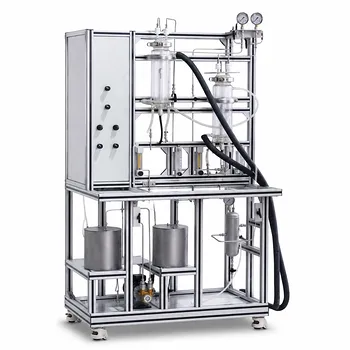
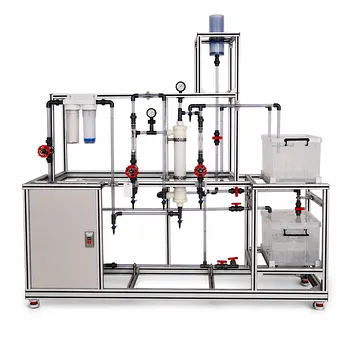
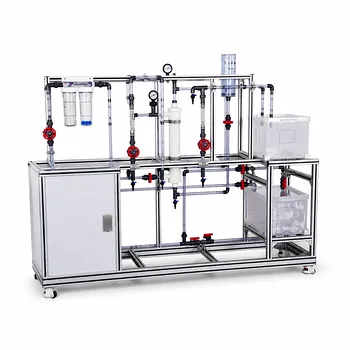
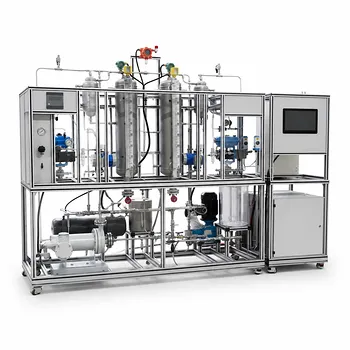
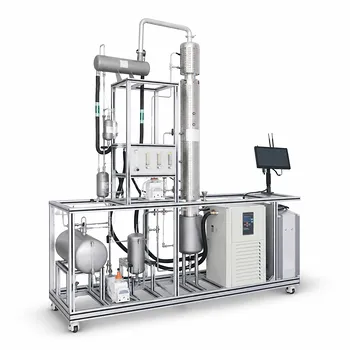
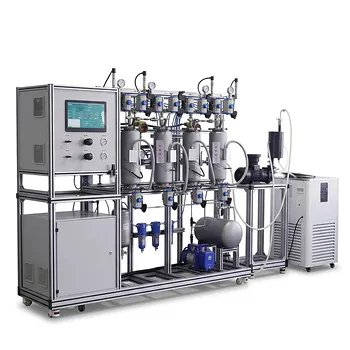
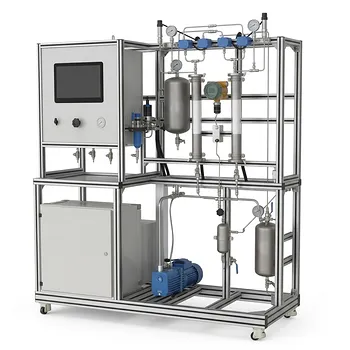
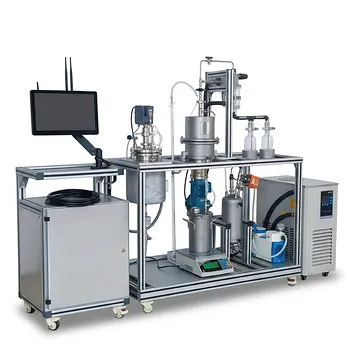
Dialysis pilot plants demonstrate colloid and macromolecule purification by using a semipermeable membrane that physically blocks large particles while letting small solvent molecules and impurity ions diffuse away. This creates a hands-on educational bridge between textbook diffusion theory and real industrial processing. In a typical teaching lab, students prepare a membrane, feed a colloid like ferric hydroxide sol containing chloride impurities, and then monitor how the chloride ions are gradually removed into the surrounding water. They verify the purification progress chemically—for instance, by testing the dialysate with silver nitrate to detect residual chloride—which makes the abstract concept of size-selective transport tangible and measurable.
Dialysis is not just a slow lab curiosity; it’s a controlled experimental stage where students directly observe the interplay between membrane selectivity, concentration gradients, and efficiency testing. Mastering this unit operation in a pilot-plant setting builds the foundational understanding required to grasp any downstream industrial membrane separation technology, from ultrafiltration to reverse osmosis.
The Core Mechanism: How the Membrane Separates
Size-Exclusion at Work
The heart of the dialysis pilot plant is a semipermeable membrane—historically a collodion or cellulose film—with pores large enough for water and small dissolved ions (like Na⁺, Cl⁻) to pass freely but too small for colloidal particles (1–1000 nm) or macromolecules (e.g., proteins, polymers) to squeeze through.
When a synthetic colloid solution (e.g., ferric hydroxide sol contaminated with chloride) sits on one side of the membrane and pure water on the other, a concentration gradient forms. Small, mobile impurity ions diffuse out while the bulky colloid remains trapped, achieving purification without any applied pressure.
Monitoring Purification in Real Time
An educational pilot plant doesn’t just let the process happen; it turns it into an investigative experiment. Students sample the water on the dialysate side at timed intervals and use simple chemical tests—like adding silver nitrate to check for chloride—to track how fast impurities are being removed.
This transforms the unit operation from a passive separation into an active kinetics study, reinforcing concepts like Fickian diffusion, partition coefficients, and membrane resistance.
Learning by Doing: The Pilot Plant as a Teaching Tool
From Beaker to Unit Operation
A glass beaker with a dialysis bag is a classic organic-chemistry workhorse, but it’s a batch, static process. The pilot plant elevates this concept by introducing continuous-flow components, temperature control, and modular membrane holders that mimic industrial module geometry.
Students learn to prepare and mount a membrane, control the feed and dialysate flow rates, and calculate the removal efficiency over time. This hands-on progression transforms a mere “wait and test” activity into a structured unit operation experiment, complete with mass balances and performance curves.
Bridging Theory and Industrial Sense
By running a dialysis pilot, students directly observe why membrane characteristics (pore size distribution, thickness, hydrophilicity) and fluid dynamics (stagnant boundary layers) matter. They see that a thicker membrane slows diffusion but increases selectivity—a living lesson in the trade-offs that chemical engineers must navigate.
This foundational experience makes it easier to later appreciate why industrial membrane processes like ultrafiltration use cross-flow to fight concentration polarization, or why reverse osmosis needs massive pressure to overcome osmotic effects.
From Dialysis to Broader Membrane Processes
Dialysis as a Gentler Gateway
Compared to pressure-driven methods, dialysis is gentle and thermally mild, which makes it especially illustrative for heat-sensitive biomolecules. The pilot plant demonstrates that purification can be achieved without denaturing macromolecules—a critical requirement in pharmaceutical and food industries.
Students can compare this directly with findings from ultrafiltration or nanofiltration pilots, where shear and pumping energy can alter fragile structures. The dialysis unit thus becomes a benchmark for evaluating when and why to choose a low-energy, diffusion-based separation.
Linking to Quantitative Analysis
While the primary focus is visual and chemical detection, the dialysis pilot plant naturally introduces the concept of membrane selectivity. Although the formal separation factor (α) is often taught in reverse osmosis or pervaporation modules, the underlying idea is the same: how much more (or less) of a component passes through compared to the feed.
Students can calculate an effective selectivity between chloride ions and the colloid simply by measuring concentrations over time, planting the seed for more advanced process design exercises later in their curriculum.
Understanding the Trade-offs of Dialysis Pilot Plants
Speed Versus Fidelity
Dialysis is inherently slow. Achieving complete removal of small impurities can take hours or even days, depending on the membrane area and temperature. This limits the number of experiments that can be run in a single lab session and requires careful planning.
In contrast, a pressure-driven ultrafiltration unit can purify the same sample in minutes. The educational trade-off is that the rapid process can obscure the basic diffusion physics, while dialysis lays them bare step by step.
Membrane Fouling and Lifetime
Even in a demo setting, colloids and macromolecules can adsorb onto or plug the membrane pores over time, reducing flux. Students quickly learn that membrane performance degrades, introducing them to the industry-wide challenge of fouling mitigation.
A well-designed pilot plant addresses this by allowing easy membrane replacement or cleaning, reinforcing the importance of material selection and maintenance in real plants.
Limited Industrial Relevance for Macromolecule Purification
While dialysis is still used in niche applications like hemodialysis, most large-scale separation of colloids and macromolecules in industry has moved to cross-flow ultrafiltration or diafiltration, which are faster and more productive. The pilot plant thus serves best as a conceptual stepping stone, not a direct model of a modern bioprocess skid.
Acknowledging this limitation prevents students from overgeneralizing and emphasizes the evolution of technology driven by economic and efficiency demands.
Making the Right Choice for Your Educational Goal
Your decision to use a dialysis pilot plant should align with what you want your students to internalize. Here's how to match the tool to the objective:
- If your primary focus is teaching fundamental transport phenomena: The dialysis pilot plant is ideal because it strips separation down to pure diffusion and concentration gradients, with no confusing pressure variables.
- If your primary focus is industrial bioprocessing relevance: Consider supplementing the dialysis experiment with an ultrafiltration or diafiltration pilot, which demonstrates how the same size-exclusion principle is engineered for speed and scalability.
- If your primary focus is analytical method development: Use the dialysis unit to have students design their own purity testing protocols (e.g., conductivity monitoring, silver nitrate endpoint detection) and evaluate the mass balance closure.
- If your primary focus is membrane material science: Let students prepare different membrane formulations (cellulose vs. synthetic) and directly correlate the membrane’s pore structure and hydrophilicity with ion retention and colloid rejection.
By intentionally selecting the level of complexity, you turn a simple purification demonstration into a complete, layered investigation that grows with the student’s understanding. That is precisely the purpose of a pilot plant—to compress industrial reality into a controlled learning environment where mistakes become insight and principles become practice.
Summary Table:
| Feature | Dialysis Pilot Plant Demo | Educational Value |
|---|---|---|
| Mechanism | Size-exclusion via semipermeable membrane | Illustrates diffusion and concentration gradients |
| Monitoring | Real-time chemical tests (e.g., AgNO3) | Visualizes kinetics and impurity removal |
| Controls | Adjustable flow rates & temperature | Builds understanding of mass balances & fluid dynamics |
| Focus | Low-energy, pressure-free separation | Serves as a gentle gateway to advanced membrane tech |
Bring Industrial-Scale Learning to Your Lab with LABPARK
Bridge the gap between theoretical transport phenomena and physical unit operations. LABPARK provides high-quality Educational and Vocational Unit Operations Pilot Plants across chemical engineering, bioprocess & biotech, and environmental & water treatment.
Tailored for universities, research institutes, and enterprises, our pilot plants empower students and researchers to master separation processes with hands-on, industry-relevant equipment.
Contact LABPARK today to find the ideal pilot plant for your curriculum!
Related Products
- Multi-Functional Membrane Separation Educational Pilot Plant for Unit Operations Lab
- Photocatalytic Membrane Separation and Degradation Unit Operations Pilot Plant
- Multifunctional Membrane Separation Educational Pilot Plant with Ultrafiltration, Nanofiltration, Reverse Osmosis
- Ultrafiltration Membrane Separation Educational Pilot Plant
- Hollow Fiber Ultrafiltration Membrane Separation Educational Pilot Plant
People Also Ask
- What are the key differences in membrane configurations? Choose the Right Unit Operations Pilot Plant
- How Do Pervaporation, Vapor, and Gas Permeation Differ in Pilot Plants? Key Comparison
- What are the advantages of membrane separation pilot plants? Energy-saving process intensification.
- Pervaporation vs. Vapor Permeation: Handling Suspended Solids in Membrane Pilot Plants
- How do PEI, PVDF, and PSU membranes compare in pilot plants? Find the best fit.