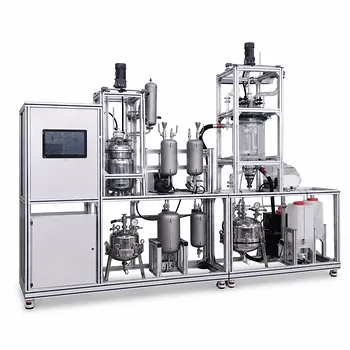
The magic of ionotropic gelation lies in a precise chemical handshake. When a sodium alginate solution meets divalent cations like calcium, the alginate’s guluronic acid blocks instantly cross-link, forming a hydrogel sphere that can entrap cells, drugs, or nutrients. To achieve uniform microcapsules at pilot scale, you must rigorously control alginate and calcium concentration, pH, temperature, and the shear rate during droplet formation.
Bioprocess microencapsulation via ionotropic gelation is deceptively simple—yet its success in a pilot plant hinges on managing a web of interdependent factors. A few seconds of uncontrolled shear or a tenth of a pH unit can mean the difference between a monodisperse, high-viability product and a failed batch. Understanding the mechanism is just the start; mastering the interplay of these variables is what builds a robust, scalable process.
How Ionotropic Gelation Creates a Hydrogel Cage
The Selective Cross-Linking That Defines the Process
Sodium alginate is a polysaccharide composed of mannuronic (M) and guluronic (G) acid blocks. The ionotropic gelation magic happens specifically on the G-blocks. Their carboxylate groups have a unique geometry that allows them to selectively bind divalent cations, particularly Ca²⁺, forming ionic bridges between polymer chains.
This binding is not a random entanglement. It’s a highly cooperative process where multiple G-block sequences from different alginate chains zip together in the presence of calcium, creating junction zones. These zones act as stable cross-links, instantly transforming a liquid droplet into a solid hydrogel bead.
The "Egg-Box" Model and Why It’s the Key to Stability
The spatial arrangement of this binding is often described by the “egg-box” model. In this structure, calcium ions sit in pockets formed by the carboxylate and hydroxyl groups of two adjacent G-block chains, much like eggs in a carton. This maximizes ionic interactions and physically locks the chains together.
The resulting three-dimensional network is what traps your payload inside the microcapsule. The strength, porosity, and stability of this network—and thus, the release profile and protection it offers—are entirely dictated by the conditions under which the gelation occurs. In a pilot plant, you’re not just gelling; you’re architecting this egg-box structure at scale.
The Pilot Plant Levers: Factors You Must Control
Alginate and Calcium Concentration: The Backbone of Gel Strength
Alginate concentration dictates the viscosity of your feed solution and the density of the final gel. Higher concentrations (typically 1-4% w/v) produce stronger, less permeable gels but require more shear to form consistent droplets. Lower concentrations are easier to atomize but can yield fragile, leaky capsules.
Calcium ion concentration is the other half of the equation. It must be high enough to drive rapid, complete cross-linking at the droplet surface, forming a skin that prevents coalescence. However, too much calcium can cause a dense, cracked crust that inhibits desired release. The standard is often a calcium chloride bath at 1-5% w/v, but the optimal ratio between alginate and calcium is always process-specific.
pH and Temperature: The Hidden Kinetics Modulators
pH controls the ionization state of the alginate’s carboxyl groups. Below a pKa of ~3.5, these groups become protonated and cannot chelate calcium, preventing gelation. A safe working range is typically pH 5-7, where groups are fully ionized. Straying too low stops the process; too high can slow down gelation kinetics and affect the payload stability.
Temperature is a direct throttle on reaction speed. Higher temperatures accelerate cross-linking, which can be useful for quickly setting the capsule skin but may also create thermal stress on a heat-sensitive biologic. Lower temperatures slow gelation, yielding a more homogenous internal structure but requiring longer bath residence times. Pilot equipment must include precise temperature control for both the alginate solution and the gelling bath.
Shear Rate During Droplet Formation: The Arbiter of Size and Uniformity
The microcapsule size—critical for everything from injectability to nutrient diffusion—is primarily set at the droplet formation zone. Whether you use a vibrating nozzle, coaxial air-flow, or electrostatic extrusion, the shear rate at the point of detachment dictates the droplet volume. Higher shear forces break the alginate stream into smaller droplets.
In pilot-scale equipment, this means controlling gas flow rates, vibration frequencies, or applied voltages with extreme precision. A fluctuating air pressure can instantly broaden a narrow size distribution, ruining batch consistency. The target size range of 1 to 1000 µm is only achievable if the shear environment is both reproducible and understood.
Understanding the Interconnected Trade-offs
None of these factors acts in isolation. Changing one often forces a cascade of adjustments.
- Strength vs. Viability: High alginate and calcium concentrations yield robust capsules but can create a harsh microenvironment with high osmotic pressure, stressing or killing encapsulated mammalian cells. Softer gels are gentler but may fall apart during handling.
- Throughput vs. Monodispersity: Increasing shear rate (e.g., higher airflow) boosts production speed but also broadens the size distribution if the system is pushed beyond its laminar operating window. You may gain volume but lose the batch uniformity required for predictable release kinetics.
- Gelation Speed vs. Homogeneity: A high calcium concentration and elevated temperature create an instant, dense skin that can trap unreacted alginate inside, leaving a liquid core that shrinks or bursts later. A slower, more controlled gelation often yields a more uniform, stable hydrogel but requires a longer process line.
- pH Sensitivity of the Payload: The optimal pH for gelation may be incompatible with your biologic. Forcing the process at a lower pH to improve survival can compromise the egg-box cross-linking, requiring a change in alginate grade or cation source instead.
Ignoring these crosstalks is the most common source of failure during scale-up. A pilot plant isn't just a larger benchtop; it's a system where the optimization of one variable must be a compromise with others.
Making the Right Choice for Your Bioprocess
Your equipment settings must flow from your endpoint goals. There is no universal recipe.
- If your primary focus is achieving a tight, reproducible microcapsule size distribution (monodispersity): Deeply characterize your shear-generating component—air flow, nozzle vibration, or voltage—and map its stability across your entire operating range before committing to a single setpoint.
- If your primary focus is maximizing the viability of encapsulated mammalian cells: Titrate alginate and calcium to the lowest concentration that still provides mechanical integrity, and choose a processing pH and temperature closest to physiological conditions, even at the cost of a slightly broader size range.
- If your primary focus is ensuring a predictable, slow-release profile of a small-molecule drug: Use a higher alginate concentration and a controlled, cooler gelation temperature to build a dense, homogenous egg-box network, and rigorously validate that your shear rate consistently yields the target particle size to eliminate surface-area-to-volume variability.
- If your primary focus is rapid technology transfer from benchtop to pilot scale: Acknowledge that the shear and mixing environments are fundamentally different. Map the dimensionless numbers (like Weber or Reynolds) of your droplet formation, not just your recipe, to maintain equivalent breaking forces across scales.
True process control in ionotropic gelation comes from seeing it not as a single step, but as a dynamic equilibrium of chemical kinetics, fluid dynamics, and material science. Master that interplay, and the microcapsules master your product’s potential.
Summary Table:
| Control Factor | Target Range / Standard | Impact on Microcapsules |
|---|---|---|
| Alginate Concentration | 1% - 4% w/v | Dictates viscosity, gel strength, and shell permeability. |
| Calcium Concentration | 1% - 5% w/v CaCl2 | Controls surface cross-linking speed and skin integrity. |
| pH Level | 5.0 - 7.0 | Determines carboxyl ionization and gelation kinetics. |
| Shear Rate | Method-dependent | Controls droplet size (1 - 1000 µm) and size distribution. |
Scale Up Your Bioprocess with LABPARK
Transitioning from laboratory microencapsulation to pilot-scale production requires precise control over shear, temperature, and chemical kinetics. LABPARK provides advanced Educational and Vocational Unit Operations Pilot Plants in chemical engineering, bioprocess & biotech, and environmental & water treatment for universities, research institutes, and enterprises.
Our pilot systems empower you to accurately control critical parameters, ensuring consistent gel strength, precise droplet sizes, and high cell viability.
Ready to elevate your research and training? Contact our experts today to find the ideal pilot plant configuration for your needs!
Related Products
- Ion Exchange Water Purification Educational Pilot Plant for Engineering Unit Operations
- Multi-Functional Special Distillation Educational Pilot Plant
- Micro-Scale Gas-Solid Catalytic Reaction Educational Pilot Plant
- Gallium and Indium Selective Extraction Educational Pilot Plant
- Multi-Functional Membrane Separation Educational Pilot Plant for Unit Operations Lab
People Also Ask
- How to Prevent Ion Exchange Channeling? Expert Solutions for Pilot Plants
- How does ion exchange work in water treatment pilot plants? Cost & process guide.
- What operational precautions should lab operators take for resin volume changes and air pockets? Key Guide
- How to use ion exchange pilot plants to verify alkalinity? A hands-on guide for engineering students.
- How can students use ion exchange pilot plants for column sizing? Master Wastewater Design