Wet-basis and dry-basis gas analyses cannot be inserted interchangeably into a material balance. Wet-basis composition includes water vapor in the total gas, while dry-basis Orsat analysis excludes water after condensation or absorption. Because removing water changes the denominator of every remaining mole fraction, engineers must convert both gas composition and flow rate to a common basis before calculating combustion performance, conversion, emissions, or energy balances.
Core takeaway: A dry Orsat result describes the composition of the moisture-free gas, but a stack flow usually represents total wet gas. The water content must therefore be measured or calculated separately and used to reconcile the analytical composition with the actual material balance.
Why the Two Analysis Bases Differ
Wet-basis composition includes water vapor
For a wet gas stream, the mole fractions satisfy:
[ \sum_i y_{i,\text{wet}} + y_{\mathrm{H_2O},\text{wet}} = 1 ]
The water may originate from fuel hydrogen oxidation, feed moisture evaporation, humidification, or contact with an aqueous process stream.
Dry-basis composition excludes water
An Orsat analyzer normally removes condensable water before measuring components such as carbon dioxide, oxygen, and carbon monoxide. Its reported composition satisfies:
[ \sum_i y_{i,\text{dry}} = 1 ]
The dry result is therefore normalized over the remaining gases. It does not indicate that water was absent from the original stack gas.
Condensation changes the apparent concentrations
Suppose the wet gas contains 10 mol% water and 9 mol% carbon dioxide. On a dry basis, the carbon dioxide concentration becomes:
[ y_{\mathrm{CO_2},\text{dry}}
\frac{0.09}{1-0.10}
0.10 ]
The carbon dioxide has not increased in amount. Its reported percentage has increased because water was removed from the denominator.
How to Convert Gas Compositions
Converting wet basis to dry basis
If the wet-basis water mole fraction is known, each non-water component is converted using:
[ y_{i,\text{dry}}
\frac{y_{i,\text{wet}}}{1-y_{\mathrm{H_2O},\text{wet}}} ]
For example, if a wet flue gas contains 8 mol% oxygen and 12 mol% water:
[ y_{\mathrm{O_2},\text{dry}}
\frac{0.08}{1-0.12}
0.0909 ]
The corresponding dry oxygen concentration is approximately 9.09 mol%.
Converting dry basis to wet basis
If the dry composition and wet-basis water fraction are known:
[ y_{i,\text{wet}}
y_{i,\text{dry}} \left(1-y_{\mathrm{H_2O},\text{wet}}\right) ]
If the water-to-dry-gas molar ratio is known instead, (r_{\mathrm{H_2O}/\mathrm{dry}}), then:
[ y_{i,\text{wet}}
\frac{y_{i,\text{dry}}} {1+r_{\mathrm{H_2O}/\mathrm{dry}}} ]
The water fraction itself is:
[ y_{\mathrm{H_2O},\text{wet}}
\frac{r_{\mathrm{H_2O}/\mathrm{dry}}} {1+r_{\mathrm{H_2O}/\mathrm{dry}}} ]
Measuring the water content
Water content can be obtained from a humidity measurement, dew-point determination, psychrometric calculation, or a direct condensate measurement. The method must correspond to the same sampling location and operating conditions as the gas analysis.
How the Distinction Changes Material Balances
Total molar flow must use the correct denominator
Let (F_{\text{wet}}) be the total wet-gas molar flow and (F_{\text{dry}}) the moisture-free flow. Then:
[ F_{\text{dry}}
F_{\text{wet}} \left(1-y_{\mathrm{H_2O},\text{wet}}\right) ]
and:
[ F_{\text{wet}}
\frac{F_{\text{dry}}} {1-y_{\mathrm{H_2O},\text{wet}}} ]
A dry Orsat composition multiplied directly by a wet stack flow gives incorrect component flow rates. The result may overstate or understate the actual amounts depending on which basis was used for the flow and composition.
Component flow rates require a matching basis
For component (i):
[ \dot n_i
F_{\text{dry}}y_{i,\text{dry}}
F_{\text{wet}}y_{i,\text{wet}} ]
Both expressions are equivalent only when the composition and total flow are expressed on matching bases.
This is particularly important for carbon dioxide, oxygen, nitrogen, and carbon monoxide, which are often used to infer combustion stoichiometry and process performance.
Mass balances need water as an explicit component
In a combustion balance, hydrogen in the fuel generates water, while moisture may also enter with the fuel or combustion air. The outlet water flow should therefore be calculated explicitly:
[ \dot n_{\mathrm{H_2O,out}}
\dot n_{\mathrm{H_2O,formed}} + \dot n_{\mathrm{H_2O,in}}
\dot n_{\mathrm{H_2O,condensed}} ]
A dry Orsat analysis does not measure this outlet water directly. Omitting it can produce an apparently closed balance only by forcing errors into other components or into the inferred air and fuel rates.
Volume-based flows are also affected
At the same temperature and pressure, gas volume is proportional to total molar flow. Consequently, a wet stack volume and a dry standard volume do not represent the same quantity of gas.
The conversion must account for both moisture removal and the specified reference conditions. Reporting a dry pollutant concentration with a wet volumetric flow, for example, creates a basis mismatch in the calculated mass emission rate.
Effects on Combustion and Pilot-Plant Evaluation
Excess-air calculations
Oxygen concentration is commonly used to estimate excess air. Dry Orsat oxygen is suitable for a dry-basis combustion calculation, but it must be combined with dry carbon dioxide, nitrogen, and carbon monoxide data and an appropriate dry-gas balance.
Using wet oxygen with dry nitrogen or dry carbon dioxide produces an internally inconsistent calculation.
Theoretical air and flue-gas prediction
Theoretical air requirements are determined from fuel composition and stoichiometry, not from whether the analyzer reports wet or dry gas. However, measured flue-gas concentrations must be converted to the selected basis before they are compared with theoretical predictions.
Moisture affects the apparent concentrations of oxygen and carbon dioxide and can therefore distort inferred air leakage, fuel conversion, or combustion completeness.
Pollutant emissions
Pollutant concentrations may be reported on a wet basis, dry basis, or a corrected reference-oxygen basis. The reporting basis must be stated because the numerical concentration changes when water is removed.
For a meaningful comparison between pilot runs or with regulatory limits, use the same moisture correction, oxygen correction, temperature, pressure, and flow reference for every result.
Energy and enthalpy balances
Water has a substantial effect on the gas-stream enthalpy because it can be present as vapor, liquid condensate, or both. A dry composition alone is insufficient for calculating the actual wet-gas enthalpy.
The energy balance must include the water flow and its thermodynamic state, including sensible and, where relevant, latent heat effects.
Choosing a Consistent Calculation Basis
Establish the process basis first
For a continuous pilot plant, a basis such as one hour of operation is usually convenient. For a batch operation, the basis may be one charge or one complete batch.
The basis should be defined before converting analytical data so that all inlet, outlet, condensed, and reacted streams are accounted for consistently.
Use element balances for reacting systems
Combustion is a reacting operation, so a simple total mole balance is generally not sufficient. Carbon, hydrogen, oxygen, and nitrogen balances, together with reaction stoichiometry and measured conversion, provide the correct framework.
The wet/dry conversion supplies consistent stream compositions; it does not replace the reaction balance.
Treat condensation as a separate stream when needed
If water condenses in a cooler, sampling line, heat exchanger, or downstream scrubber, the condensate must be included as an outlet stream. A dry analyzer result may reflect the gas after condensation rather than the gas composition at the process outlet.
This distinction matters when the material balance boundary includes the sampling or cooling equipment.
Understanding the Trade-offs
Dry analysis is easier to compare
Dry-basis analysis is useful because it removes a highly variable component. Gas analyzers operating through water or aqueous solutions also tend to produce measurements that are effectively moisture-free.
This makes dry data convenient for comparing combustion conditions, provided the water content is retained separately.
Dry analysis does not describe the complete stack stream
A dry Orsat result cannot by itself determine the total wet-gas flow, water discharge, wet-gas enthalpy, or the complete hydrogen balance. Those quantities require an independent moisture measurement or a justified process calculation.
Treating the dry result as a complete stack analysis is a common source of material-balance error.
Moisture measurements introduce uncertainty
The water fraction may vary with temperature, pressure, air leakage, feed moisture, and condensation in sampling lines. Inaccurate or poorly located humidity measurements can therefore create significant uncertainty in converted flow rates and emissions.
Sampling systems should prevent unintended condensation when the objective is to characterize the process gas, or explicitly account for it when the objective is to characterize the gas reaching the analyzer.
Basis errors can look like process changes
A change in reported oxygen or carbon dioxide may result from a change in moisture content rather than a change in combustion conditions. Comparing a wet result from one run with a dry result from another can falsely suggest changes in excess air, conversion, or reactor performance.
Basis, reference conditions, sampling location, and moisture correction should accompany every reported gas composition.
How to Apply This to Your Pilot Plant
The most reliable procedure is to select one basis, convert every gas measurement to it, and then perform the material and energy balances.
- If your primary focus is material-balance closure: Calculate component flows from matching total-flow and composition bases, and include water vapor and any condensate as explicit streams.
- If your primary focus is combustion efficiency: Use dry Orsat data with a dry-gas stoichiometric balance, while applying the measured moisture content separately to recover wet flows and hydrogen balance.
- If your primary focus is pollutant monitoring: Report whether concentrations are wet or dry and standardize moisture, oxygen, temperature, pressure, and volumetric-flow corrections.
- If your primary focus is energy performance: Convert the dry analysis to a complete wet-gas stream and include water vapor or condensate in the enthalpy calculation.
- If your primary focus is comparing pilot runs: Keep the analytical basis and reference conditions constant, or convert all runs to the same basis before drawing conclusions.
A wet/dry basis conversion is not a cosmetic reporting adjustment; it is the step that makes gas analysis compatible with a physically correct pilot-plant balance.
Summary Table:
| Key area | Required approach | Risk of basis mismatch |
|---|---|---|
| Gas composition | Convert wet and dry mole fractions to a common basis | Incorrect component percentages |
| Flow rate | Match total wet or dry flow with the corresponding composition | Wrong component flow rates |
| Water balance | Include vapor formation, inlet moisture, and condensate | Incomplete hydrogen balance |
| Combustion analysis | Use dry Orsat data with a consistent dry-gas stoichiometric balance | Distorted excess-air results |
| Emissions | Standardize moisture, oxygen, temperature, pressure, and flow references | Misleading emission comparisons |
| Energy balance | Account for water vapor, condensate, sensible heat, and latent heat | Inaccurate enthalpy calculations |
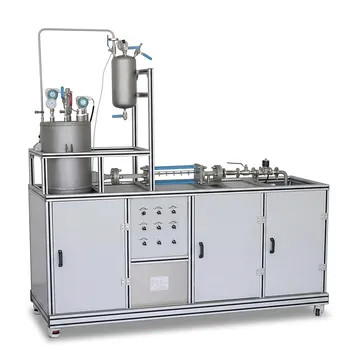
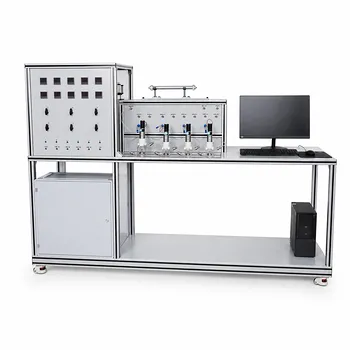
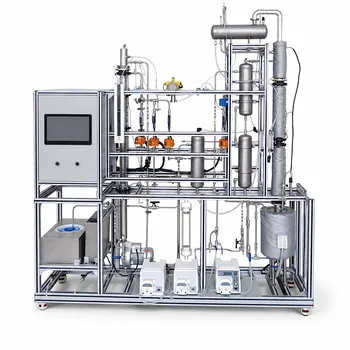
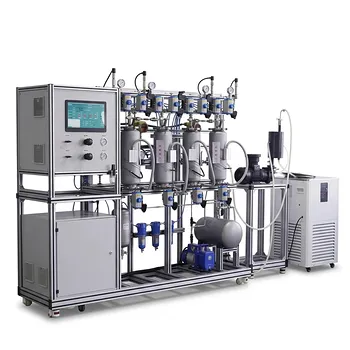
Need reliable pilot-plant data for teaching, research, or process development? Contact LABPARK to discuss your requirements. LABPARK provides Educational and Vocational Unit Operations Pilot Plants for chemical engineering, bioprocess and biotech, and environmental and water treatment applications. Our systems help universities, research institutes, and enterprises perform consistent gas analysis, material balances, combustion studies, energy evaluations, and process training with properly integrated sampling and measurement solutions.
Related Products
- Orifice and Venturi Flowmeter Calibration Educational Pilot Plant for Fluid Mechanics Laboratory
- Fixed-Bed Chemical Reaction and Gas Dust Tar Removal Unit Operations Pilot Plant
- Bench Scale Dual Column Gas Separation and Capture Educational Pilot Plant
- Gas-Solid Heterogeneous Separation Demonstration Educational Unit Operations Pilot Plant
- Two Phase Flow Pattern Velocity Resistance Measurement Educational Pilot Plant
People Also Ask
- What is the difference between static and stagnation pressure? Master Pilot Plant Flow Measurement
- How is the hydrodynamic entrance length estimated for high-Re channel flows? Design accurate pilot-plant measurements
- How do fluid mechanics pilot plants distinguish streamlines from streaklines? See flow visualization in action
- How do velocity profiles and flow rates differ in Newtonian and power-law fluids? A Pilot Plant Guide
- How does high-frequency pressure oscillation affect velocity distribution and boundary layer behavior? Discover Stokes-layer effects