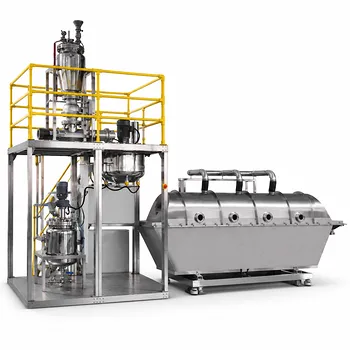
The defining difference is in what flows through the pump. An Oslo (classified-suspension) crystallization pilot plant prevents secondary nucleation by circulating only clear mother liquor, never the crystal slurry. In a Forced Circulation (FC) unit, the slurry—crystals and all—is repeatedly pumped at high velocity through a heat exchanger, causing intense mechanical impact and crystal breakage. The Oslo design eliminates this primary source of contact-induced nuclei, allowing crystals to grow quietly in a fluidized bed without ever colliding with a pump impeller or tube wall.
While all industrial crystallizers battle secondary nucleation, the Oslo unit’s architecture solves the problem at its root. By separating the circulation and growth zones, it keeps fragile crystals out of the high-shear pump loop entirely—a protective strategy that a Forced Circulation unit simply cannot replicate.
How the Oslo Design Physically Isolates Crystals from Harm
The Clarified Mother Liquor Circulation Loop
The heart of the Oslo crystallizer is its divided flow path. A settling zone at the top of the crystal bed allows only a clear, crystal-free solution to overflow to the circulation pump.
This clear mother liquor is then sent to a vaporization chamber (or heat exchanger) where supersaturation is generated. Crucially, no solid particles pass through the pump or the heat-transfer surfaces. Once supersaturated, the liquid returns to the bottom of the crystallizer body, rising upward through the suspended crystal mass to relieve its supersaturation directly onto the growing crystals.
Fluidization Without Mechanical Agitation
In the growth chamber, the upward flow of supersaturated solution fluidizes the crystal bed. The crystals are suspended purely by hydraulic forces, not by impellers.
This gentle, homogeneous suspension avoids the violent crystal–impeller and crystal–wall collisions that dominate the nucleation rate in stirred vessels. Contact nucleation—the micro-attrition of crystals—is minimized because the only collisions are low-energy crystal–crystal interactions within a smoothly fluidized bed.
Internal Classification as a Natural Protective Mechanism
The upward liquid velocity inherently classifies the crystals by size. Large crystals settle lower in the bed, while smaller fines are carried higher—where they can be selectively removed or dissolved.
This self-regulating classification prevents the uncontrolled accumulation of fragments that would otherwise serve as seed nuclei for further secondary nucleation. It also ensures that only the largest, most robust product crystals are withdrawn, while fragile fines are either dissolved or stay suspended until they grow enough to settle.
The Forced Circulation Alternative: A Design That Invites Nucleation
Why the Pump Becomes a Nucleation Machine
In a typical Forced Circulation unit, the entire magma is pulled through a recirculation pump and forced through a shell-and-tube heat exchanger at high velocity. The pump impeller physically shatters crystals, and the tube-side shear grinds them further.
Every passage generates thousands of new micro-fragments that act as secondary nuclei, consuming supersaturation and producing a broad, fine-dominated size distribution. The very act of circulating the slurry is the dominant source of new particles.
The Inherent Trade-off: Transport vs. Crystal Integrity
FC crystallizers are forced to strike a painful balance. High circulation rates are needed for heat transfer and to keep solids suspended, but higher rates also mean more violent collisions and more nuclei.
While supplementary measures—such as reducing impeller tip speed, using softer impeller materials, or adding fines destruction loops—can mitigate the damage, they only treat a symptom. The root cause—crystals passing through a pump—remains fundamentally embedded in the FC design.
Understanding the Trade-offs of the Oslo Pilot Plant
Not a Universal Solution
The Oslo design’s exclusive reliance on fluidized-bed growth limits it to relatively fast-settling, non-fragile crystalline materials. Slow-settling or needle-like crystals may not form a stable bed, making them unsuitable for this configuration.
Additionally, the clear-liquor circulation rate is constrained by fluidization dynamics; excessively high rates would lift the bed and carry fines into the pump, eroding the very separation the system relies on. This can limit throughput and make the unit less responsive to rapid changes in heat input.
Scaling and Plugging Risks Still Exist
While crystals avoid the pump, the heat exchanger and vaporization surfaces are exposed to supersaturated solutions. Incorrect operation—allowing local supersaturation spikes near the heat-transfer surfaces—can cause scaling or encrustation.
The pilot plant is an ideal teaching tool for these phenomena: it lets students see how to maintain a metastable operating window and why fine temperature control matters even in a design that protects crystals. The absence of crystal–impeller contact does not mean the system is immune to all nucleation pathways.
The Classified Suspension Demands Operator Skill
Maintaining a stable fluidized bed requires careful control of the upflow velocity, temperature, and concentration. Start-up and disturbances can disrupt the classification zone, temporarily letting fines escape into the circulation loop.
Researchers using an Oslo pilot plant learn to balance these parameters precisely—lessons that FC units, with their simpler “pump it around” mentality, do not teach. The Oslo design rewards careful process design and penalizes cavalier operation, making it the superior platform for studying nucleation kinetics and fluidization dynamics.
Making the Right Choice for Your Goal
Whether an Oslo or Forced Circulation pilot plant is the better tool depends entirely on what you need to learn or produce. Use the following guide to align the design with your objective.
- If your primary focus is producing large, uniform crystals and studying intrinsic fluidization dynamics: The Oslo unit’s gentle, circulated mother-liquor design is unmatched. It eliminates mechanical impact nucleation, making it the definitive tool for demonstrating growth-dominated crystallization.
- If your primary focus is handling slow-settling or scale-prone materials with meaningful heat-transfer studies: An FC unit may be necessary for solids suspension, but you must accept that you are studying a process where secondary nucleation from the pump loop is a dominant—and often limiting—variable.
- If your primary focus is scale-up research where impeller design and agitation rate are the variables of interest: A stirred-tank pilot plant with independent agitation control is more appropriate; comparing results from that system against an Oslo unit will reveal the true cost of mechanical contact in your specific chemistry.
- If your primary focus is teaching the fundamentals of secondary nucleation suppression: The Oslo pilot plant provides a pristine, repeatable baseline. Once you understand how the system behaves without pump-induced attrition, you can later run an FC unit and immediately see the impact of slurry circulation on size distribution.
By choosing the right hardware for your specific crystallization challenge, you stop fighting symptoms and start learning from a process that either protects crystals or exposes their fragility.
Summary Table:
| Feature | Oslo (Classified-Suspension) | Forced Circulation (FC) |
|---|---|---|
| Circulation Medium | Clear mother liquor only | Active crystal slurry (magma) |
| Suspension Method | Gentle hydraulic fluidization | High-shear mechanical pumping |
| Crystal Damage & Attrition | Minimized (no pump contact) | High (impeller & tube wall collisions) |
| Primary Output | Large, narrow-sized crystals | Broad, fine-dominated size distribution |
| Ideal Application | Growth-dominated crystallization studies | Slow-settling or scale-prone materials |
Optimize Your Crystallization & Process Engineering Lab with LABPARK
Are you looking to equip your laboratory with advanced chemical engineering tools? LABPARK provides premium Educational and Vocational Unit Operations Pilot Plants in chemical engineering, bioprocess & biotech, and environmental & water treatment for universities, research institutes, and enterprises.
Whether you need an Oslo crystallization unit to demonstrate growth-dominated dynamics or a Forced Circulation unit for scaling studies, our pilot plants are designed to deliver reliable, repeatable results for education and research.
Contact LABPARK today to discuss your laboratory specifications and request a tailored quote!
Related Products
- Multi Functional Membrane Crystallization Educational Unit Operations Pilot Plant
- Potassium Salt Thermal Dissolution and Crystallization Separation Educational Unit Operations Pilot Plant
- Multi-Functional Special Distillation Educational Pilot Plant
- Dual-Mode Rectification Pilot Plant for Practical Training Unit Operations
- Supercritical High-Gravity Flash Evaporation Educational Unit Operations Pilot Plant
People Also Ask
- Why is precise temperature control critical in crystallization pilot plants? Key to Scale-Up Success
- Control Crystallization Pilot Plant Secondary Nucleation: 4 Key Adjustments
- What key factors should be considered when configuring a crystallization unit operations pilot plant?
- What are the benefits of integrating online PAT tools like ATR-FTIR into crystallization unit operations pilot plants?
- How to use crystallization pilot plant agitation speed to identify diffusion vs reaction growth?