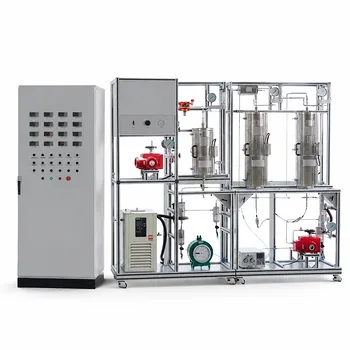
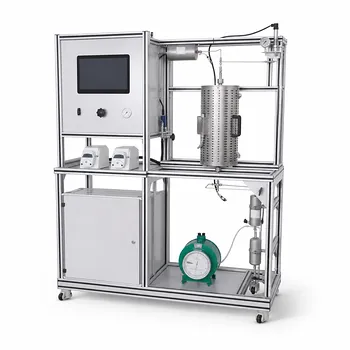
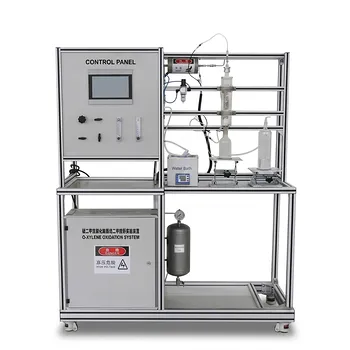
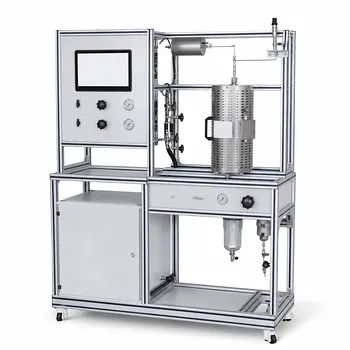
The reactor type in a Fischer-Tropsch pilot plant is not just a vessel choice; it is the primary architect of your entire downstream process.
The direct link is thermodynamic: Low-temperature reactors (fixed-bed or slurry) maximize heavy waxes ($C_{19+}$), mandating robust solid-liquid separation and hydrocracking units. High-temperature fluidized-bed reactors pivot to lighter gasoline and gaseous alkenes, requiring gas-solid cyclones and condensation trains instead. The reactor’s operating temperature and hydrodynamics dictate the carbon number distribution, which effectively writes the specification sheet for every downstream piece of equipment.
The core insight is this: A Fischer-Tropsch pilot plant is a single, integrated system, not a reactor followed by add-ons. The reactor choice determines the phase and composition of the outlet stream, making the separation units a direct, unavoidable consequence of that initial decision. For a pilot plant, this means the reactor configuration is your main lever for exploring entirely different process architectures.
The Thermodynamic Fork in the Road: Waxes vs. Gasoline
The primary determinant of your downstream process is the reactor's operating temperature, which directly controls the Anderson-Schulz-Flory (ASF) product distribution. This creates two distinct pilot plant archetypes.
The Low-Temperature Path: Maximizing Heavy Waxes
Operating in the 210-260°C range, fixed-bed and slurry-phase reactors optimize for long-chain hydrocarbons. This creates a waxy product stream that behaves more like a solid at room temperature.
The major fraction is $C_{19+}$ waxes, often accounting for roughly half the total product weight. This fundamentally changes the nature of your separation challenge. You are no longer performing simple distillation; you are initiating a liquid-solid separation to remove the catalyst from a high-viscosity product.
The High-Temperature Path: Maximizing Gasoline and Light Alkenes
Operating above 320°C in a fluidized-bed reactor shifts selectivity toward shorter chains, with gasoline ($C_5–C_{11}$) becoming the dominant product. Wax production becomes negligible.
Here, the separation challenge is entirely different. The reactor effluent is a hot, fast-moving gas stream loaded with catalyst fines. The first step isn't filtration but gas-solid separation via internal cyclones to protect downstream equipment. This renders the classic wax filtration unit obsolete.
Beyond Temperature: How Transport Phenomena Shape the System
The phase behavior inside the reactor dictates the mixing patterns, which then sets the boundary conditions for separation. This is a more subtle but equally critical principle for a pilot plant designed for deep research.
The Critical Role of Backmixing and Selectivity
Backmixing is not just an academic concept; it’s a product distribution control knob. In the supplementary case of a series reaction where a target intermediate can overreact, a pilot plant must minimize backmixing.
This is why reactor geometry matters so much. A spray tower or venturi loop reactor, which provides highly controlled contact time and minimal backmixing, can suppress the secondary reaction. This directly shows how a reactor's internal mixing profile—a transport phenomenon—becomes a primary tool for controlling selectivity, thus changing the composition of the feed entering the separation train.
Matching Reactor Geometry to Phase State
The physical state of reactants mandates a specific reactor geometry for efficient heat and mass transfer, which then locks in your downstream configuration. A pilot plant must reflect this cause-and-effect chain.
A homogeneous single-phase reaction naturally pairs with a simple tubular or tank reactor, leading to straightforward phase management downstream. A complex three-phase reaction (gas-liquid-solid) forces a choice like a slurry bubble column, which inherently requires that intricate downstream liquid-solid filtration step. The separation unit is a functional extension of the reactor's phase management challenge.
Understanding the Trade-offs and Common Pitfalls
Choosing a reactor is a decision about which benefits to pursue and which costly challenges to manage. A well-designed pilot plant makes these trade-offs transparent to the student or researcher.
The Conversion-Selectivity Penalty
Chasing high single-pass conversion in the reactor almost always leads to lower selectivity for the desired product. High product concentrations promote side reactions, generating unwanted byproducts that must be removed.
The pilot plant solution is a design lesson in itself: run the reactor at a lower, more selective conversion rate and integrate a separation unit immediately downstream to isolate the product and recycle unreacted reactants. This teaches the critical economic balance between reactor capital costs and separation energy requirements, a core unit operations principle.
The Catalyst-Wax Separation Bottleneck
For slurry-phase, low-temperature reactors, the greatest operational headache is separating the catalyst fines from the heavy wax product. This is rarely a trivial step.
The process requires robust, often proprietary, filtration systems to ensure long-term operability. A pilot plant failing to clearly demonstrate this bottleneck presents an incomplete and unrealistic picture of the industrial process. This specific separation challenge is a primary reason many processes historically favored fixed-bed reactors, despite their own heat removal complexities, as seen in the deliberate choice of reactor configuration for polymers to control molecular weight distribution.
Making the Right Choice for Your Pilot Plant Goal
The reactor is an intellectual catalyst, selected to teach a specific set of engineering principles or to de-risk a particular technology. Your choice is entirely a function of your learning or research objective.
- If your primary focus is teaching the classic fuels-to-chemicals value chain: Prioritize a low-temperature, slurry-phase reactor. This forces the study of catalyst-wax separation and downstream hydrocracking, showcasing the path to high-value lubricants and waxes.
- If your primary focus is demonstrating process intensification and compact design: A microchannel reactor is the definitive choice. Its sevenfold productivity increase over conventional fixed beds and superior heat management allows you to explore high-throughput testing within a minimal footprint.
- If your primary focus is exploring the gasoline and light-olefin production window: A high-temperature fluidized-bed reactor is essential. It introduces the critical downstream unit operations of cyclone design for fines removal and the complex refrigeration and condensation cascade for separating light hydrocarbons.
- If your primary focus is studying the fundamental control of reaction kinetics and mixing: Configure the pilot plant for a series reaction using a reactor with minimal backmixing, like a spray tower. This teaches how residence time distribution is a direct lever to control product selectivity before any separation occurs.
Ultimately, the pilot plant reactor is the architect of the entire downstream process, translating a thermodynamic choice into a tangible separation sequence for maximum learning impact.
Summary Table:
| Reactor Type | Temp Range | Main Products | Primary Downstream Operations |
|---|---|---|---|
| Low-Temp (Fixed-Bed/Slurry) | 210–260°C | Heavy Waxes ($C_{19+}$) | Liquid-solid filtration, hydrocracking |
| High-Temp (Fluidized-Bed) | >320°C | Gasoline ($C_5–C_{11}$), light alkenes | Gas-solid cyclones, condensation trains |
Elevate Your Chemical Engineering Lab with LABPARK
Building a state-of-the-art laboratory requires precise, reliable equipment. LABPARK provides premium Educational and Vocational Unit Operations Pilot Plants across chemical engineering, bioprocess & biotech, and environmental & water treatment.
We help universities, research institutes, and enterprises bridge the gap between theory and industrial reality. Contact us today to find the perfect pilot plant solution for your institution.
Related Products
- Internal Circulation Gradient Free Catalytic Reaction Educational Pilot Plant
- Fixed-Bed Chemical Reaction and Gas Dust Tar Removal Unit Operations Pilot Plant
- 100L Continuous Loop Hydrogenation Educational Unit Operations Pilot Plant
- Fixed Bed Gas Solid Catalytic Reaction Educational Pilot Plant
- Multi-Reactor Educational Pilot Plant for Reaction Engineering Unit Operations
People Also Ask
- Why is thermal management a major challenge in methane oxidative coupling? Reactor Solutions for Pilot Plants
- Why is a multibed configuration necessary for exothermic reactions? Optimize your pilot plant trajectory.
- Fluidized vs. Fixed Bed Reactors: Comparing Heat & Complexity in Pilot Plants
- How to choose a 1D or 2D model for simulating a fixed-bed reactor? The Mears Criterion Decoded.
- What safety features are required for hydrogen halide pilot plants? Key design tips based on halogen reactivity.