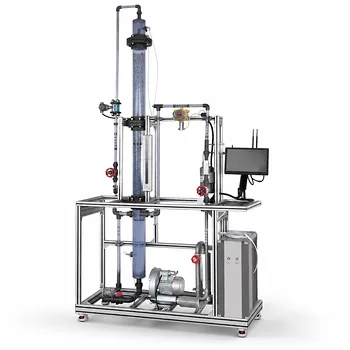
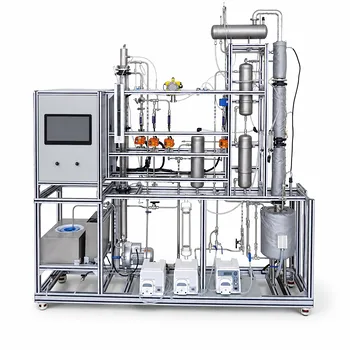
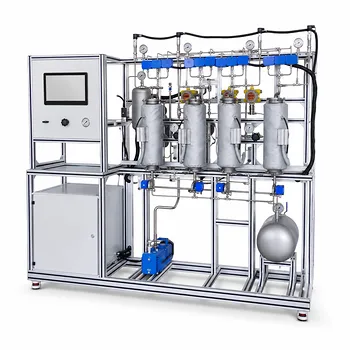
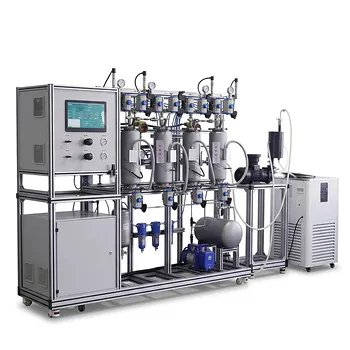
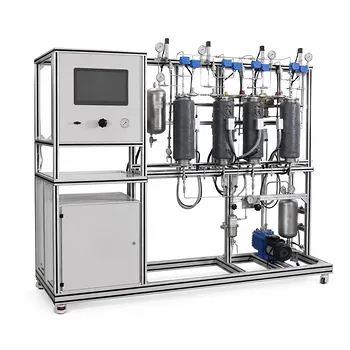
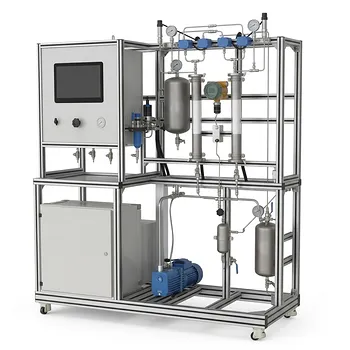
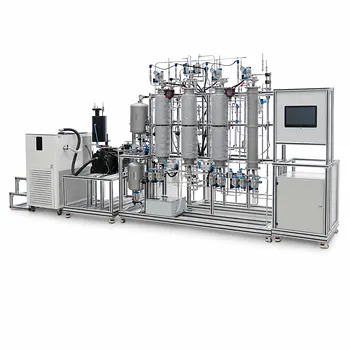
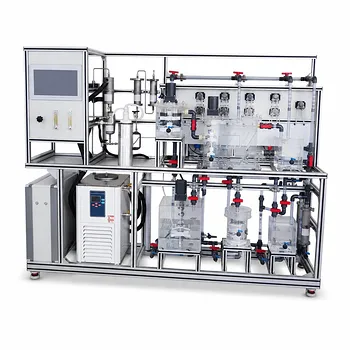
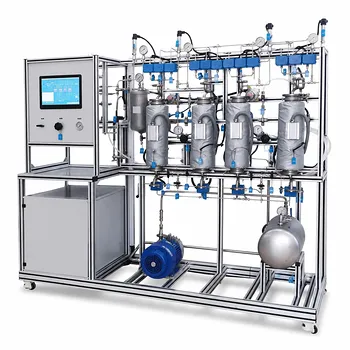
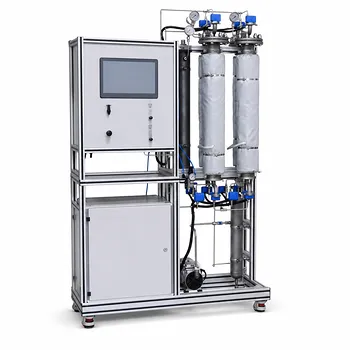
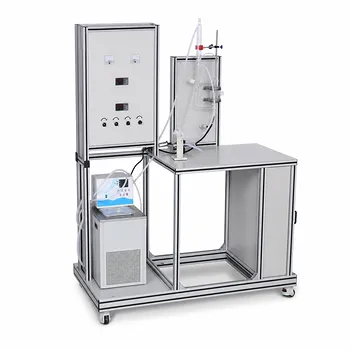
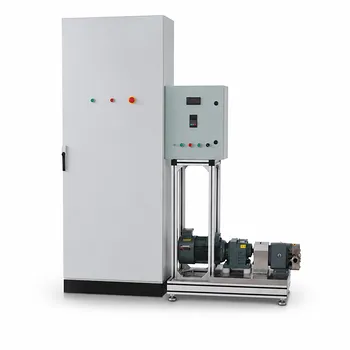
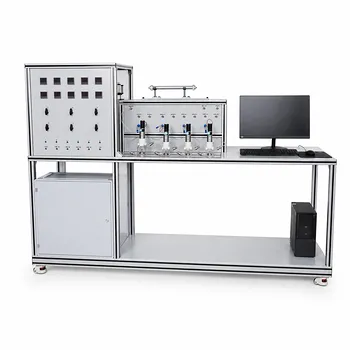
Temperature control is not an auxiliary feature—it is the defining design constraint. In pilot plants producing sodium hypochlorite, the gas-liquid absorption unit must be engineered around a single non-negotiable requirement: the reaction zone must remain cold. This means the absorber itself must function as an efficient heat exchanger, integrating a cooling jacket or internal coils to maintain temperatures low enough to stabilize the hypochlorite product and prevent its immediate thermal decomposition.
Core Takeaway: The highly exothermic reaction between chlorine gas and alkaline solution yields a product that is thermodynamically fragile. Without aggressive, continuous heat removal, the hypochlorite breaks down into useless chloride and oxygen. Therefore, the design of the pilot absorption column is shaped by the need to provide sufficient cooling surface area and liquid turbulence to keep the bulk temperature inside a narrow, low-temperature window.
The Temperature-Sensitive Chemistry of Hypochlorite Formation
The process relies on absorbing chlorine gas into a cold solution of sodium hydroxide. The target reaction forms sodium hypochlorite and sodium chloride, but this reaction releases significant heat.
The Decomposition Danger That Drives Design
The moment the liquid temperature rises, the hypochlorite ions become unstable. They rapidly decompose via side reactions into sodium chloride, sodium chlorate, or oxygen gas. This destruction of yield is not a gradual decline—it is a runaway process once a thermal threshold is crossed. The primary reference confirms that to “successfully yield hypochlorites and prevent their decomposition,” the chlorine must be reacted with a cold alkaline solution. Therefore, the absorber cannot simply be a mass transfer device; it must be a precision thermal management system.
The Thermodynamic Advantage of Cold Operation
Operating at a low temperature does far more than just protect the product. It fundamentally improves the absorption process itself, creating a powerful synergy between selectivity and efficiency.
Enhanced Gas Solubility as a Driving Force
The supplementary references underscore a general principle: gas solubility in a liquid decreases as temperature rises. For chlorine gas, chilling the alkaline solvent dramatically increases its solubility according to Henry’s Law. A colder liquid provides a higher equilibrium concentration of dissolved chlorine at the gas-liquid interface, which steepens the concentration gradient and increases the mass transfer driving force. This allows the absorption to achieve the required chlorine loading with a smaller column or a lower solvent circulation rate.
Balancing Diffusion and Reaction Kinetics
There is a counter-effect: a drop in temperature slows molecular diffusion (the diffusion coefficient is proportional to (T^{3/2})) and reduces the intrinsic reaction rate constant. However, in this specific chemistry, the gain from higher solubility and the suppression of decomposition far outweighs the kinetic slowdown. The reaction with a highly alkaline solution is fast enough at cold temperatures to proceed to completion, while the increased solubility ensures the liquid phase never starves of reactant. The result is a net gain in overall volumetric efficiency.
Engineering the Cooling Solution into the Absorber
Since the absorption step must inherently be a cooled step, the column’s physical design integrates the heat transfer surface directly into the reaction zone. The primary reference explicitly states that “the gas-liquid absorption column or reactor unit [must be] integrated with a reliable cooling jacket or heat exchanger system.”
Jacketed Walls and the Turbulence Bonus
The most common approach in pilot-scale design is a jacketed bubble column or packed column. The vessel wall acts as the heat transfer surface, with chilled water or brine circulated through the jacket. As the supplementary references point out, the introduction of gas bubbles into a liquid dramatically increases turbulence in the liquid film near the heat transfer surface. This gas-induced agitation enhances the process-side heat transfer coefficient, making wall cooling much more effective than in an unsparged tank. The absorber becomes an integrated, highly efficient heat exchanger partly because the very gas being absorbed is stirring the fluid.
Internal Cooling Coils and External Loops
For higher heat loads or when scaling up, a simple jacket may provide insufficient surface area. Designers then turn to internal cooling coils immersed in the liquid or an external circulation loop that passes the reaction mixture through a dedicated shell-and-tube heat exchanger. The choice influences column internals, liquid holdup, and mixing patterns. In any variant, the design must ensure that no stagnant hot spots develop where local temperatures could trigger decomposition, making uniform mixing and cooling distribution non-negotiable.
Understanding the Built-in Trade-offs
Designing for maximum cooling is not without its practical limits, and an over-engineered system can create new problems.
The Risk of Overcooling and Chlorine Hydrates
Pushing the temperature too low—typically below 9°C—risks forming solid chlorine hydrates that can block distributor nozzles, packings, and instrument lines. Additionally, an extremely low temperature can increase the liquid’s viscosity, reducing the diffusion coefficient to a point where the reaction rate becomes the true bottleneck. The optimal pilot-plant design targets a tight, well-monitored temperature band, often between 10°C and 20°C, where stability is high but physical and kinetic penalties are minimal.
Handling Variable Gas Loads and Start-Up Transients
The exothermic heat release is directly tied to the chlorine feed rate. A poorly designed cooling system might handle a steady-state load but fail during a flow ramp-up, allowing a temperature excursion that ruins an entire batch. The pilot unit must therefore have a cooling system with enough turndown capability and rapid response to match dynamic process conditions. This usually mandates precise temperature control loops, and often, the use of a stirred or well-baffled reaction zone to homogenize the temperature profile before it can stratify.
Designing Your Pilot Absorption Unit: A Temperature-First Approach
When specifying a pilot plant for hypochlorite production, let your primary goal dictate the thermal design strategy.
- If your primary focus is product purity and high yield: Make heat removal the dominant factor. Choose a high-surface-area internal coil or a jacketed column with chilled coolant and design for a stable operating point well below the decomposition threshold, even if it requires a slightly larger reactor volume to compensate for slower kinetics.
- If your primary focus is mass transfer efficiency and compact size: Use a counter-current packed column operated at the lowest practical temperature. This maximizes the driving force from increased chlorine solubility, reducing the required packing height. Integrate the cooling so the liquid inlet is pre-chilled and the jacket removes heat of absorption along the column length.
- If your primary focus is scalability and safe operation: Adopt an external cooling loop with a recirculation pump. This decouples the heat transfer surface from the column geometry, allowing easier scale-up calculations and providing robust, uniform temperature control without internal internals that complicate cleaning and maintenance.
In a hypochlorite pilot plant, temperature control ceases to be a simple process parameter. It becomes the sole principle governing column geometry, heat exchanger surface area, and operational safety envelope, transforming a dangerous, exothermic mixing event into a stable, productive chlorination process.
Summary Table:
| Design Parameter | Impact of Temperature Control | Engineering Implementation |
|---|---|---|
| Reaction Stability | Prevents rapid decomposition of hypochlorite | Cooling jackets, internal coils, or external loops |
| Mass Transfer | Low temp increases chlorine solubility & driving force | Counter-current packed or jacketed bubble columns |
| Operating Window | Avoids chlorine hydrate blockages (>9°C) | Precise temperature loops & dynamic control (10-20°C) |
Optimize Your Chemical Engineering Projects with LABPARK
Are you looking to equip your university, research institute, or enterprise with state-of-the-art pilot plants? LABPARK provides premium Educational and Vocational Unit Operations Pilot Plants across chemical engineering, bioprocess & biotech, and environmental & water treatment.
Whether you need high-precision gas-liquid absorption units with robust thermal management or custom-designed reaction systems, our equipment ensures safety, accuracy, and scalability.
Contact LABPARK today to discuss your lab requirements and get a professional solution!
Related Products
- Packed Bed Absorption Educational Unit Operations Pilot Plant
- Dual-Mode Gas Absorption and Desorption Unit Operations Training Pilot Plant
- Absorption and Desorption Educational Unit Operations Pilot Plant
- Carbon Dioxide Absorption and Desorption Educational Pilot Plant for Carbon Capture Studies
- Carbon Dioxide Adsorption and Capture Educational Unit Operations Pilot Plant
People Also Ask
- How Do Flow Regimes Transition in Packed Bed Pilot Plants? Key Scale-up Insights
- How does reactant concentration determine absorption column control? Gas-film vs. dual-film.
- How is the packing height of an absorption column calculated? Master HTU & NTU Concepts
- How does static vs. operating holdup affect pilot plant calibration? Avoid Critical Scale-Up Errors
- Why is counter-current flow selected for gas absorption? Maximize Pilot Plant Efficiency