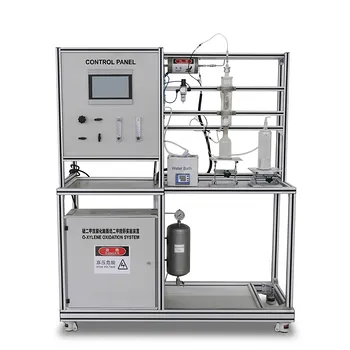
The number of operating states a catalytic reactor can settle into is not always one—it can be two, three, or even five for the exact same inlet conditions. Steady-state multiplicity, driven by interphase and intraparticle temperature and concentration gradients, means a reactor may jump between a low-conversion, a high-conversion, or an unstable intermediate state. These abrupt transitions—ignition and extinction—are governed by the heat and mass transport resistances at the pellet surface and within its pores, creating the classic hysteresis loops that define reactor stability.
The central insight is that the interplay between heat generation and transport inside and around catalyst pellets creates a non-linear feedback loop. In exothermic reactions, even a tiny change in feed temperature or flow can trigger a catastrophic shift to a runaway state or a complete loss of activity. Educational pilot plants make this invisible boundary tangible, allowing engineers to safely explore, map, and ultimately control the kind of dangerous sensitivities that would be unacceptable in full-scale production.
How Interphase and Intraparticle Gradients Create Multiple Steady States
The root cause of multiplicity lies in the thermal and concentration profiles that develop across the stagnant film surrounding a pellet (interphase) and within its porous structure (intraparticle). These profiles are not just secondary details—they are the key that unlocks non-unique reactor behavior.
The Feedback Loop Between Reaction, Heat, and Transport
An exothermic catalytic reaction generates heat faster than it can be removed when diffusion and conduction are slow. The catalyst pellet interior becomes hotter than the surrounding fluid.
This temperature rise boosts the intrinsic reaction rate exponentially, which in turn generates even more heat. The pellet can “light off” to a high-temperature, high-conversion steady state even if the bulk fluid conditions remain unchanged.
Why This Leads to Hysteresis and Ignition-Extinction
The steady-state heat generation curve for a pellet is sigmoidal because of the Arrhenius temperature dependence, while heat removal is roughly linear. When the two curves intersect, each intersection represents a steady state.
Under certain conditions, you get three intersections: a stable low-temperature state, an unstable middle state, and a stable high-temperature (ignited) state. As you slowly change the feed temperature or flow, the reactor follows a path that jumps between the stable branches—this is the ignition-extinction hysteresis loop.
How Gradients Propagate to Full Reactor Multiplicity
A catalyst particle with internal gradients can exhibit multiple steady states on its own. When thousands of such pellets are packed into a reactor, their collective behavior gives rise to the same pattern at the reactor scale.
Tubular reactors with axial dispersion and heat exchange, and CSTRs with perfectly mixed bulk conditions, can both display three or more overall steady states because the underlying pellet-level multiplicity couples with the macroscopic heat and mass balances.
The Operational Impact: Why You Can’t Ignore the Unseen States
Multiple steady states fundamentally change how a reactor starts up, shuts down, and responds to disturbances. A state that looks stable on paper may be just a small perturbation away from collapse.
Sudden Transitions That Defy Intuition
A reactor operating at a high-conversion, high-temperature state can suddenly extinguish if a minor feed temperature drop pushes it past the extinction point. The conversion may crash without warning.
Conversely, starting from a low-activity state and increasing the feed temperature slightly can trigger a runaway ignition. In fixed-bed reactors, this can lead to catalyst sintering, reactor damage, and even safety incidents.
The Unstable Middle State and Its Control Trap
Many theoretical analyses predict three steady-states: low, intermediate, and high. The intermediate state is always unstable—any small fluctuation will drive the system to either the high or low stable branch.
In a pilot plant, operators quickly learn that trying to maintain operation exactly at the middle state is impossible. The reactor “falls off” to one of the stable extremes, reinforcing the need for robust startup trajectories and automated control that keeps the process on the desired branch.
Parametric Sensitivity Amplifies the Risk
When a reactor is near a bifurcation point, the sensitivity of the output to tiny changes in inlet conditions becomes enormous. A 1°C temperature shift or a 2% flow change can be the difference between a stable production run and a thermal runaway.
Interphase and intraparticle resistance magnify this sensitivity because they decouple the pellet’s internal state from the bulk measurements that operators typically see. You might be reading a safe bulk temperature while the catalyst interior is already at a destructive temperature.
The Critical Role of Educational Pilot Plants: From Equations to Instinct
You cannot learn reactor stability from simulation alone. The true value of a pilot plant is that it forces students and operators to confront the physical reality of multiplicity—to see the hysteresis curve appear in real data, and to feel the consequences of crossing an extinction boundary.
Visualizing Bifurcation Diagrams in Real Time
In a CSTR or tubular reactor pilot plant, varying the feed flow rate—which changes the dimensionless residence time or Damköhler number—allows the operator to map the entire ignition-extinction loop experimentally. They can watch the conversion jump suddenly at a specific flow, then fail to return along the same path when the flow is reversed.
This hands-on mapping demolishes the abstract nature of stability theory. The “S-shaped” hysteresis curve becomes a recorded data set, not just a graph in a textbook.
Developing Process Control Intuition for Industry
Pilot plants allow students to design and test control strategies for processes where the measured variable (bulk fluid temperature) is a lagging indicator of the true catalyst state. They learn that simple PID loops can fail when the gain changes drastically near the bifurcation point.
By deliberately inducing extinction or runaway in a safe, contained setting, future engineers internalize the importance of Inoue’s stability criterion, parametric sensitivity analysis, and the correct sequence for startup heating and shutdown cooling.
Understanding Autothermal and Adiabatic Operation
Fixed-bed pilot reactors configured for autothermal operation (where hot product gas preheats the feed) display up to three steady states on a conversion-temperature diagram: a stable ignited state, a stable extinguished state, and an unstable middle point. Students see how crossing the heat removal line triggers a rapid transition.
Adiabatic tubular reactors with equal mass and heat dispersion (Le = 1) experimentally confirm that the low- and high-conversion steady states are asymptotically stable, while the intermediate state is unstable. This directly validates the mathematical models and teaches the critical lesson that a poorly chosen startup procedure will inevitably fail.
Understanding the Trade-offs: High Productivity Versus Fragile Stability
Operating on the high-conversion ignited branch seems like the obvious choice—maximum product per unit time. But that state can be alarmingly fragile.
The Narrow Operating Window of the Ignited State
The high-temperature steady state often exists close to the extinction point. A small increase in feed rate or decrease in feed temperature can cause the reactor to extinguish entirely, halting production. You gain productivity but sacrifice operational robustness.
Risk of Runaway and Catalyst Deactivation
The same ignited state may also be dangerously close to a thermal runaway threshold if an unexpected rise in feed temperature or concentration pushes the pellet temperature beyond the catalyst’s sintering limit. Permanent damage can occur within minutes.
Pilot plant experiments make this trade-off concrete: students see that a higher setpoint reduces the margin of safety, and they learn to define safe operating windows based on experimental stability limits rather than ideal assumptions.
The Hidden Danger of Mass Transfer Limitations
Strong intraparticle concentration gradients can lead to a pellet that is internally diffusion-limited, so the measured bulk conversion overestimates the real catalyst effectiveness. In a multi-state scenario, this can mask the fact that the reactor is operating on the wrong stable branch—a low-activity state that looks acceptable only because of the averaging effect.
Making the Right Choice for Your Process and Training Goal
Whether you’re designing a reactor or learning to operate one, the lesson is the same: multiplicity is not a rare academic curiosity; it is the default behavior of many exothermic catalytic systems. Your approach must reflect the specific stability needs of your goal.
- If your primary focus is maximizing yield: Operate on the high-conversion ignited branch but build in active safeguards—like feed-effluent heat exchangers and fast-response temperature probes—to prevent extinction with the smallest of disturbances.
- If your primary focus is robust, failure-proof operation: Choose a conservative setpoint away from bifurcation points, even if it means lower per-pass conversion. The trade-off in productivity is often recovered in uptime and catalyst life.
- If your primary focus is education and technology transfer: Use pilot plant runs to deliberately sweep through the entire hysteresis loop and record the exact conditions of ignition and extinction. This data becomes the foundation for safe startup procedures and reliable control logic in the full-scale plant.
- If your primary focus is process control design: Incorporate a model that explicitly accounts for pellet-scale gradients. Standard reactor models that assume uniform pellet temperature will fail to predict the stable operating window, leaving you blind to the true risk of runaway or extinction.
Demonstrating multiplicity in a pilot plant transforms a mathematical curiosity into an unforgettable lesson in operational reality—one that equips engineers with the instincts to keep industrial reactors safe, productive, and under control.
Summary Table:
| Aspect | Key Driver / Phenomenon | Operational Impact & Educational Value |
|---|---|---|
| Transport Gradients | Temperature & concentration profiles in film/pores | Decouples internal catalyst state from bulk fluid measurements. |
| Multiplicity & Hysteresis | Sigmoidal heat generation vs. linear heat removal | Causes sudden transitions (ignition/extinction) and unstable middle states. |
| Pilot Plant Training | Real-time mapping of ignition-extinction loops | Builds intuitive process control skills and validates stability criteria safely. |
Bring Complex Reactor Stability Theory to Life with LABPARK
Understanding steady-state multiplicity is vital for preventing catastrophic industrial runaways. LABPARK provides advanced Educational and Vocational Unit Operations Pilot Plants in chemical engineering, bioprocess & biotech, and environmental & water treatment for universities, research institutes, and enterprises.
Our pilot plants empower students and researchers to safely map hysteresis loops, manage parametric sensitivity, and master real-world process control.
Contact LABPARK today to equip your facility with industry-standard training systems.
Related Products
- Multi Functional Catalytic Reaction and Reactor Evaluation Educational Unit Operations Pilot Plant
- Micro-Scale Gas-Solid Catalytic Reaction Educational Pilot Plant
- Internal Circulation Gradient Free Catalytic Reaction Educational Pilot Plant
- Fixed Bed Gas Solid Catalytic Reaction Educational Pilot Plant
- Fluidized Bed Gas Solid Catalytic Reaction Educational Pilot Plant
People Also Ask
- What reaction engineering principles are shown in a catalytic reactor pilot plant? SO2 Oxidation Guide
- How does feed gas flow rate affect catalytic RFR yields? Optimize Pilot Plant Performance
- Why is FTIR integration in catalytic pilot plants important? Real-Time Student Insights
- How to analyze active metal distribution & identify catalyst poisoning in pilot plants? Expert Diagnostic Guide
- How to study catalyst poisoning & regeneration? Master catalytic reaction life cycles.