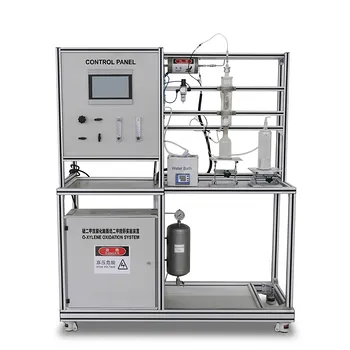
Ostwald’s isolation method determines multi-reactant rate laws by converting them into simpler pseudo-order experiments. In a pilot reactor, all reactants except one are supplied in large excess, so their concentrations remain nearly constant. The measured rate then depends primarily on the isolated reactant, allowing its individual reaction order to be determined; repeating the procedure for each reactant reveals the complete rate law.
The central idea is to isolate one concentration variable at a time. Constant concentrations of the other reactants are absorbed into an apparent rate constant, making a complex multi-reactant law experimentally manageable.
How the Isolation Method Simplifies the Rate Law
Starting with the full rate expression
For a reaction involving three reactants, the rate may be written as
[ -r_A = k C_A^\alpha C_B^\beta C_C^\gamma ]
where (k) is the true rate constant and (\alpha), (\beta), and (\gamma) are the individual reaction orders.
Determining all three exponents in a single experiment is difficult because the concentrations of all reactants may change simultaneously.
Holding two reactants effectively constant
To determine the order with respect to (A), the pilot-reactor experiment uses (B) and (C) in large excess relative to (A). Their concentrations then change only slightly during the run.
The rate expression becomes
[ -r_A = k' C_A^\alpha ]
where
[ k' = k C_B^\beta C_C^\gamma ]
The constant (k') is called a pseudo-rate constant. It includes the effects of the excess reactants while leaving the concentration dependence on (A) available for analysis.
How Individual Reaction Orders Are Measured
Determining the order with respect to (A)
With (B) and (C) maintained in excess, the concentration of (A) is varied between experimental runs, or its rate of disappearance is measured at different concentrations.
For two measurements under otherwise equivalent conditions,
[ \frac{r_1}{r_2}
\left(\frac{C_{A1}}{C_{A2}}\right)^\alpha ]
Therefore,
[ \alpha = \frac{\ln(r_1/r_2)} {\ln(C_{A1}/C_{A2})} ]
This comparison removes the unknown pseudo-rate constant and directly yields the reaction order with respect to (A).
Determining the order with respect to (B)
A second set of runs uses (A) and (C) in large excess, isolating (B):
[ -r_A = k'' C_B^\beta ]
The order is then obtained from
[ \beta = \frac{\ln(r_1/r_2)} {\ln(C_{B1}/C_{B2})} ]
The same approach applies to (C), using (A) and (B) in excess to determine (\gamma).
Determining orders from concentration-time data
In batch pilot reactors, samples can be taken at specified times to construct concentration-time profiles. These data provide reaction rates or allow integrated pseudo-order equations to be tested.
For example, a first-order dependence on the isolated reactant produces a linear relationship between (\ln C_A) and time. A zero-order dependence produces a linear (C_A)-versus-time relationship, while other orders can be assessed using the corresponding integrated form or nonlinear regression.
How the Complete Rate Law Is Reconstructed
Combining the measured exponents
After determining each partial order independently, the rate law is reconstructed as
[ -r_A = k C_A^\alpha C_B^\beta C_C^\gamma ]
The overall reaction order is the sum of the individual orders:
[ n_{\text{overall}} = \alpha + \beta + \gamma ]
This distinguishes the reaction’s dependence on each reactant from its total kinetic order.
Calculating the true rate constant
Once the individual orders are known, the true rate constant can be calculated from measured rate and concentration data:
[ k = \frac{r_A} {C_A^\alpha C_B^\beta C_C^\gamma} ]
Values of (k) should be evaluated across multiple experimental conditions. Consistent values support the proposed rate law and indicate that the isolation assumptions were reasonable.
Why Pilot Reactors Are Useful
Controlled concentration changes
Laboratory pilot reactors allow operators to control initial concentrations, temperature, mixing, residence time, and sampling intervals. This makes it practical to repeat the isolation experiment under comparable conditions for each reactant.
Direct measurement of reaction progress
Periodic samples provide concentration data rather than relying only on a single final conversion. The resulting profiles help identify transient behavior, calculate rates, and detect deviations from the assumed kinetic model.
Connection to scale-up
Pilot-reactor measurements are more representative of real processing conditions than purely theoretical calculations. They can reveal issues such as heat-transfer limitations, mixing effects, or concentration gradients that may influence the apparent rate.
However, the intrinsic rate law should be distinguished from transport-limited behavior. If mixing or mass transfer controls the observed rate, the fitted exponents may describe the reactor system rather than the underlying chemical reaction.
Understanding the Trade-offs
The excess-reactant assumption must be valid
The isolation method works only when the excess reactants remain approximately constant. If their concentrations change substantially, they cannot be absorbed into a constant (k'), and the calculated order may be biased.
A practical design should use sufficiently large excess concentrations and verify their variation through sampling or material-balance calculations.
Apparent constants depend on experimental conditions
The pseudo-rate constant includes the concentrations of the excess reactants:
[ k' = k C_B^\beta C_C^\gamma ]
Consequently, (k') changes when those concentrations change. It should not be mistaken for the true rate constant (k).
Temperature and reactor conditions must be controlled
Reaction orders should be compared at the same temperature and under consistent mixing and sampling conditions. Because the rate constant is temperature-dependent, changes in temperature can be incorrectly interpreted as changes in concentration dependence.
Measurement error can affect logarithmic calculations
The two-point order formula uses logarithms of rate and concentration ratios. Small differences between the compared concentrations or rates can magnify experimental error.
Using several concentration levels and fitting the data statistically is generally more reliable than basing an order on only two measurements.
The method may not capture more complex kinetics
Simple power-law expressions may be inadequate when the reaction involves reversible steps, inhibition, catalyst saturation, parallel reactions, or changing mechanisms. In such cases, isolation experiments remain useful for initial diagnosis but should be supplemented with a broader kinetic model.
Applying the Method in the Laboratory
Plan one isolation series per reactant
For a rate law involving (A), (B), and (C), design:
- A series with (B) and (C) in excess to determine (\alpha).
- A series with (A) and (C) in excess to determine (\beta).
- A series with (A) and (B) in excess to determine (\gamma).
Keep temperature, reactor operation, and analytical procedures consistent across the series.
Confirm the pseudo-order behavior
Use concentration-time data to test whether the isolated reactant follows a plausible zero-, first-, or higher-order relationship. Agreement across multiple runs is stronger evidence than a single fitted slope.
Validate the reconstructed law
Substitute the measured values of (\alpha), (\beta), and (\gamma) into the full rate equation. Check whether one value of (k) predicts rates across all experimental conditions.
Choosing the Right Experimental Focus
- If your primary focus is determining individual reaction orders: Keep all other reactants in large excess, compare rates at different concentrations of the isolated reactant, and repeat the procedure for each species.
- If your primary focus is obtaining reliable pilot-reactor kinetics: Control temperature, mixing, sampling, and concentration changes, then validate the calculated rate constant across multiple runs.
- If your primary focus is reactor scale-up: Confirm that the measured rate is chemically controlled and not limited by mass transfer, heat transfer, or inadequate mixing.
- If your primary focus is identifying complex mechanisms: Use isolation experiments as an initial screening tool, then test the resulting power-law model against broader concentration and operating data.
Ostwald’s isolation method turns a difficult multi-reactant kinetic problem into a sequence of controlled pseudo-order experiments, enabling the full rate law to be built from independently measured reaction orders.
Summary Table:
| Key Aspect | Practical Insight |
|---|---|
| Core principle | Supply all but one reactant in large excess to create pseudo-order conditions. |
| Individual orders | Repeat isolation experiments for each reactant to determine its reaction order. |
| Rate-law validation | Reconstruct the full power-law expression and verify a consistent true rate constant. |
| Pilot-reactor controls | Maintain consistent temperature, mixing, residence time, sampling, and concentration conditions. |
| Main limitation | Excess reactants must remain nearly constant; transport limitations can distort apparent kinetics. |
| Best practice | Use multiple concentration levels and statistical fitting instead of relying on two-point comparisons. |
Need dependable kinetic data for process development or scale-up? Contact LABPARK to discuss Educational and Vocational Unit Operations Pilot Plants for chemical engineering, bioprocess and biotech, and environmental and water treatment applications. LABPARK helps universities, research institutes, and enterprises run controlled pilot-reactor studies, measure concentration-time behavior, determine reaction orders, validate rate constants, and identify mixing, heat-transfer, or mass-transfer limitations. Our pilot plants support practical training, research, process optimization, and more confident equipment and scale-up decisions.
Related Products
- Fixed Bed Gas Solid Catalytic Reaction Educational Pilot Plant
- Multi-Reactor Educational Pilot Plant for Reaction Engineering Unit Operations
- Fixed-Bed Chemical Reaction and Gas Dust Tar Removal Unit Operations Pilot Plant
- Tubular Reactor Flow Characteristics Determination Educational Unit Operations Pilot Plant
- Residence Time Distribution and Reactor Flow Characteristics Determination Educational Pilot Plant
People Also Ask
- Fixed-Bed vs. Fluidized-Bed Reactor: How to Choose the Right Pilot Plant for Gas-Solid Catalytic Reactions
- How to determine catalyst pore radius & porosity? Optimize your chemical engineering pilot plant.
- What reactor configurations study gas-solid reactions? Guide to key types and applications.
- How does identifying the rate-limiting step optimize reaction conditions? Pilot Plant Guide
- How do reactor pilot plants safely study gas-solid reactions? Master kinetics with thermal & flow control.