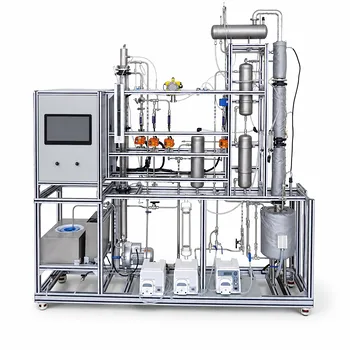
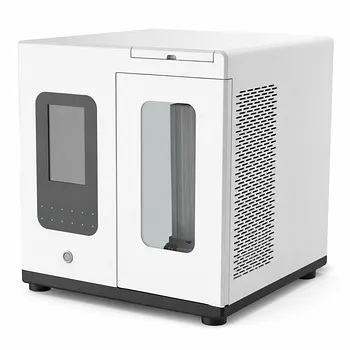
Operating temperature is one of the most powerful thermodynamic levers in any membrane-based gas separation pilot plant. It directly and exponentially governs both gas permeability and selectivity through the Arrhenius relationship. In simple terms, as you raise the temperature, the diffusivity of all gas molecules through the polymer increases, but the solubility of vapors drops—and this asymmetric shift fundamentally changes what your membrane will let through and how purely it will separate it. For pilot-plant operators and researchers, this means that a deliberate temperature strategy can transform a single membrane module from a high-throughput, low-purity device into a highly selective, lower-flux separation unit.
Temperature does not simply speed up or slow down gas transport—it rewrites the balance between solubility and diffusivity in a gas-specific way. For pilot plants, mapping this behaviour reveals the activation energies of each species and helps engineers pinpoint the exact operating window where flux and selectivity align with the separation goal.
The Thermodynamic Foundation: Arrhenius and Dual-Mode Effects
Permeability as a Product of Solubility and Diffusivity
Membrane permeability is not a single physical property; it is the product of solubility (S) and diffusivity (D). A gas molecule must first dissolve into the polymer surface, then diffuse across the membrane. Temperature influences both factors, but in opposite directions for many gas–polymer pairs.
- Diffusivity always increases with temperature. Warmer conditions give polymer chains more thermal energy, enlarging the transient free-volume gaps that gas molecules jump through. This is why permanent gases like nitrogen or hydrogen permeate faster at elevated temperatures.
- Solubility often decreases with temperature for permanent gases and organic vapors in rubbery polymers. Condensation-like sorption is exothermic, so lower temperatures favour higher solubility—packing more molecules into the polymer surface.
How Temperature Shifts Each Parameter Differently
Because the Arrhenius equation describes an exponential relationship, even a modest 20°C shift can double or halve the permeability of a given gas. Smart pilot-plant experiments exploit this to calculate activation energy of permeation for each species. By measuring flux at several controlled temperatures, students and researchers can derive the empirical coefficients that distinguish a solubility-controlled separation from a diffusivity-controlled one.
This distinction is the secret to decoding selectivity. If the more permeable gas relies on solubility, then cooling the feed can dramatically boost its solubility advantage. If the more permeable gas relies on diffusivity, heating amplifies its edge.
Asymmetric Impact: Organic Vapors vs. Permanent Gases
Why Organic Vapors Thrive at Lower Temperatures
In rubbery membranes, organic vapor permeation is overwhelmingly solubility-driven. When the operating temperature drops, vapor solubility rises sharply because the organic molecules condense more readily into the polymer matrix. This elevated sorption plasticizes the membrane, loosening the polymer chains and further accelerating the vapor’s own diffusion.
The net result: lower temperatures simultaneously increase the organic vapor’s solubility and its diffusion coefficient, producing a higher flux and the highest possible selectivity over permanent gases. In a pilot plant recovering volatile organic compounds (VOCs) from a nitrogen stream, chilling the feed can push the selectivity from 10 to well over 100.
Permanent Gases and the Heat-Driven Flux Increase
Permanent gases like oxygen, nitrogen, and methane behave differently. Their solubility in the polymer is low and relatively insensitive to small temperature changes. Their permeation is primarily controlled by diffusivity. Therefore, as temperature rises, the flux of permanent gases increases, but the organic vapor flux declines due to reduced sorption. The separation factor tilts away from the organic compound, and the membrane’s ability to selectively enrich that target molecule collapses.
In pilot-scale air separation (O₂/N₂), the same principle holds: higher temperature often raises the raw permeation rate of both gases but reduces the selectivity because the faster gas’s diffusivity advantage does not grow as steeply as the total flux surge.
Pilot Plant Insights: Measuring and Leveraging the Temperature Effect
Calculating Activation Energies and Correlation Coefficients
An educational or research pilot plant gives you the unique ability to systematically vary the feed gas temperature while holding pressure and flow constant. By logging the permeate flow and composition at each temperature step, you can fit the data to the Arrhenius model and extract activation energies for each gas species.
These numbers are more than theoretical—they tell you whether you can economically heat or cool a separation stage to meet a purity target without oversizing the membrane area. This is the same empirical approach used to scale up industrial units from 5-cm² test cells to multi-module systems.
Plotting Performance Against the Robeson Upper Bound
A powerful pedagogical exercise is to take the measured permeability and selectivity data and plot them on a log-log graph of the Robeson upper bound. This empirical limit shows the best selectivity achievable for a given permeability in polymer membranes.
When students overlay data from modern, tailor-made membranes against older generic materials, they see how polymer chemistry has pushed the bound outward. More importantly, by repeating the experiment at two or three different temperatures, they can observe that the same membrane moves along a trade-off curve—confirming that temperature management is as critical as material selection.
Understanding the Trade-offs
The Flux–Selectivity Balancing Act
Temperature control in membrane pilot plants is inherently a compromise. Lower temperatures maximise organic vapour selectivity and flux, but they may also:
- Increase the risk of liquid condensation in the membrane module, causing physical damage.
- Require additional cooling energy, raising operating costs.
- Reduce the permeation of permanent gases so much that very large membrane areas are needed if total throughput must be maintained.
Higher temperatures deliver higher permanent-gas throughput and can prevent condensation, but they:
- Drastically reduce organic vapor selectivity, making them unsuitable for VOC recovery.
- Can accelerate polymer ageing or plasticisation, shortening membrane life.
Pilot-plant experiments that deliberately push from one extreme to the other give researchers the data to find the economic sweet spot—the temperature where the cost of lost selectivity just outweighs the cost of increased membrane area or energy.
Material Limitations: The 100°C Ceiling
Most common polymer-based membranes—whether elastomeric or glassy—cannot operate above approximately 100°C without risk of thermal degradation. The polymer structure can collapse, crystallize, or oxidize, permanently destroying the thin-film active layer. In a teaching pilot plant, this is the absolute “do not exceed” limit that forces students to think about the material science behind the separation, not just the thermodynamics.
Furthermore, the exact ceiling depends on the membrane chemistry. Tailor-made high-performance polymers may possess higher thermal stability, but they often trade off some solubility selectivity. Exploring these limits is a core part of unit operations education.
Making the Right Choice for Your Pilot Plant Goal
Deciding where to set the operating temperature—and how to programme your experiments—depends on what you are trying to accomplish.
- If your primary focus is maximizing organic vapor recovery and selectivity: Operate at the lowest practical temperature (just above the dew point to avoid condensation). Use the data to model the solubility-driven flux increase and demonstrate selectivity values far above 100.
- If your primary focus is maximizing permanent gas throughput or studying air separation: Run experiments at multiple elevated temperatures and plot the flux against selectivity to illustrate the trade-off. Compare your results directly with the Robeson upper bound to show how modern membranes can shift the curve.
- If your primary focus is educational exploration and parameter mapping: Systematically vary temperature over the full safe range (e.g., 10°C to 80°C) while keeping pressure constant. Let students calculate activation energies for each gas and present a report that links thermodynamics, material science, and industrial process economics.
Every degree of temperature in a membrane pilot plant is a data point that tells a story about molecular motion, sorption equilibrium, and the real cost of purity. Use it deliberately, and you turn a simple separation exercise into a masterclass in process intensification.
Summary Table:
| Parameter | High Temperature Effect | Low Temperature Effect | Key Driver |
|---|---|---|---|
| Diffusivity | Increases (Faster transport) | Decreases (Slower transport) | Polymer chain mobility |
| Solubility | Decreases | Increases | Exothermic condensation |
| Organic Vapors | Lower flux & selectivity | Higher flux & selectivity | Solubility & plasticization |
| Permanent Gases | Higher flux, lower selectivity | Lower flux | Diffusivity-dominated |
Scale Your Research with LABPARK Pilot Plants
Optimizing gas separation processes requires precise control over thermodynamic variables like temperature. LABPARK provides state-of-the-art Educational and Vocational Unit Operations Pilot Plants in chemical engineering, bioprocess & biotech, and environmental & water treatment for universities, research institutes, and enterprises.
Our systems empower researchers and students to accurately model real-world separations, calculate activation energies, and study transport phenomena.
- Academic Rigor: Hands-on teaching tools for unit operations.
- Industrial Scaling: High-fidelity data for process optimization.
Ready to upgrade your lab? Contact LABPARK today to explore our custom pilot plant solutions!
Related Products
- Multifunctional Membrane Separation Educational Pilot Plant with Ultrafiltration, Nanofiltration, Reverse Osmosis
- Ultrafiltration Membrane Separation Educational Pilot Plant
- Multi-Functional Membrane Separation Educational Pilot Plant for Unit Operations Lab
- Hollow Fiber Ultrafiltration Membrane Separation Educational Pilot Plant
- Photocatalytic Membrane Separation and Degradation Unit Operations Pilot Plant
People Also Ask
- How do PEI, PVDF, and PSU membranes compare in pilot plants? Find the best fit.
- Pervaporation vs. Vapor Permeation: Handling Suspended Solids in Membrane Pilot Plants
- What are the trade-offs of polymer vs inorganic membranes in teaching pilot plants? Key laboratory comparison.
- How can operators optimize operating conditions and cleaning protocols in membrane separation pilot plants to mitigate fouling?
- What are the advantages of membrane separation in pilot plants? Efficient Organic Vapor Recovery