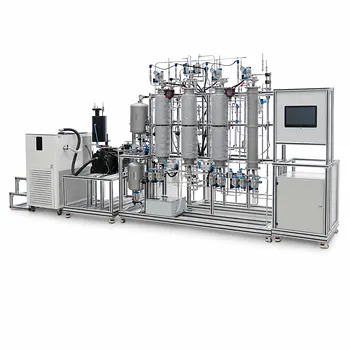
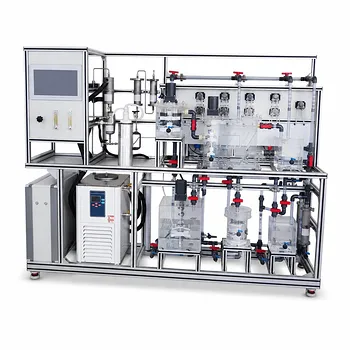
Chemical absorption doesn't just dissolve a gas—it actively consumes it.
By reacting the dissolved gas with a component in the liquid solvent, the process keeps the solute concentration at the interface far below equilibrium. This amplifies the driving force for mass transfer and slashes the liquid‑side resistance, resulting in a much higher overall absorption rate. In pilot plants, you quantify this boost by running parallel physical and chemical experiments, calculating the enhancement factor (\beta), and dissecting how reaction kinetics, heat effects, and column hydraulics transform a simple solubility‑limited operation into a high‑efficiency separations tool.
Chemical absorption enhances mass transfer by maintaining a steep concentration gradient and reducing liquid‑phase mass transfer resistance. Pilot plants let you measure and optimize this effect through controlled comparative tests, turning the chemical enhancement factor (\beta) into an actionable design parameter.
Why Chemical Absorption Outperforms Physical Absorption
The Fundamental Difference in Driving Force
In physical absorption, the dissolved gas concentration at the interface is set by Henry’s Law. The solute simply accumulates in the liquid until equilibrium halts the process.
In chemical absorption, a reactive component in the solvent immediately consumes the dissolved solute. This lowers the interfacial concentration of free solute to near zero, continually refreshing the driving force. The result is a much steeper concentration gradient that pushes more gas into the liquid per unit time.
Reducing Liquid‑Phase Resistance
Mass transfer in gas‑liquid systems often faces its biggest bottleneck in the liquid‑side boundary layer. Physical absorption leaves that layer saturated with solute, throttling the transfer rate.
Because the chemical reaction scavenges solute right inside the liquid film, the effective liquid‑phase mass transfer resistance drops dramatically. The overall mass transfer coefficient increases, and in many systems the controlling resistance shifts from the gas film to liquid‑phase reaction kinetics—a fundamentally more efficient regime.
The Enhancement Factor (\beta): Quantifying the Gain
The enhancement factor (\beta) is the ratio of the liquid‑side mass transfer rate with reaction to that without reaction. It is the multiplier that turns the physical absorption coefficient (k_L) into the effective coefficient (\beta k_L).
You can calculate (\beta) using the double‑film, penetration, or surface renewal models. For an irreversible pseudo‑first‑order reaction, these models agree within less than 10% across typical operating ranges. This allows you to use the mathematically simpler double‑film model in pilot‑plant work without sacrificing practical accuracy.
How Pilot Plants Decode the Process
Running Side‑by‑Side Physical and Chemical Experiments
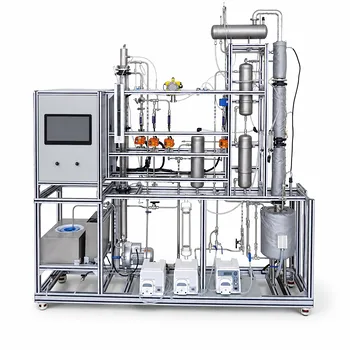
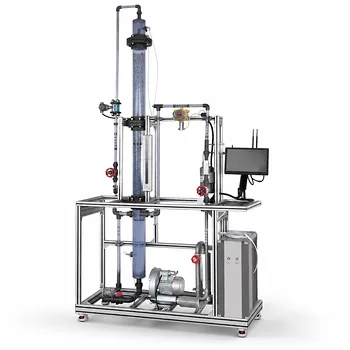
A unit‑operations absorption pilot plant lets you swap solvents and feed gases in a controlled loop. You first absorb CO₂ into pure water—a physical process governed strictly by temperature and pressure.
Then you introduce an alkaline solution like sodium hydroxide. Immediately, the measured absorption rate and outlet gas composition change drastically. By comparing the two runs, students and researchers directly observe how a chemical reaction accelerates uptake and quantify the gain through mass transfer coefficients.
Critical Instrumentation for Accurate Analysis
Pilot plants are instrumented to capture the “fingerprint” of chemical enhancement. In‑line gas and liquid concentration sensors at the column inlet and outlet track exactly how much solute is removed. Flow meters maintain steady liquid and gas loads, while temperature probes along the column map the reaction exotherm.
These measurements let you calculate local and overall mass transfer coefficients, validate the enhancement factor, and assess non‑isothermal effects. For a reactive system like CO₂‑NaOH, the temperature profile itself becomes a powerful qualitative indicator of reaction rate and mixing efficiency.
Exploiting Different Absorber Configurations
Choosing the right laboratory absorber shapes what you learn. A stirred cell gives excellent control over gas‑ and liquid‑film resistances independently. A wetted‑wall column provides a known interfacial area and short contact times typical of some industrial packings. A laminar jet with millisecond contact times isolates liquid‑film kinetics from bulk convection.
Each device targets a different mass transfer regime. By running chemical absorption across multiple configurations, you can decouple reaction kinetics from hydrodynamics and extract intrinsic rate constants—essential for reliable scale‑up.
Understanding the Trade‑offs and Pitfalls
Heat Management
Chemical absorption is often exothermic. An uncontrolled temperature rise can alter reaction equilibria, shift the enhancement factor, and even cause solvent degradation. Pilot plants without sufficient cooling or precise temperature control will produce data that misrepresent large‑scale performance.
Solvent Equilibrium and Reversibility
Not all chemical absorption systems are thermodynamically favorable for regeneration. If the reaction product is too stable, solvent recovery becomes energy‑intensive. Pilot studies must look beyond momentary mass transfer enhancement to the full regeneration cycle; otherwise, a highly enhanced absorber can turn into an uneconomical process.
Model Lift‑over and Assumptions
The enhancement factor models assume an irreversible pseudo‑first‑order reaction and constant physical properties. Real solvents may deviate due to concentration‑dependent diffusivities or reversible reaction pathways. Use the model agreement (<10%) as a screening tool, but always verify against pilot data under conditions that mimic your target application.
Instrumentation Lag and Liquid‑Phase Sampling
Chemical reactions can be fast—often faster than sensor response times. In such cases, direct measurement of liquid‑phase solute concentration becomes challenging. Pilot designs often rely on gas‑phase analysis and overall material balances, introducing uncertainty that must be accounted for when reporting (\beta) values.
Making the Right Choice for Your Pilot Plant Study
If your primary focus is quantifying enhancement: Run the same gas through a physical solvent and a reactive solvent under identical hydrodynamic conditions, then calculate (\beta) directly from the measured outlet concentrations and liquid‑side coefficients.
If your primary focus is screening candidate solvents: Equip the pilot plant with precise chemical dosing and temperature control. Measure the temperature profile and outlet gas composition for each solvent to rank them by both mass transfer rate and regeneration potential.
If your primary focus is educational demonstration: Choose a simple, visually dramatic system like CO₂/NaOH. Compare a plain water run to an alkaline run—the drop in CO₂ concentration and the column temperature rise make the concept unforgettable.
If your primary focus is scale‑up design: Use a stirred cell or wetted‑wall absorber to extract intrinsic kinetic data. Pair that with a pilot‑scale packed column to validate the enhancement factor under realistic fluid mechanics before committing to a full‑size design.
Mastering chemical absorption in a pilot plant means not just observing a faster process, but understanding why it is faster and how to harness that acceleration reliably in a real‑world separation.
Summary Table:
| Feature | Physical Absorption | Chemical Absorption |
|---|---|---|
| Driving Force | Equilibrium solubility limit (Henry's Law) | Solute reaction continually refreshes driving force |
| Liquid-Side Resistance | High (bottleneck in boundary layer) | Low (reaction is key to reducing film resistance) |
| Transfer Coefficient | Standard coefficient ($k_L$) | Enhanced coefficient ($\beta k_L$) |
| Pilot Measurement | Focus on temperature, pressure, and solubility | Focus on chemical enhancement factor ($\beta$) and kinetics |
Optimize Your Separation Processes with LABPARK
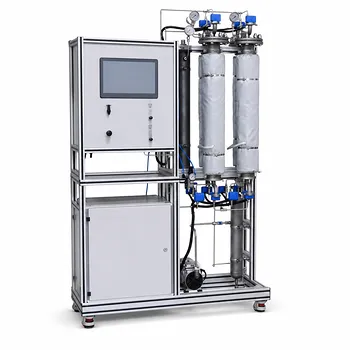
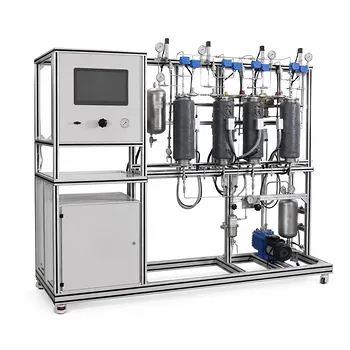
Are you looking to bridge the gap between chemical theory and industrial application? LABPARK provides state-of-the-art Educational and Vocational Unit Operations Pilot Plants in chemical engineering, bioprocess & biotech, and environmental & water treatment.
Designed specifically for universities, research institutes, and enterprises, our pilot plants enable students and researchers to analyze mass transfer kinetics, calculate enhancement factors, and test scale-up designs with reliable, real-world data.
Ready to elevate your laboratory and research capabilities? Contact LABPARK today to discover the ideal pilot plant solution for your institution!
Related Products
- Carbon Dioxide Absorption and Desorption Educational Pilot Plant for Carbon Capture Studies
- Absorption and Desorption Educational Unit Operations Pilot Plant
- Packed Bed Absorption Educational Unit Operations Pilot Plant
- Dual-Mode Gas Absorption and Desorption Unit Operations Training Pilot Plant
- Low Concentration Carbon Dioxide Capture Pressure Swing Adsorption Educational Pilot Plant
People Also Ask
- How does operating pressure influence the transition between absorption and desorption in a CO2 pilot plant?
- How do temperature variations affect CO2 transport models in pilot plants? Model vs Reality
- What unit operations are critical for CCUS training pilot plants? Build hands-on engineering expertise.
- How do electrolytes affect phase equilibrium in absorption pilot plants, and how to calculate it?
- Why is critical surface tension key in column internals? Optimize gas absorption pilot plant efficiency