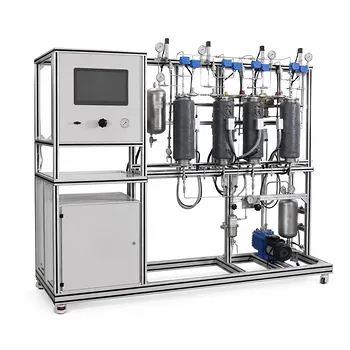
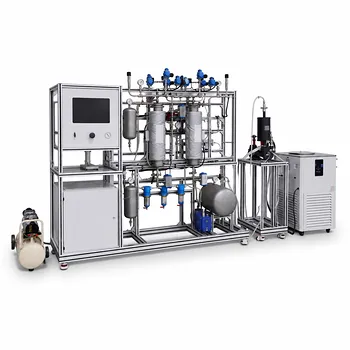
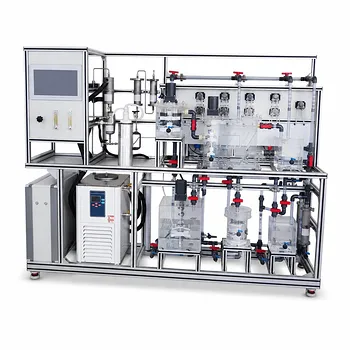
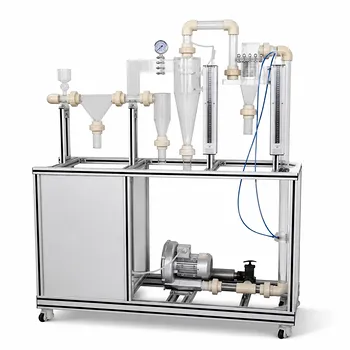
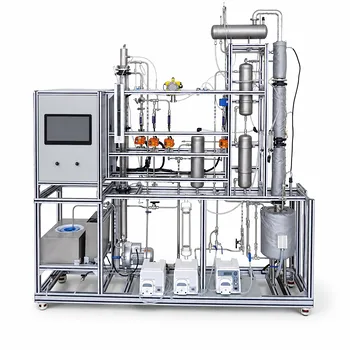
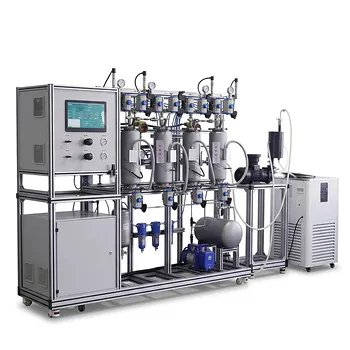
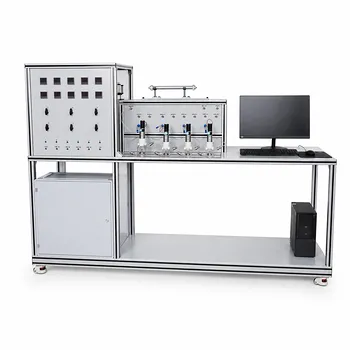
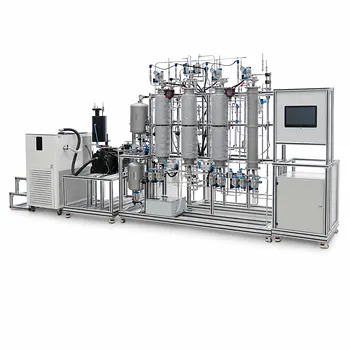
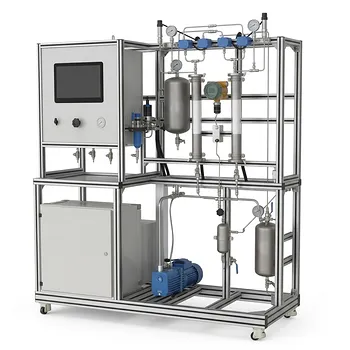
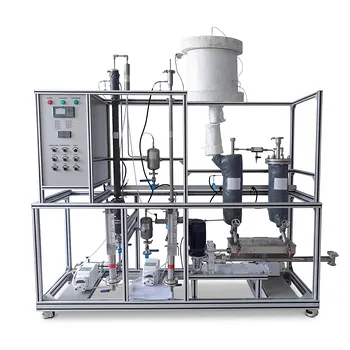
A pilot plant setup for gas cleanup is a live-scale, hands-on laboratory where the environmentally critical unit operations of wastewater treatment become physically tangible. Rather than studying abstract diagrams, the system deliberately generates a real, multi-phase wastewater—laden with condensed unreacted water, fly ash, carbon, dissolved hydrogen sulfide, ammonia, carbon dioxide, and phenolic tars—then forces you to design and operate the very separations that protect receiving waters. The integrated treatment train turns gas impurities into a liquid challenge and immediately demonstrates how gravity separation, sub-micron filtration, and gas stripping work together to transform a toxic liquor into a recyclable or dischargeable effluent.
By pairing an authentic gas cleanup waste stream with a dedicated water treatment pilot plant, the setup replaces textbook theory with direct experience in the unit operations that industry relies on—clarifying how gravity separators, fine filters, and stripping columns bridge the gap between contaminated condensates and environmental compliance.
The Contaminated Water You Actually Have to Treat
The starting point for all downstream learning is a waste stream that mirrors the complexity of real industrial condensates. Without this, any treatment demonstration becomes an oversimplified simulation.
Why the Wastewater from Gas Cleanup is a Perfect Teaching Medium
Gas scrubbing and cooling processes condense water vapor that carries everything the raw gas contained. That means the resulting liquid is not just dirty—it is a layered, dynamic mixture of light oily fractions, dense tarry phenols, fine char particles, and dissolved gases.
This cocktail forces students to confront the same characterization challenges faced in refineries and gasification plants. They must analyze a stream that contains both free and emulsified organics, sub-micron carbon solids that resist simple settling, and volatile dissolved contaminants like ammonia and H₂S that cannot be removed by filters alone.
The Multi-Phase Reality that Drives Unit Operation Selection
Because the wastewater holds immiscible organics both lighter and heavier than water, suspended fine solids, and dissolved gases, no single piece of equipment can clean it. That diversity is precisely what makes the pilot plant an educational powerhouse: it demands a sequence of fundamentally different separation principles, each targeting a specific phase.
The Core Unit Operations Demonstrated in Action
Once the contaminated liquid is produced, the pilot plant reveals how each treatment step physically separates, traps, or volatilizes a distinct class of pollutant. This is where abstract unit operations become muscle memory.
Gravity Separation: Letting Density Do the Heavy Lifting
The first treatment stage often mimics an API separator or a settling tank. Because the waste contains both buoyant oily materials and heavy tarry phenols, the vessel provides sufficient residence time for light organics to rise and dense tar droplets to sink.
Students observe the formation of an oil layer at the top and a dark, viscous bottom phase, directly linking fluid density and residence time to separation. They can vary flow rates and measure how carryover increases when hydraulic loading exceeds the design’s settling velocity—turning an equation on Stokes’ law into a visible outcome.
Filtration: Polishing the Sub-Micron Solids
Even after gravity separation, the water still carries ultra-fine fly ash, carbon, and precipitated metals that will never settle in a reasonable time. The pilot plant incorporates a filtration stage—often a cartridge, bag, or membrane unit—that captures these sub-micron particulates.
Students measure differential pressure across the filter media and watch it climb as solids build a cake. They quickly learn why gravity settling is a necessary pretreatment: without it, the filter would blind in minutes. This drives home the principle of staged separation and the real cost of poor upstream oil‑water separation.
Gas Stripping: Chasing Dissolved Volatiles into the Air
The final demonstrable unit operation addresses the invisible threat: dissolved hydrogen sulfide, carbon dioxide, and ammonia. A stripping column—sometimes packed, sometimes operated with counter‑current air or steam—pulls these dissolved gases out of the liquid phase.
By adjusting the air‑to‑water ratio and monitoring pH changes, students see how ammonia shifts from dissolved ions to free gas. They can measure inlet and outlet concentrations and calculate the strip‑out efficiency for each volatile. This extends the lesson beyond mechanical separation into mass transfer, tying the pilot plant to the same principles used in refinery sour‑water strippers.
Understanding the Trade-offs and Real-World Limitations
No pilot setup perfectly mirrors a 24/7 industrial operation without compromises. Acknowledging these gaps is essential for the learning to translate into responsible engineering.
The Pilot Scale Sacrifices Continuous Steady State for Flexibility
In a full-scale gas cleanup plant, wastewater flows are continuous, compositions change slowly, and operators respond within narrow control bands. A pilot plant often runs shorter campaigns, with manual intervention for sampling and flow changes. This deliberate variability is a strength for learning but means students cannot always appreciate long‑term fouling trends or chemical consumption profiles that define true operating cost.
Safety and Handling of Hazardous Gas Liquors Require Careful Boundary Conditions
The tarry and oily gas liquor contains phenols and dissolved H₂S, which are toxic and odorous. At pilot scale, rigorous containment, ventilation, and personal protective equipment are essential, which can slow down the fast iteration students might want. The educational value depends on treating these hazards not as obstacles but as part of the operational discipline that real plants demand.
Not All Unit Operations Are Represented with the Same Fidelity
Gravity separation, filtration, and gas stripping are the direct demonstrations. Advanced steps like biological treatment, membrane desalination, or deep-bed activated carbon polishing are often modular add‑ons or represented through smaller bench‑scale kits. The core train remains powerful, but a complete zero‑liquid‑discharge picture often requires supplementary experiments or modeling.
Making the Right Choice for Your Learning or Research Goal
The value of a gas‑cleanup‑to‑water‑treatment pilot plant depends entirely on what you need from the experience. Use the following focus points to align your expectations.
- If your primary focus is hands‑on operational skill: Prioritize a pilot plant that lets you physically manipulate valves, start pumps, and observe phase layers in real glass separators. The visceral feedback—oil weir adjustments, rising filter differential pressure, foam in a stripper—is the fastest teacher.
- If your primary focus is process design and optimization: Look for a setup that allows you to take frequent samples and vary critical parameters like residence time, air flow rate, and pH. The data you generate to draw a filtration curve or a stripping efficiency graph is what will anchor your design decisions.
- If your primary focus is meeting environmental discharge limits: Ensure the pilot plant integrates analysis instruments downstream. Being able to measure final phenol, ammonia, and turbidity levels after each unit operation directly shows how the train stacks up against regulation thresholds.
- If your primary focus is wastewater recycling and water reuse: Extend the demonstration with membrane or ion‑exchange modules after the stripping step. The gas cleanup liquor then becomes a challenging feed for advanced purification, linking the initial unit operations to high‑recovery water treatment.
When the sight glass of a gravity separator shows a crisp hydrocarbon interface, and the stripper’s pH confirms ammonia release, the entire sequence of environmental unit operations ceases to be an abstract flow sheet. It becomes a practical skill set for protecting water resources, learned through the very contamination that gas cleanup creates.
Summary Table:
| Unit Operation | Separation Principle | Target Pollutants | Key Learning Metric |
|---|---|---|---|
| Gravity Separation | Density differences & hydraulic residence time | Buoyant light oils, dense tarry phenols | Phase boundary visibility, oil-water interface control |
| Filtration | Physical barrier retention & cake filtration | Sub-micron char, fly ash, suspended solids | Differential pressure climb, membrane blinding |
| Gas Stripping | Gas-liquid mass transfer & pH adjustment | Dissolved gases (ammonia, H₂S, CO₂) | pH shift, air-to-water ratio, stripping efficiency |
Bring Industrial-Scale Learning to Your Laboratory
Bridge the gap between textbook theory and physical engineering with LABPARK. We design and manufacture high-performance Educational and Vocational Unit Operations Pilot Plants tailored for chemical engineering, bioprocess & biotech, and environmental & water treatment applications.
Whether you are a university training the next generation of engineers, a research institute testing novel separation processes, or an enterprise looking to scale up wastewater operations, LABPARK provides the robust, transparent, and flexible pilot systems you need to succeed.
Contact LABPARK Today to Request a Quote
Related Products
- Fixed-Bed Chemical Reaction and Gas Dust Tar Removal Unit Operations Pilot Plant
- Bench Scale Carbon Dioxide Capture Educational Unit Operations Pilot Plant
- Dual-Mode Gas Absorption and Desorption Unit Operations Training Pilot Plant
- Bench Scale Dual Column Gas Separation and Capture Educational Pilot Plant
- Thermal Desorption Exhaust Gas and Tail Water Treatment Educational Pilot Plant
People Also Ask
- When to transition from PID to adaptive control in pilot plants? Key process indicators.
- How do deviations in estimating latent heat impact pilot plant thermal systems? Avoid hardware mis-sizing.
- Why Compare Predicted and Experimental Excess Enthalpy? Key to Accurate Pilot Plant Scale-up
- How to study gasification in pilot plants? Compare exit gas composition & efficiency
- Why Use PTFE & Hastelloy in Chemical Pilot Plants? Prevent Corrosion & Ensure Safety