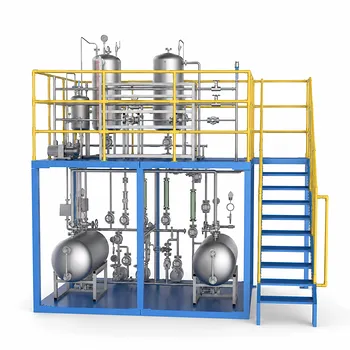
Hybrid separation unlocks the thermodynamic ceiling of distillation.
A hybrid unit that couples distillation and vapor permeation optimizes azeotropic separation by pre-concentrating the feed in the column up to its azeotropic point and then using a membrane to selectively remove the bottleneck component from the overhead vapor. This deliberate load‑balancing strategy minimizes overall energy consumption, reduces the required membrane area, and achieves nearly 100% recovery of the target organic solvent without the need for chemical entrainers.
A hybrid distillation–vapor permeation system is not a workaround—it is a design optimization that splits the separation burden: distillation handles the bulk, energy‑cheap split, while the membrane selectively pierces the azeotropic barrier. The result is a compact, energy‑efficient process that reaches purities and recoveries impossible with either unit alone.
The Azeotrope Bottleneck in Distillation
Why constant‑boiling mixtures halt conventional separation
An azeotrope is a liquid mixture whose vapor phase has the same composition as the liquid at a given pressure.
For a positive azeotrope like ethanol–water, the mixture boils at a lower temperature than either pure component, and further enrichment by simple distillation is thermodynamically impossible.
Once the column top reaches about 95.6 wt% ethanol, no additional trays or reflux will break past that barrier.
The energy and cost trap of traditional workarounds
Old‑generation methods—azeotropic distillation with an entrainer, extractive distillation, or pressure swing—add auxiliary equipment, chemical consumption, and extra thermal duty.
These approaches multiply the operating expense and often create waste streams, undermining the sustainability of the overall process design.
The Hybrid Architecture: Distillation Meets Vapor Permeation
How the distillation column pre‑concentrates the feed
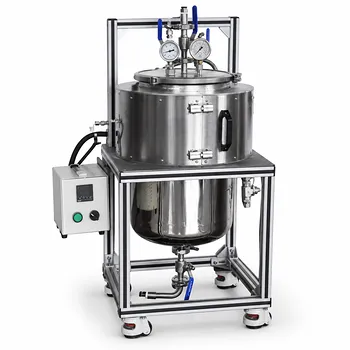
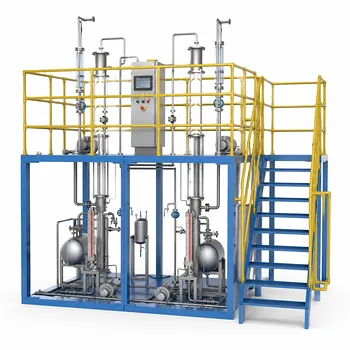
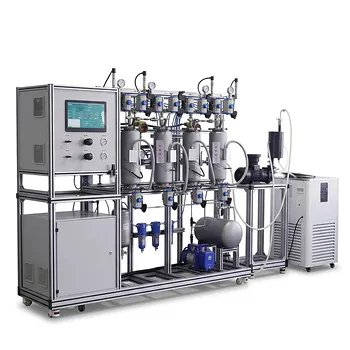
The hybrid pilot plant first uses a standard distillation column to bring the feed mixture as close as possible to its azeotropic composition.
This step exploits the low‑cost bulk‑separation ability of distillation, removing the majority of the less‑volatile component with modest energy input.
The top vapor stream is now at a composition where the membrane can work most efficiently.
The vapor permeation membrane—selective water removal at 100°C
Instead of condensing the overhead vapor, the stream is sent directly to a vapor permeation unit operating around 100°C.
A hydrophilic membrane (often a zeolite layer) selectively permeates water vapor based on differences in sorption and diffusion, not on boiling points.
The membrane acts as a molecular gate that lets water molecules pass faster than the organic solvent, stepping cleanly across the azeotropic wall without any third chemical.
The recycle loop: closing the circle for near‑100% recovery
The permeate—mostly water—is recycled back to the distillation column, while the dried, organic‑rich retentate is the high‑purity product.
Because the membrane‑retentate stream is essentially free of the original solute loss, the overall system reaches nearly 100% solvent recovery.
This recycle integrates the two unit operations into a single, self‑contained separation circuit.
The Optimization Equation: Balancing Separation Loads
Why splitting tasks minimizes overall energy consumption
Distillation is energy‑intensive when pushing purity beyond 90‑95%, while membranes see their productivity plummet if faced with a dilute feed.
By stopping the column at the azeotrope and handing the final polishing to the membrane, the hybrid sidesteps the high‑reflux penalty.
The vapor permeation step itself requires only the energy to maintain the vapor state and the driving force across the membrane—far less than boiling off the entire water content via distillation.
Membrane size and capital cost benefits
Because the membrane treats a stream already near the azeotrope, the water load is sharply reduced.
This shrinks the required membrane area dramatically compared with a standalone pervaporation system that would have to process the raw feed.
Smaller membrane modules lower capital cost, footprint, and the pressure‑drop losses of the vapor circuit.
A capacity boost without extra hardware
Integrating a membrane can increase the processing capacity of an existing distillation train by up to 40%.
The column no longer wastes trays and energy trying to cross an impossible barrier; that freed‑up capacity translates directly into higher throughput for the same equipment size.
Understanding the Trade‑offs
Thermal stability and membrane longevity
Vapor permeation at 100°C demands a membrane that resists thermal degradation.
Zeolite‑based membranes are thermally robust, but polymer‑based ones may swell or lose selectivity over time, requiring a careful material choice.
Pressure drop and auxiliary energy
Driving the vapor through the membrane module introduces a pressure drop that must be compensated—either by a vacuum pump on the permeate side or a slight compression before the unit.
This auxiliary power, though modest, must be counted in the overall energy balance.
Fouling risks in the vapor phase
Even vapor can carry trace contaminants that foul the membrane surface.
Pre‑treatment or periodic cleaning may be needed to maintain stable flux, adding to the operational complexity.
Capital vs. operational expenditure
The upfront cost of the membrane system and its housing can be high.
The investment pays back through substantial energy savings and higher recovery, but the economics require a case‑by‑case assessment—particularly for lower‑value products.
Not every azeotrope is a candidate
The membrane must have sufficient selectivity for the target component.
For some separations no suitable membrane exists, and the hybrid concept cannot be applied until new materials are developed.
Making the Right Choice for Your Process Goal
The optimal configuration depends on whether you are prioritizing energy efficiency, product purity, or zero‑waste operation.
- If your primary focus is drastic energy reduction: Use the hybrid to stop distillation at the azeotrope and let the membrane handle the rest; avoid the high‑reflux trap entirely.
- If your primary focus is chemical‑free absolute purity: The vapor permeation step delivers water‑free product without entrainers, eliminating downstream contamination concerns.
- If your primary focus is maximum recovery and zero solvent loss: Close the recycle loop from permeate back to the column, achieving almost 100% material efficiency.
- If your primary focus is educational or pilot‑scale demonstration: The transparent load‑balancing and measurable energy savings make this an ideal platform for teaching modern process intensification.
The hybrid distillation–vapor permeation unit transforms a fundamental thermodynamic limitation into a design lever—shifting the question from “Can we separate this?” to “How little energy do we need to do it?”.
Summary Table:
| Feature | Traditional Methods (Entrainers/Swing) | Hybrid Distillation-Vapor Permeation |
|---|---|---|
| Separation Mechanism | Chemical additives or pressure changes | Thermal pre-concentration + molecular sieving |
| Energy Consumption | High (high reflux & extra thermal duty) | Low (load-balanced, minimal reflux penalty) |
| Solvent Recovery | Moderate (losses in waste streams) | Up to ~100% recovery via recycle loop |
| Chemical Use | Requires auxiliary entrainers/solvents | Zero chemical additives (eco-friendly) |
| Footprint / CAPEX | Complex multi-column setups | Compact modular membrane addition |
Optimize Your Process Engineering Lab with LABPARK
Looking to demonstrate advanced process intensification like hybrid separation in your curriculum or research? LABPARK provides state-of-the-art Educational and Vocational Unit Operations Pilot Plants in chemical engineering, bioprocess & biotech, and environmental & water treatment.
We help universities, research institutes, and enterprises bridge the gap between theory and industrial reality with high-fidelity, safe, and modular pilot systems that showcase real-world energy savings and separation efficiency.
Ready to upgrade your lab's capabilities? Contact our engineering experts today to find the perfect pilot plant configuration for your needs!
Related Products
- Multi-Modal Distillation Unit Operations Training Pilot Plant
- Binary System Vapor Liquid Equilibrium Data Determination Educational Unit Operations Pilot Plant
- Continuous Sieve-Plate Distillation Pilot Plant for Unit Operations Laboratory Education
- Green Anhydrous Ethanol Purification Extractive Distillation Unit Operations Training Pilot Plant
- Dual-Mode Rectification Pilot Plant for Practical Training Unit Operations
People Also Ask
- How can energy balance equations for condensers & reboilers be validated experimentally? Guide
- How can real-time carbon number prediction improve distillation pilot plants? Optimize control.
- Why is vacuum operation capability an essential feature for a distillation unit operations pilot plant? Unlock Efficiency
- How does catalyst water concentration affect distillation pilot plant design? Key separation train choices.
- What are the primary reflux ratio control strategies? Master Distillation Unit Operations