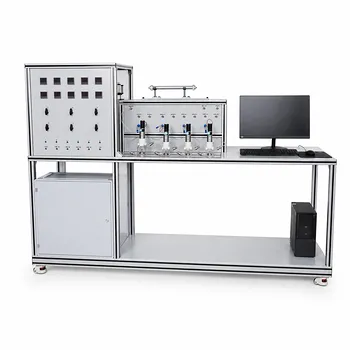
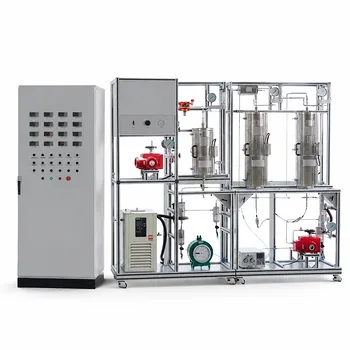
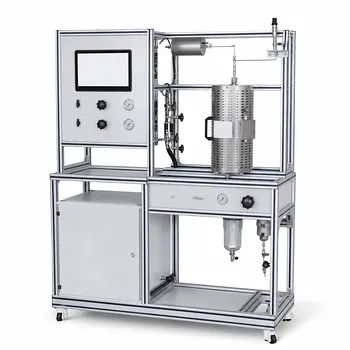
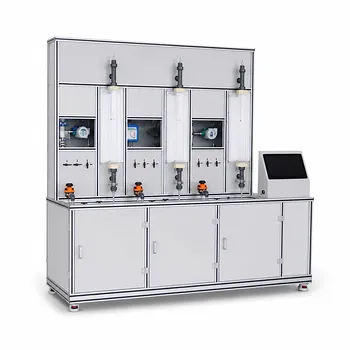
The key to bridging ideal mixing and true plug flow. A pilot plant built with a multi-stage mixed flow reactor (MFR) series lets you directly sample concentration and temperature between each stage, transforming abstract kinetic models into a measurable concentration trajectory. By operating the same chemistry in a single MFR, in a staged series, and in a plug flow reactor (PFR) within the same facility, you can pinpoint exactly how residence time distribution and backmixing influence conversion, selectivity, and overall yield under your chosen kinetic regime.
The core value is that a cascaded MFR train systematically reduces backmixing. As the number of stages increases, the overall flow behavior and the resulting concentration profile approach that of a PFR. This one platform therefore enables a side‑by‑side experimental gradient—from fully mixed to near‑plug‑flow—giving you the data needed to separate intrinsic kinetics from mixing artifacts, validate rate laws, and design the optimum reactor configuration for maximum yield.
Turning Each Stage into a Kinetic Data Point
Sampling the Reaction Pathway Without Guessing
In a single MFR, the entire reaction volume experiences the same exit concentration. You get one data point per run. With a series of well‑mixed stages, samples taken at the outlet of each stage give you a stepwise map of how concentration changes along the reaction coordinate. This discrete concentration profile allows you to calculate reaction rates at multiple conversion levels from a single steady‑state experiment, dramatically reducing the number of runs needed to fit rate expressions.
Progressively Shifting Performance Toward Plug Flow
The theoretical behavior of an MFR cascade is well established: more stages reduce the overall residence time distribution, pushing the system’s performance envelope toward that of an ideal PFR. On your pilot plant, you can operate with one stage (a single CSTR), then two stages, then four, and finally compare the data with a tubular PFR using the same catalyst and feed. The measured conversions and selectivities will show a clear trend, allowing you to quantify exactly how many stages are required to approach plug‑flow results for your specific reaction order and kinetic parameters.
Validating Rate Laws Against Measurable Gradients
When you suspect a complex kinetic network—such as an intermediate that can over‑react to an unwanted byproduct—the staged MFR becomes an experimental truth‑check. You can compare the measured concentration of the intermediate at each stage with predictions from your kinetic model. Systematic deviations will reveal whether the model is missing an inhibition term, a parallel pathway, or a mixing effect. Because you are seeing concentration changes unfold in steps, you can back‑calculate local rates without relying on a fully integrated PFR design equation.
Turning Staging into a Yield‑Optimization Tool
Controlling Selectivity for Series and Parallel Networks
Supplementary pilot‑plant research underscores that series reactions (A → R → S) are highly sensitive to backmixing: any fluid that spends longer in a highly backmixed vessel will convert more of the desired intermediate R to the waste product S. By running the same chemistry in a multi‑stage MFR, you can limit backmixing to that which occurs inside each individual stage. Increasing the number of stages progressively narrows the residence time distribution, boosting the yield of R. For parallel reactions where the undesired path has a different reaction order, the stepwise change in concentration—and in each stage’s individual feed composition—lets you explore how local concentration influences the selectivity split, a direct leverage point for yield improvement.
Identifying Where Transport, Not Chemistry, Limits the Rate
Even a perfectly designed kinetic model can fail if the reactor is mixing‑controlled. The pilot plant’s ability to operate each stage with independent agitation allows you to run replicate experiments at different stirrer speeds—for example, 200 rpm versus 1000 rpm. If the conversion per stage or the product quality changes noticeably with rpm, the reaction rate is being throttled by mesomixing or micromixing near the feed zone, not by chemical kinetics alone. In a staged train, you can isolate the mixing effect to specific conversion levels, enabling you to decide whether reactor engineering or kinetic refinement is the real path to higher yield.
Understanding the Trade‑offs
The Price of Staging in Volume and Complexity
A classic engineering fact is that for a given conversion, a series of MFRs will always require a larger total reactor volume than a single PFR, especially when the number of stages is small. The pilot plant makes this visible: you can measure the volume‑versus‑stages trade‑off directly and weigh it against the yield benefit. Additionally, more stages mean more vessels, inter‑stage piping, pumps, and instrumentation—increasing capital footprint and control complexity. The staged setup is ideal for study, but the optimal commercial design might converge to fewer, larger stages or a different reactor type altogether.
When the Assumption of Perfect Mixing in a Stage Breaks Down
Each stage in the cascade is treated as an ideal MFR. In reality, short‑circuiting, dead zones, or poor macromixing can cause the actual stage performance to deviate from the perfect‑mixing assumption. A pilot plant with transparent vessels or tracer‑injection ports can reveal these non‑idealities. If a stage’s measured conversion is lower than the kinetic model predicts for a perfectly mixed volume, the true active volume is being compromised—a critical insight that prevents scale‑up surprises.
How to Apply This to Your Research or Development Goals
- If your primary focus is deriving intrinsic rate laws: Operate the pilot plant with multiple MFR stages and compare the data to a single‑stage CSTR and a PFR. Use the concentration profile from the cascade to fit kinetic parameters, and validate by checking if the model correctly predicts the PFR result.
- If your primary focus is maximizing the yield of an intermediate in a series reaction: Use the staged train to map intermediate concentration versus stage number. Gradually increase the number of stages until the intermediate yield plateaus; that point tells you the minimum backmixing your process needs to be economically viable.
- If your primary focus is diagnosing whether the process is mixing‑limited: Run the same cascade experiment at widely different agitator speeds while keeping feed rate and temperature constant. A strong rpm dependence flags the need for feed‑zone redesign or higher power input, rather than further kinetic optimization.
- If your primary focus is scaling down to teach or demonstrate principles: Use the pilot plant to let operators and students physically sample intermediate streams, directly seeing how stage number, temperature, and mixing control the final yield and purity.
The multi‑stage MFR pilot plant bridges the gap between idealized textbooks and messy reality—giving you the experimental clarity to choose the right kinetic model and the right reactor configuration for the yield that actually matters.
Summary Table:
| Reactor Configuration | Flow Behavior | Key Benefit for Yield & Kinetics |
|---|---|---|
| Single MFR (CSTR) | Fully backmixed | Provides baseline kinetic data; subject to high backmixing. |
| Multi-Stage MFR Series | Cascaded gradient | Stepwise concentration mapping; limits backmixing to optimize intermediates. |
| Plug Flow Reactor (PFR) | No backmixing (ideal) | Yield comparison baseline; maximizes conversion for plug-flow kinetics. |
Accelerate Your Chemical Engineering Research & Training
Are you looking to bridge the gap between theoretical reaction kinetics and real-world process scale-up? LABPARK provides state-of-the-art Educational and Vocational Unit Operations Pilot Plants in chemical engineering, bioprocess & biotech, and environmental & water treatment.
Designed specifically for universities, research institutes, and enterprises, our pilot plants empower your students and researchers to master reactor configuration, optimize yields, and diagnose mixing limitations with hands-on, industry-grade equipment.
Ready to elevate your laboratory capabilities? Contact LABPARK today to find the perfect pilot plant solution for your institution!
Related Products
- Multi-Stage Stirred Tanks in Series Residence Time Distribution and Mixing Performance Determination Educational Pilot Plant
- Gas Phase Mixing and Residence Time Distribution Determination Educational Unit Operations Pilot Plant
- Residence Time Distribution and Reactor Flow Characteristics Determination Educational Pilot Plant
- Multi-Reactor Educational Pilot Plant for Reaction Engineering Unit Operations
- Crude Benzene Hydrogenation Educational Unit Operations Pilot Plant
People Also Ask
- How does MRF model impeller rotation in CFD? Key Boundary Conditions Explained
- How can a CSTR pilot plant demonstrate reactor staging? Visualize volume savings.
- How does steady-state multiplicity affect the operation and safety of exothermic reactions within a CSTR pilot plant? - Guide
- What parameters to monitor transitioning from Batch to CSTR? Master Pilot Plant Setup
- Why is temperature regulation via a cooling jacket a critical feature in CSTR pilot plants used for laboratory training?