Predicting solvent flux in organic solvent nanofiltration is less about picking a “better” equation and more about choosing a description of physics that respects membrane swelling. In pilot plants, the classic one-parameter Hagen-Poiseuille model consistently fails because it forces a constant, average permeability onto a polymer matrix that physically reshapes itself in different solvents. The solution-diffusion model — and carefully modified two-parameter pore-flow variants — succeed because they embed the thermodynamic and structural consequences of swelling directly into the prediction.
The core difference is not mathematical complexity, but whether the model treats the membrane as a static sieve or as a dynamic material that interacts with each solvent. Swelling makes the static-sieve assumption useless. For accurate pilot-plant predictions, you need a framework — most often solution-diffusion — that lets each pure solvent’s permeability tell you how much the membrane swelled in that solvent, rather than forcing all solvents to share a single, imagined pore size.
Understanding the Two Transport Paradigms
To see why swelling breaks one model and not the other, you first need to separate the physical assumptions each model makes.
The Pore-Flow Model Assumes Stable, Pressure-Driven Channels
In its simplest form, the Hagen-Poiseuille model pictures the membrane as a bundle of fixed cylindrical pores. Flux is driven purely by a pressure gradient, and the only fluid property that matters is viscosity.
This is the fundamental mismatch with organic solvent nanofiltration. OSN membranes are polymeric, and when they contact a solvent, the polymer chains relax and the “pores” change dimension. The one-parameter version uses a single average permeability for all solvents, completely blind to that structural shift.
Not All Pore-Flow Models Are Equally Blind
A modified two-parameter Hagen-Poiseuille approach can recover predictive accuracy. It introduces a parameter that explicitly captures solvent-polymer interactions — essentially a composition-dependent membrane permeability. For certain binary mixtures like toluene/ethyl acetate, such a model can match or even slightly outperform solution-diffusion predictions.
The key takeaway: saying “Hagen-Poiseuille fails in OSN” is too broad. The one-parameter variant fails. Two-parameter, swelling-aware formulations can be viable, but they require additional experimental input.
The Solution-Diffusion Model Embraces the Membrane as a Participating Phase
The solution-diffusion model treats the membrane’s active layer as a dense, non-porous film. Transport is a three-step sequence: the solvent dissolves into the polymer matrix, diffuses down a chemical potential gradient, and desorbs on the permeate side.
Because the driving force is a concentration (activity) gradient, not a pressure-driven flow through static pores, the model naturally absorbs swelling. Each pure solvent has its own permeability, which implicitly encodes the degree to which that solvent opens the polymer chains. When you predict a mixture flux, you’re combining the individual, swelling-informed permeabilities — so the model inherently respects the membrane’s altered state.
Why Swelling Makes or Breaks Predictions
Swelling is not a minor correction; it redefines the transport medium. Ignoring it turns straightforward pilot-plant data into misleading trajectory.
Swelling Rewrites the Membrane’s Geometry
When a solvent permeates a polymer matrix, it increases the free volume between chains — effectively widening any nanoscale pathways. That means the membrane’s “pore radius” in a Hagen-Poiseuille sense is now a function of the solvent mixture, not a constant.
A one-parameter model forces the membrane’s structural resistance to be identical for methanol and toluene, even if one causes twice the swelling. The resulting flux predictions can easily be off by hundreds of percent.
Two-Parameter Models Restore a Physical Link to Swelling
To fix this, you move from a single average permeability to a model that uses pure-solvent permeabilities as independent references. In the solution-diffusion framework, those permeabilities are already your two (or more) parameters; in a modified pore-flow model, you introduce a swelling coefficient that adjusts the physical properties of the membrane with solvent composition.
In both cases, you are no longer pretending the membrane is the same for every solvent. You are explicitly telling the model, “In solvent A, the membrane looks like this; in solvent B, it looks like that — now predict the mixture.”
The Material Dictates How Much This Matters
For rigid, low-swelling membranes like crosslinked polyimides (swelling below 15%), the simple solution-diffusion model is remarkably effective. The matrix changes little, so the model’s built-in swelling account is sufficient.
For highly swollen, rubbery materials like polydimethylsiloxane (PDMS), even standard solution-diffusion starts to strain. The solvent uptake is so large that specialized swollen-rubber models, which factor in the thermodynamic activity of the solvent inside the polymer, become necessary to avoid systematic errors.
Understanding the Trade-offs in a Pilot Plant
Your choice of model directly shapes how you interpret experiments and scale up the process. Overlooking the limitations leads to false confidence.
Compaction Blurs the Boundary Between the Models
Operating above 20 bar can compact the membrane, squeezing the porous support and reducing free volume in the active layer. This increases membrane resistance, which from a resistances-in-series perspective diminishes the relative contribution of boundary-layer effects. Both solution-diffusion and pore-flow models that assume a constant membrane structure will then drift from reality — this time because pressure, not just solvent, is altering the membrane.
Viscosity Alone Cannot Explain Flux Rankings
Viscosity explains the pressure drop through a static pore, but OSN fluxes often rank differently than viscosity alone would predict. Resistance-in-series models show that surface tension differences between the solvent and membrane, plus thermodynamic activities, strongly influence overall transport. Swelling, again, sits at the center: it changes both the viscous resistance (by altering pore dimensions) and the surface-layer resistance (by modifying the polymer surface’s interaction with the solvent).
Picking a Model Also Picks Your Experimental Validation Strategy
If you assume solution-diffusion, you will plot flux against concentration-driven driving forces and look for linearity. If you assume a two-parameter pore-flow model, you will track how membrane properties vary with solvent composition. The model you suspect true condition what data you collect on the pilot unit — and how you explain deviations.
Making the Right Choice for Your OSN Pilot Plant
Your goal dictates which framework will serve you best. Align the model to the problem, not the other way around.
- If your primary focus is a rigid, low-swelling membrane (e.g., crosslinked polyimide): Lean on the solution-diffusion model. Its pure-solvent permeability approach will give reliable mixture predictions and is straightforward to parameterize from simple permeability experiments.
- If your primary focus is a highly swollen, rubbery membrane (e.g., PDMS): Move beyond basic solution-diffusion. Use a swollen-rubber model or a two-parameter pore-flow model that explicitly captures solvent uptake and the resulting matrix expansion.
- If your primary focus is educational proof-of-concept or model discrimination: Run pressure‑flux experiments with a single solvent, then a binary mixture. Plot flux vs. pressure to test for linearity (suggesting pore-flow) versus a plateau or nonlinearity (suggesting solution-diffusion), and compare both models’ predictions against the mixture data.
- If your primary focus is scaling up from pure-solvent data to real solvent mixtures: Select the solution-diffusion framework. It inherently embeds the thermodynamic dissimilarity between solvents and requires no arbitrary mixing rule for membrane structure — making it the safer choice for design.
By anchoring your model in the reality of membrane swelling, you turn pilot-plant data into a trustworthy blueprint for full-scale OSN performance.
Summary Table:
| Model | Membrane Assumption | Swelling Integration | Ideal Application |
|---|---|---|---|
| 1-Param Hagen-Poiseuille | Static pores, fixed radius | None (ignores swelling) | Rigid, non-swelling systems |
| 2-Param Hagen-Poiseuille | Dynamic pores, variable radius | Partial (via composition parameter) | Specific binary mixtures |
| Solution-Diffusion | Dense, non-porous polymer | Implicit (via pure-solvent permeability) | Rigid, low-swelling membranes (e.g., Polyimide) |
| Swollen-Rubber Models | Highly swollen, dynamic matrix | Explicit (thermodynamic solvent activity) | Rubbery, high-swelling membranes (e.g., PDMS) |
Bridge the Gap Between Theory and Scale-Up with LABPARK
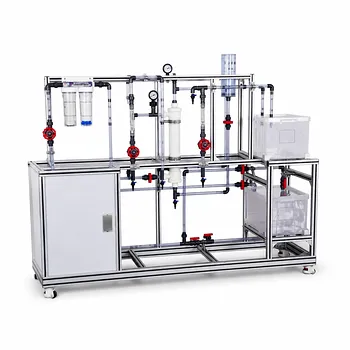
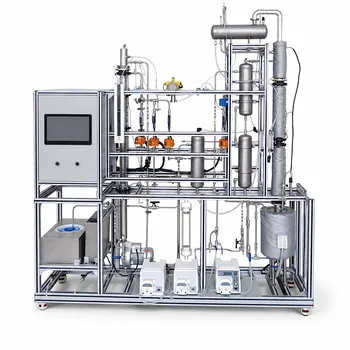
Accurate transport modeling requires high-precision experimental data. LABPARK provides premium Educational and Vocational Unit Operations Pilot Plants in chemical engineering, bioprocess & biotech, and environmental & water treatment. Specifically designed for universities, research institutes, and enterprises, our systems offer:
- Real-World Modeling: Reliable testing grounds to study membrane swelling, compaction, and flux prediction.
- Robust Construction: Industrial-grade components scaled for safe, educational, and research-focused environments.
- Tailored Solutions: Customizable configurations to match your exact curriculum or research objectives.
Accelerate your research and training outcomes—contact our technical experts today to discuss your project requirements!
Related Products
- Multifunctional Membrane Separation Educational Pilot Plant with Ultrafiltration, Nanofiltration, Reverse Osmosis
- Multi-Functional Membrane Separation Educational Pilot Plant for Unit Operations Lab
- Ultrafiltration Membrane Separation Educational Pilot Plant
- Hollow Fiber Ultrafiltration Membrane Separation Educational Pilot Plant
- Multi Functional Membrane Crystallization Educational Unit Operations Pilot Plant
People Also Ask
- Pervaporation vs. Vapor Permeation: Handling Suspended Solids in Membrane Pilot Plants
- How do PEI, PVDF, and PSU membranes compare in pilot plants? Find the best fit.
- What are the trade-offs of polymer vs inorganic membranes in teaching pilot plants? Key laboratory comparison.
- What are the key flow configuration loops in membrane pilot plants? Optimize Performance
- How can operators optimize operating conditions and cleaning protocols in membrane separation pilot plants to mitigate fouling?