For a gas absorption pilot plant handling the ammonia-carbon dioxide-water system, the Guggenheim and Pitzer equations are the critical tools that translate solution chemistry into usable vapor-liquid equilibrium data. They correct the non-ideality of the electrolyte solution, allowing you to predict the equilibrium partial pressures of NH₃ and CO₂ that govern column design, minimum solvent flow rates, and absorption efficiency. The key operational rule is a hard concentration boundary: the simple, empirical Guggenheim equation is sufficient for dilute ionic solutions, but as the ionic strength climbs above roughly 2 molal, you must switch to the more rigorous, semi-theoretical Pitzer model to avoid significant prediction errors.
The choice between Guggenheim and Pitzer is fundamentally a boundary problem. Guggenheim delivers fast, adequate accuracy for teaching and dilute pilot studies, while Pitzer is mandatory for the concentrated solutions encountered in industrial acid gas removal research and scale-up.
The Hidden Complexity of a Three-Component System
Ammonia-carbon dioxide-water is not a simple physical absorption. It is a reactive electrolyte system where dissolved gases immediately dissociate and react, forming a soup of ionic and molecular species.
The Chemistry That Drives the Equilibrium
When NH₃ and CO₂ dissolve, they produce ammonium (NH₄⁺), carbamate (NH₂COO⁻), bicarbonate (HCO₃⁻), and carbonate (CO₃²⁻) ions. The total ionic strength can quickly exceed 2 molal in practical scrubbing liquors. The vapor-liquid equilibrium (VLE) is not just about Henry’s law constants for the gases—it is inextricably linked to the liquid-phase chemical reactions and the non-ideal behavior of the resulting electrolyte solution. Your thermodynamic model must simultaneously solve the chemical reaction equilibria and the physical phase equilibria.
Why You Cannot Ignore Activity Coefficients
In an ideal solution, the partial pressure of a volatile component is directly proportional to its liquid mole fraction. That assumption collapses in a sea of ions.
The Departure from Ideal Raoult’s Law
The strong Coulombic interactions between ions dramatically reduce the effective concentration, or activity, of the species. Using raw molarity or molality in your VLE calculations will give you wildly inaccurate partial pressures and, consequently, a useless column design. You must replace the concentration with the activity, which requires a model for the activity coefficient (γ). This is where the Guggenheim and Pitzer equations become non-negotiable.
The Guggenheim Equation: A Practical Starting Point
For many educational and research pilot plants, the Guggenheim equation is often the first tool you reach for, and for a good reason. It is the simplest upgrade from the theoretical Debye-Hückel limiting law.
An Empirical First-Order Correction
The Debye-Hückel theory only works for extremely dilute solutions. The Guggenheim equation adds an empirical, linear correction term (often written as bI) to the theoretical square-root-of-ionic-strength dependence.
The Clear Accuracy Boundary
This approach works well up to ionic strengths of about 1 to 2 molar, perfectly matching the conditions of a dilute scrubbing experiment. It's straightforward to code into a pilot-plant data analysis script and requires only a few interaction parameters. However, the primary reference is unequivocal: for highly concentrated solutions with molalities above 2, the Guggenheim correlation deviates significantly and leads to design errors.
The Pitzer Model: Precision for High-Concentration Design
When your pilot plant is evaluating the highly concentrated solvents needed for industrial gas scrubbing, you cross into the domain of the Pitzer model.
A Semi-Theoretical Framework for Aggressive Solvents
The Pitzer equation is not a simple band-aid on Debye-Hückel; it is a semi-theoretical virial expansion that models the physics of short-range ion-ion and ion-molecule interactions. It introduces binary and ternary interaction parameters (β⁰, β¹, C^φ) that capture the specific chemistry of the solution far more accurately at high molalities.
Why Concentrated Systems Require Pitzer
In a concentrated NH₃-CO₂-H₂O pilot plant, the interactions between ammonium, carbamate, and carbonate ions are dominant and cannot be approximated by a single empirical term. The Pitzer model directly accounts for these forces, allowing you to reliably predict CO₂ and NH₃ solubility in the rich solvent before the column floods or fails to meet its specification. Supplementary references confirm that models like Pitzer’s are the standard for predicting how changes in solute concentration and temperature govern absorption capacity.
Understanding the Trade-Offs
No model is a perfect mirror of reality. The choice between Guggenheim and Pitzer is a deliberate trade-off between simplicity and accuracy, with concrete implications for your pilot plant’s data quality.
The Cost of Simplicity
The Guggenheim equation’s simplicity is its strength and its fatal flaw. Its single empirical parameter can fit a limited range of data but will extrapolate dangerously outside that range. For a pilot plant testing process variability, relying on Guggenheim for high-loading scenarios will generate a false sense of security about the column’s true thermodynamic limits.
The Price of Rigor
The Pitzer model demands a much larger set of binary and ternary interaction parameters for the complex electrolyte mixture. If these parameters are not available in the literature for your specific system, you cannot guess them. You must either obtain them from targeted experiments or accept that your model, while structurally rigorous, may carry significant parameter uncertainty. Furthermore, the computation is more complex, requiring a more robust solver for the simultaneous phase and chemical equilibria.
Making the Right Choice for Your Pilot Plant Goal
Your thermodynamic model must align with the specific objective of your ammonia-CO₂-water pilot plant campaign. A blanket rule is less effective than a context-driven selection.
- If your primary focus is educational demonstration of a simple process: Use the Guggenheim equation with dilute solvent. It cleanly illustrates activity corrections without burying students in convergence algorithms and large parameter files.
- If your primary focus is initial scoping for a new scrubbing concept: Start with Guggenheim for rapid modeling at low to moderate concentrations to identify feasible operating windows quickly.
- If your primary focus is rigorous validation of scale-up data for industrial design: The Pitzer model is mandatory. It is the only way to trust your measured mass transfer coefficients and projection of column height when operating at the high ionic strengths of real industrial liquors.
- If your primary focus is handling missing VLE data: Do not extrapolate. Use the Pitzer framework with parameters estimated from chemical similarity or binary data, as it offers a more consistent physical basis than the purely empirical Guggenheim term, but always validate against a few key experimental points from your pilot plant.
The boundary isn't just a number—it's a discipline that separates a reliable pilot-plant study from a misleading one. Choose your tool based on the concentration you intend to test, and your results will speak for themselves.
Summary Table:
| Feature | Guggenheim Equation | Pitzer Model |
|---|---|---|
| Accuracy Boundary | Low ionic strength ($\le$ 2 molal) | High ionic strength ($>$ 2 molal) |
| Mathematical Basis | Empirical, first-order correction | Semi-theoretical virial expansion |
| Parameter Requirements | Few interaction parameters | Large set of binary & ternary parameters |
| Primary Application | Educational demos & dilute scoping | Industrial scale-up & concentrated solvents |
Optimize Your Chemical Engineering Lab with LABPARK
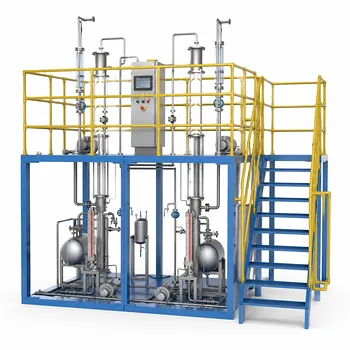
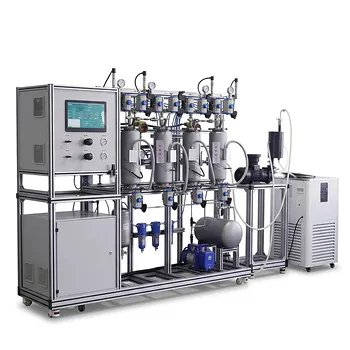
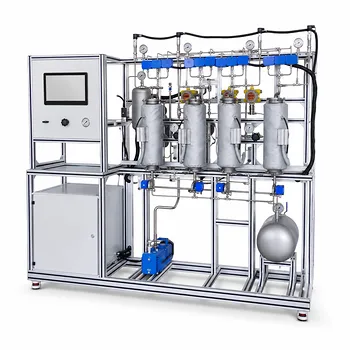
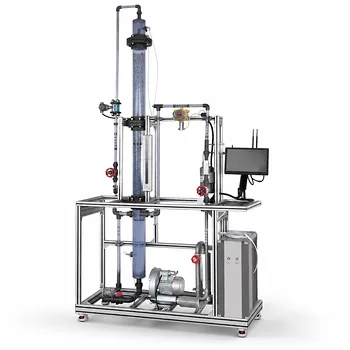
Ready to bridge the gap between thermodynamic theory and practical pilot plant operation? LABPARK provides state-of-the-art Educational and Vocational Unit Operations Pilot Plants in chemical engineering, bioprocess & biotech, and environmental & water treatment.
Designed specifically for universities, research institutes, and enterprises, our systems offer the precision and scalability needed to validate complex models and train the next generation of engineers.
Contact us today to discuss your pilot plant requirements and discover how LABPARK can elevate your research and training capabilities!
Related Products
- Dual-Mode Gas Absorption and Desorption Unit Operations Training Pilot Plant
- Multi-Component Gas Pressure Swing Adsorption Pilot Plant for Unit Operations Education
- Carbon Dioxide Adsorption and Capture Educational Unit Operations Pilot Plant
- Packed Bed Absorption Educational Unit Operations Pilot Plant
- Absorption and Desorption Educational Unit Operations Pilot Plant
People Also Ask
- How do two-film & penetration theories apply to gas absorption pilot plant teaching? Key pedagogical insights.
- How is the direction and driving force of mass transfer determined in a gas absorption unit operations pilot plant?
- How does partial pressure behavior influence gas absorption pilot plants? Master Mass Transfer
- What are the limitations of Henry's Law in gas absorption pilot plants? Avoid critical lab errors.
- How to model chemical absorption as physical absorption? The pilot plant simplification criterion.