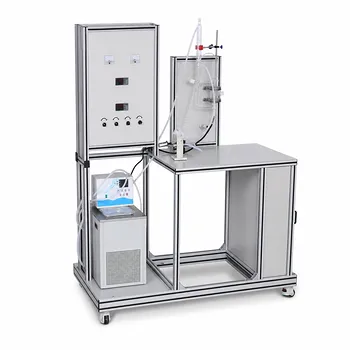
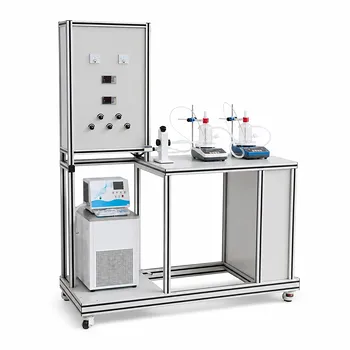
Choosing between NRTL and UNIQUAC is not a matter of one being universally better—it’s about matching the model’s theoretical foundations to the specific phase behavior and data availability of your pilot-plant system. Both models can simulate vapor-liquid (VLE) and liquid-liquid equilibria (LLE), but UNIQUAC offers a more robust mathematical structure that avoids the parameter ambiguity often seen with NRTL, making it the more reliable choice when you must extract unique binary interaction parameters from limited mutual solubility data.
The core distinction lies in the parameterization: NRTL uses three parameters and can thus fit LLE data perfectly yet yield multiple, equally valid parameter sets—a non-uniqueness problem. UNIQUAC, with only two adjustable parameters and a built-in combinatorial term that accounts for molecular size and shape, uniquely defines the system from the same data, giving you more trustworthy predictions for both VLE and LLE across wider conditions.
Understanding the Fundamentals of NRTL and UNIQUAC
Both models describe non-ideal liquid mixtures by calculating activity coefficients from excess Gibbs energy, but they do so with distinct structural philosophies.
The NRTL Model: Handling Liquid-Phase Splitting with Three Parameters
The Non-Random Two-Liquid equation is conceptually intuitive: it introduces a non-randomness factor to account for the local composition of molecules.
It can model binary systems that exhibit a phase-split in the liquid phase, making it directly applicable to ternary systems where liquid-liquid immiscibility is critical, such as in extraction or heterogeneous distillation.
However, this flexibility comes at a cost. The model requires three adjustable parameters per binary pair, and when these are regressed from mutual solubility data alone, the solution is not unique—multiple parameter sets can fit the tie-line data equally well, leading to uncertainty when extrapolating to multicomponent VLE.
The UNIQUAC Model: A More Rigorous Two-Parameter Approach
The Universal Quasi-Chemical model mathematically separates the excess Gibbs function into two distinct contributions: a combinatorial term that accounts for molecular size and shape differences, and a residual term that captures molecular interactions.
This partitioning is its superpower. Because the combinatorial effects are handled explicitly, the model requires only two adjustable parameters per binary.
This simpler parameter space means that when you fit mutual solubility data, you arrive at a unique parameter set—no ambiguity. This gives UNIQUAC a decisive edge in reliability for rigorous process simulation.
Performance in Vapor-Liquid Equilibria (VLE)
Accurate VLE prediction is the bedrock of distillation column design and optimization in any unit operations pilot plant.
Simulating Distillation with Limited Data
When your pilot-plant study focuses on simple distillation of miscible mixtures, both models can deliver excellent activity coefficient predictions.
However, the uniqueness of UNIQUAC parameters becomes invaluable if you are fitting your own experimental VLE data obtained from the pilot plant’s equilibrium cell or batch distillation column.
You can regress the two UNIQUAC parameters with confidence that the model will not introduce hidden numerical artifacts, leading to a simulation that more faithfully maps the actual temperature and concentration profiles of your column.
Cross-Predicting Phase Behavior
A common task is using VLE data to predict whether a system might split into two liquids at a different temperature.
Because NRTL’s parameters can be influenced by a non-unique representation of the non-randomness, its LLE predictions extrapolated from VLE fits can be erratic. The UNIQUAC model, with its foundational separation of combinatorial and residual effects, typically provides a more reliable transition from VLE to LLE predictions, a critical factor for safety and operability analyses.
Performance in Liquid-Liquid Equilibria (LLE)
For liquid-liquid extraction and heterogeneous azeotropic distillation pilots, the accurate prediction of phase splitting and tie lines is non-negotiable.
Modelling Extraction and Decanting Operations
NRTL is widely used and performs exceptionally well for highly non-ideal and partially miscible systems. It can accurately predict the formation of two liquid phases and model heterogeneous azeotropes.
Yet, its parameter non-uniqueness is most pronounced right in this domain. When you derive NRTL parameters from the mutual solubility data of a ternary system like water–acetone–toluene, you might obtain several parameter sets that all reproduce the equilibrium data perfectly.
Choosing the wrong one can cause a decanter simulation to predict the wrong phase volumes or compositions entirely, invalidating your scale-up calculations.
The Uniqueness Problem with NRTL
This is the critical difference. Because UNIQUAC uses only two parameters, the mutual solubility data overdetermines the parameter set, forcing a unique solution.
This means your calculated distribution coefficients and solvent selectivity from a pilot-scale LLE run will be built on a single, unambiguous thermodynamic foundation. When you study ternary-phase diagrams and tie lines, the UNIQUAC model ensures the equilibrium compositions you predict are the only possible outcome from the given model structure.
Understanding the Trade-offs
No model is perfect, and your choice must factor in practical constraints.
Mathematical Complexity vs. Practical Application
The UNIQUAC model is mathematically more complex than NRTL, with equations that can be intimidating. However, modern process simulators handle this complexity automatically.
The real trade-off is in parameter regression: the two-parameter UNIQUAC form is simpler to fit robustly, while the three-parameter NRTL requires careful, often interactive regression to avoid physical meaningless parameter combinations.
Data Requirements and Parameter Regression
Both models rely on Binary Interaction Parameters (BIPs) that must be obtained from experimental data. Pilot plants equipped with VLE cells or fractionation columns are ideal for generating this data.
If your experimental data is abundant and highly accurate, NRTL can be very effective. But if you are working with sparse data, or data limited to a narrow temperature range, the UNIQUAC model’s stricter parameterization acts as a guardrail against overfitting and nonsensical predictions.
When Neither Model is Enough
If you have no experimental data at all, neither model can be directly parameterized. In that case, you can integrate the UNIFAC group-contribution method directly with the UNIQUAC equation to predict the necessary parameters from molecular structure.
Also, for pilot plants operating near supercritical conditions, standard liquid activity models break down; you would need fugacity models like the Chao-Seader or modified Redlich-Kwong equations, or Henry’s Law for light gases.
Making the Right Choice for Your Goal
Your decision should be guided by the specific objectives of your pilot-plant campaign. Use these criteria to match the model to your mission.
- If your primary focus is on rapid screening of concepts for mixed VLE/LLE systems: Start with NRTL if your simulator has a robust databank of pre-fitted parameters for the chemicals in question. This gets you a quick, actionable result to validate feasibility.
- If your primary focus is on generating a unique, trustworthy parameter set from your own mutual solubility or VLE data: Choose UNIQUAC. The two-parameter structure eliminates ambiguity and provides the most reliable foundation for scaling up to production design.
- If your primary focus is on modeling mixtures with components of widely different molecular sizes (e.g., polymer solutions or large bio-chemicals): UNIQUAC is the better choice because its combinatorial term explicitly accounts for size and shape effects, unlike the basic NRTL equation.
- If your primary focus is on educational or vocational reinforcement of thermodynamic theory: Use both and compare. Fitting both models to the same pilot-plant data exquisitely teaches the real-world impact of model selection, showing how non-uniqueness in NRTL manifests and why UNIQUAC’s formal structure leads to better consistency.
Ultimately, mastering the selection and application of these thermodynamic models transforms your pilot plant from a piece of hardware into an instrument for precise scientific inquiry, directly de-risking the path to industrial scale.
Summary Table:
| Feature | NRTL Model | UNIQUAC Model |
|---|---|---|
| Adjustable Parameters | 3 per binary pair | 2 per binary pair |
| Parameter Uniqueness | Low (risk of multiple non-unique fits) | High (guarantees a unique parameter set) |
| Molecular Size & Shape | Accounts for local composition only | Explicitly modeled via combinatorial term |
| Extrapolation (VLE to LLE) | Can be erratic due to parameter ambiguity | More reliable and physically consistent |
| Best Application | Fast screening with existing databank parameters | Rigorous scale-up, LLE extraction, & polymer systems |
Bridge Thermodynamic Theory and Physical Operations with LABPARK
Ready to validate your thermodynamic simulations with high-accuracy experimental data? LABPARK provides state-of-the-art Educational and Vocational Unit Operations Pilot Plants in chemical engineering, bioprocess & biotech, and environmental & water treatment.
Whether you represent a university looking to elevate practical teaching, or a research institute/enterprise seeking to de-risk process scale-ups, our pilot plants deliver the reliable data needed to master complex phase equilibria.
Contact LABPARK today to discuss your laboratory configuration and discover our customized solutions!
Related Products
- Binary System Vapor Liquid Equilibrium Data Determination Educational Unit Operations Pilot Plant
- Ternary Liquid-Liquid Equilibrium Educational Pilot Plant
- Comprehensive Liquid-Liquid Extraction Pilot Plant for Engineering Education
- Quantitative Dosing and Liquid Flow Control Educational Unit Operations Pilot Plant
- Two-Dimensional Fluidization Hydrodynamics Educational Pilot Plant for Unit Operations Training
People Also Ask
- How can pilot plants assist in validating VLE models? Bridge theory and physical reality.
- Why Collect Isothermal vs. Isobaric VLE Data? Key Pilot Unit Advantages
- How Do Equations of State Predict VLE in Pilot Plants? Optimize Your Separation Design
- How do intermolecular forces and molecular kinetic energy govern gas liquefaction and vaporization? Explore VLE pilot plants
- For VLE Experiments: Fugacity vs. Activity Coefficient Method Selection Criteria