The short answer is that in laminar film condensation, the heat transfer coefficient drops as the film thickens, but once the film becomes turbulent, the coefficient rises again due to intense mixing within the liquid.
This counterintuitive reversal stems from a fundamental shift in how heat is transported. Under laminar flow, the condensate moves in orderly layers, and heat must slowly conduct through a thickening film. When turbulence kicks in, eddies shatter those layers, slashing the thermal resistance and sharply improving heat transfer. In educational pilot plants, students can directly observe this transition by manipulating the condensation load and plotting how the heat transfer coefficient changes with film Reynolds number.
The core insight is that the condensate film’s flow regime acts as a switch: below a Reynolds number of about 1800, a thicker film insulates and lowers performance; above that threshold, turbulent mixing breaks the insulating barrier and boosts the coefficient. A well‑designed pilot plant makes this invisible physics tangible, letting students trace the classic Nusselt theory and the Badger correlation on a single graph.
The Physics of Laminar Film Condensation
When vapor condenses on a cool vertical tube, the liquid drains downward under gravity. In the early stages, this film is thin and smooth.
Nusselt’s Theory and the Thickening Film
Nusselt’s classical analysis assumes the film flow is perfectly laminar and that heat is removed only by conduction across the liquid.
As more vapor condenses, the film grows thicker further down the tube.
This increased thickness adds thermal resistance because heat must now travel through a longer, purely conductive path.
Consequently, the local heat transfer coefficient decreases as the film builds up.
Why a Thicker Film Reduces Heat Transfer
In a laminar film, fluid layers slide past each other without mixing.
There is no mechanism to carry hot liquid from the wall outward or to bring cooler liquid to the interface—heat moves only by molecular conduction.
Therefore, the heat transfer coefficient is inversely proportional to film thickness.
The longer the vertical tube, the thicker the pool of condensate at the bottom, and the lower the overall average coefficient becomes.
The Turbulent Transition and Enhanced Performance
As the condensation rate rises, the film’s flow velocity and thickness increase. Eventually, the orderly layers break down into chaotic, turbulent motion.
The Reynolds Number Threshold
The film Reynolds number (Re) is the key metric that signals this change.
It is typically defined as ( Re = \frac{4\Gamma}{\mu_L} ), where ( \Gamma ) is the condensate mass flow rate per unit tube perimeter and ( \mu_L ) the liquid viscosity.
When Re stays below roughly 1800, the film is considered laminar.
Once the load drives Re above this value, turbulent flow dominates the film.
Mixing, Eddy Transport, and the Badger Correlation
Turbulence completely transforms the heat transfer mechanism.
Eddies and swirls violently mix the liquid, tearing away the stagnant boundary layer and replacing it with fresh fluid from the bulk.
This convective mixing dramatically increases the heat transfer coefficient, even though the average film thickness might still be growing.
Engineers capture this behaviour with the Badger equation, an empirical correlation that shows the coefficient rising with increasing Reynolds number in the turbulent regime.
In a pilot plant, a student might see the coefficient first falling with higher steam flow (laminar thickening), then suddenly reversing and climbing as turbulence sets in.
Demonstrating Regime Transitions in an Educational Pilot Plant
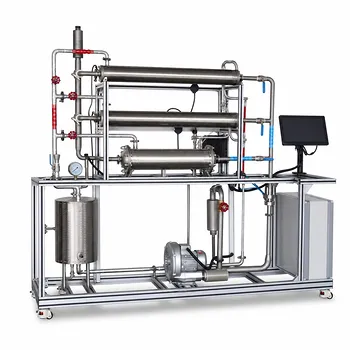
A unit‑operations pilot plant turns this theory into a repeatable experiment. The goal is to let students sweep through both flow regimes under controlled conditions.
Varying the Condensation Rate to Cross the Threshold
Students can manipulate two primary knobs: the cooling water flow rate and the steam inlet pressure or flow.
Increasing the steam flow delivers more vapor, which raises the condensation rate and therefore the condensate load on the tube.
Alternatively, lowering the cooling water temperature extracts more heat from the same vapor, thickening the film faster.
By gradually stepping through these variables, the experiment forces the film across the critical Re ≈ 1800 boundary.
Experimental Data Collection and Validation
The pilot plant instrumentation captures temperatures, flow rates, and pressures at key points.
From these, students calculate the overall heat transfer coefficient and then back‑out the condensation‑side coefficient.
They then compute the film Reynolds number for each run.
Plotting the condensation coefficient against Re reveals two distinct regions: a falling curve on the left (laminar) and a rising curve on the right (turbulent).
Next, they overlay theoretical lines—the Nusselt prediction for laminar flow and the Badger correlation for turbulent flow—and directly judge the agreement.
This visual match cements the link between the underlying flow physics and the macroscopic thermal performance.
Understanding the Trade‑offs and Limitations
While the laminar‑turbulent narrative is powerful, no real system follows pure theory perfectly. Students must appreciate what the pilot plant teaches and what it obscures.
- The transition Reynolds number is not a single magic number. Real films can develop surface waves well before Re = 1800, which enhance mixing even in the “laminar” zone. This often makes the experimental coefficient dip less sharply than the simple Nusselt model predicts.
- Turbulent correlations are sensitive to fluid properties. The Badger equation, like all empirical fits, carries uncertainty if applied outside its original database range. Pilot‑plant exercises often reveal a small but instructive offset between measured and predicted turbulent coefficients.
- Vapor shear can override gravity. At high vapor velocities, the film behaviour is dominated by shear at the liquid‑vapor interface, not just by the Reynolds number. In such cases, the simple laminar‑to‑turbulent picture based solely on condensate load must be augmented with shear‑controlled models (like Boyko‑Kruzhilin). A comprehensive pilot plant might include high‑velocity runs to demonstrate this second regime as well.
- Film breakdown and non‑uniformity. At very low Reynolds numbers, the film can become unstable and break into rivulets, partially un‑wetting the surface. This compromises the uniform‑film assumption and can make the heat transfer coefficient higher than Nusselt’s prediction. Recognizing these deviations helps students move from idealized textbook models to real engineering judgment.
Making the Most of a Vertical Condensation Pilot‑Plant Experiment
The exercise is not just about turning a knob; it is a platform to internalize how flow regimes dictate thermal design. Depending on your learning objective, emphasize different aspects of the demonstration.
- If your primary focus is grasping fundamental heat transfer mechanisms: Run the experiment slowly across a wide load range. Watch how the heat transfer coefficient initially falls then rises. Connect this shape directly to the two competing modes of heat transport—conduction in the laminar film vs. eddy mixing in the turbulent film.
- If your primary focus is validating classical correlations: Collect high‑quality data on either side of the transition. Compare your laminar points to the Nusselt equation and your turbulent points to the Badger equation. Discuss the deviations and what they imply about the assumptions (smooth surface, constant properties) that underpin each correlation.
- If your primary focus is learning to identify flow regime thresholds: Deliberately bracket the Re ≈ 1800 region with closely spaced runs. Plot the experimental coefficient versus Re on a log‑log scale; the inflection point where the slope changes sign reveals the empirical transition Reynolds number for your specific fluid and tube geometry.
- If your primary focus is bridging theory and industrial practice: Extend the discussion to design consequences. In a real vertical condenser, turbulence raises the coefficient and shrinks the required surface area—but it also increases pressure drop and film splashing. Use your pilot‑plant observations to justify why an engineer might deliberately operate a vertical condenser in the turbulent regime, and what trade‑offs that entails.
A single‑tube, vertical‑condensation pilot plant distills a rich, non‑linear physical phenomenon into a clear, repeatable pattern. By deliberately crossing the laminar‑turbulent boundary, you learn not just what the heat transfer coefficient does, but why—and how that understanding directly shapes the design of full‑scale equipment.
Summary Table:
| Feature | Laminar Film Condensation | Turbulent Film Condensation |
|---|---|---|
| Reynolds Number (Re) | < 1800 | > 1800 |
| Heat Transfer Mechanism | Molecular conduction | Convective eddy mixing |
| Film Thickness Effect | Thicker film reduces heat transfer | Thicker film increases heat transfer |
| Governing Model | Nusselt's Classical Theory | Badger Correlation |
Bring thermodynamics and fluid dynamics to life in your laboratory. LABPARK provides state-of-the-art Educational and Vocational Unit Operations Pilot Plants in chemical engineering, bioprocess & biotech, and environmental & water treatment.
Designed specifically for universities, research institutes, and enterprises, our rugged pilot plants enable students and researchers to visualize complex heat transfer phenomena, validate classical equations, and gain hands-on industrial engineering experience.
Ready to upgrade your teaching or research lab's capabilities? Contact us today to request a quote or custom solution!
Related Products
- Three-Tube Heat Transfer Educational Pilot Plant for Unit Operations Training
- Shell and Tube Heat Exchanger Heat Transfer Coefficient Determination Educational Pilot Plant
- Circulating Wind Tunnel Drying and Convective Heat Transfer Coefficient Determination Educational Pilot Plant
- Solid Spherical Heat Transfer Coefficient Determination Educational Chemical Engineering Pilot Plant
- Comprehensive Heat Transfer Coefficient Determination Educational Unit Operations Pilot Plant
People Also Ask
- When is ε-NTU preferred over LMTD in pilot plants? Predict heat exchanger performance without iteration.
- Why is emissivity critical in heat transfer pilot plants? Bridge the Gap Between Theory & Industrial Design
- How can a heat transfer pilot plant demonstrate waste heat recovery? Learn to optimize industrial thermal systems.
- How does cascade control achieve superior disturbance rejection in heat transfer pilot plants?
- What engineering trade-offs must students analyze in a heat transfer pilot plant? Balance performance & cost.