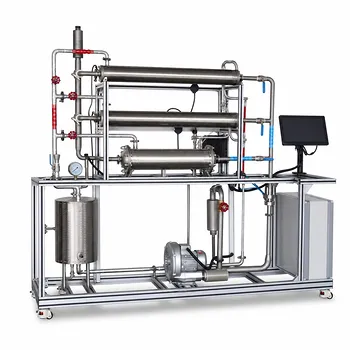
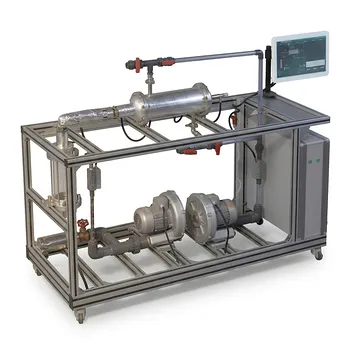
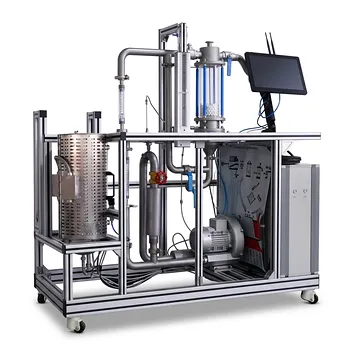
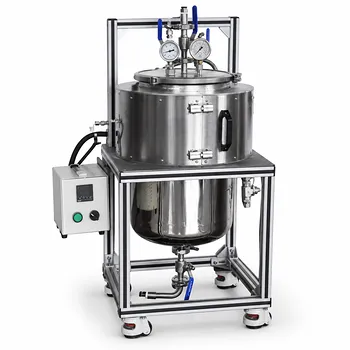
The inescapable trade-off you must analyze is the interplay between thermal performance and the energy cost of moving fluids, as expressed in the fundamental heat transfer rate equation, ( Q = K \cdot S \cdot \Delta t_m ). Every lever you pull to increase variables like velocity, area, or the temperature driving force simultaneously creates a drain on resources—typically in the form of pressure drop, material costs, or utility requirements. Your goal in a pilot plant isn't just to make a number go up; it’s to find the economic equilibrium where the marginal cost of improvement exceeds its benefit.
The core lesson of the pilot plant is that pure thermal efficiency is a mirage. Students must internalize that maximizing the heat transfer rate is not the objective; maximizing the economic and operational viability of the system is. This requires mapping a "cost-optimum" curve where the investment in hardware or pump power is perfectly balanced against the returns of higher heat recovery.
Dissecting the Hydrodynamic Trade-off: Velocity vs. Pressure Drop
The most immediate and measurable trade-off in a pilot plant involves turning the pump dial. Forcing fluids to move faster creates turbulence, which efficiently disrupts the thermal boundary layer.
The Reynolds Number Effect
Increasing fluid velocity directly raises the Reynolds number. This enhances the convective heat transfer coefficient (α), a dominant factor in the overall heat transfer coefficient (K).
Transferring more heat sounds ideal, but turbulence doesn't come free. The energy required to push fluid past the tube walls increases not linearly, but exponentially.
The Pressure Drop Penalty
A sharp rise in fluid velocity causes a correspondingly sharp rise in pressure drop (Δp). This pressure loss translates directly to higher pump power consumption, measured by your watt-meter in the pilot plant.
You must calculate whether the thermal energy recovered offsets the electrical energy spent. In many unit operations, the "sweet spot" is found where fluid flow is turbulent enough to maximize K, but not so violent that pump costs destroy the process economics.
The Structural Compromise: Area vs. Complexity
If you can’t afford the pressure drop from higher velocities, the equation suggests increasing the heat transfer area (S). The pilot plant demonstrates why this is rarely a simple scale-up.
Finned Tubes and Compact Exchangers
Adding fins or switching to plate-and-frame structures dramatically increases the surface area per unit volume. This boosts thermal performance significantly without increasing fluid velocity.
However, engineers must immediately account for the increased physical footprint and raw material costs. A larger, more complex exchanger requires more steel.
The Fouling Factor Trap
This is where the pilot plant becomes an invaluable teacher. The more intricate the surface geometry—especially with narrow plate gaps or densely packed fins—the harder the unit is to clean.
Students can measure the thermal resistance of fouling layers over time. A compact exchanger might show brilliant initial performance, but if it clogs rapidly in a dirty service, its operational efficiency will plummet below that of a simpler, oversized shell-and-tube unit. The physical design directly dictates the maintenance strategy.
Optimizing the Driving Force (ΔT): Energy Quality vs. Capital
The temperature approach is often treated as a given, but it represents one of the most critical strategic trade-offs in heat integration.
The Cost-Optimum Curve
When you use a utility with a large temperature difference, such as high-pressure steam or chilled water, the log mean temperature difference (Δtm) increases. This allows you to get away with a smaller, cheaper heat exchanger.
The trade-off is operational: these "premium" utilities are expensive to produce. Conversely, using cheap low-pressure steam requires a huge area to capture the heat due to the smaller ΔT, driving up capital expenditure. In the pilot plant, you can plot these values: annualized capital cost versus annual utility cost. The total cost curve forms a distinct U-shape, and the optimum minimum temperature approach (ΔToptimum) sits at the lowest point, typically between 15°C and 40°C.
The Drying Unit Paradox
This trade-off is vivid in a dryer. Increasing inlet air temperature ((t_1)) reduces the total air volume needed and cuts heat consumption. But if you burn your product by exceeding its thermal degradation limits, the efficiency gain is a write-off.
Recycling exhaust gas attempts to recover waste heat but introduces a humidity penalty. The recycled moisture reduces the drying rate, forcing you to either increase the temperature or accept slower throughput.
Understanding the Scale-Up Disconnect
What works perfectly on a lab bench often fails in the field, a danger that pilot plants are specifically designed to mitigate.
The Vanishing Area-to-Volume Ratio
As a reactor or heat exchanger size increases, the volume of the batch (heat capacity) grows by the cube of the linear dimension. The surface area for heat transfer only grows by the square.
The result is a drastic slowdown in the ability to add or remove heat. A temperature excursion that takes 2 minutes to correct in the pilot plant could take 20 minutes in production, creating a dangerous risk of a runaway reaction.
Validating the Wilson Plot
To truly understand this limit, students can use methods like the Wilson Plot. By measuring the heat transfer coefficient at varying stirring speeds and plotting ( 1/U ) versus ( n^{-2/3} ), the y-intercept reveals the maximum theoretical heat transfer rate (( U_{max} )).
This experiment exposes a hard physical ceiling. If your chemistry demands more heat removal than ( U_{max} ) allows, no amount of agitation will save the batch. You must either seek a different reactor geometry or alter the chemistry.
Applying Methodical Efficiency Levers
The pilot plant also reveals that not all efficiency gains come from pushing fluid dynamics. Some are system-control optimizations with distinct thermal-hydraulic limits.
Exhaust Air Optimization
Lowering the outlet air temperature ((t_2)) in a dryer keeps more sensible heat inside the system. But students quickly hit the adiabatic saturation constraint.
If the outlet temperature drops too low, moisture condenses in the ductwork. The trade-off is thermal efficiency against the operational integrity of the equipment. In practice, you must keep the exhaust gas 20°C to 50°C above its dew point to prevent corrosion and clogging.
Drag Reduction Technologies
Innovative chemistry offers a path around pressure drop. Injecting polymers can dampen turbulent eddies near the wall, a technique known as drag reduction.
This allows higher flow rates without a massive pressure drop penalty. The engineering trade-off shifts to the cost and degradation of the polymer itself. Does the chemical additive last long enough in the loop to be economical, or does the continuous dosing cost outweigh the pump savings?
Making the Right Choice for Your Goal
The pilot plant demonstrates that there is no "best" heat exchanger, only an optimal configuration for a specific cost-function. Your analysis should be guided by the limiting factor of the process itself.
- If your primary focus is minimizing operating expenses: Keep fluid velocities moderate and use extensive heat integration with a low minimum temperature approach to slash utility consumption, but accept the capital burden of a larger heat exchanger.
- If your primary focus is the upfront capital budget: Maximize the log mean temperature difference with cheap, high-temperature utilities and high velocities to shrink the equipment footprint, but reconcile yourself to a higher ongoing energy bill.
- If your primary focus is system reliability with dirty fluids: Reject finned tubes or close-clearance plate frames in favor of a simple shell-and-tube unit. Overdesign the area to account for fouling, allowing the system to operate longer between cleanings despite lower peak efficiency.
Mastering heat transfer is ultimately about defining the acceptable limit of these competing forces, using the pilot plant data to predict where the total cost curve bottoms out, not where the temperature delta peaks.
Summary Table:
| Trade-Off Parameter | Action | Thermal Benefit | Operational Cost/Risk |
|---|---|---|---|
| Fluid Velocity | Increase flow speed | Boosts convective coefficient ($K$) | Exponential pressure drop & pump costs |
| Surface Area | Compact geometry/fins | Maximizes transfer area ($S$) | Increased footprint, fouling, & maintenance |
| Driving Force | Use premium utilities | Increases $\Delta t_m$ (smaller footprint) | High utility costs (higher OPEX) |
| Equipment Scale | Scale up to production | Larger volume capacity | Lower area-to-volume ratio & runaway risk |
Bring Practical Engineering to Life with LABPARK
Mastering unit operations requires hands-on training that exposes students to real-world chemical engineering trade-offs. LABPARK provides state-of-the-art Educational and Vocational Unit Operations Pilot Plants in chemical engineering, bioprocess & biotech, and environmental & water treatment.
We help universities, research institutes, and enterprises equip their labs with robust systems designed to teach fluid dynamics, thermodynamics, and process control effectively.
Ready to enhance your teaching or research capabilities? Contact LABPARK today to explore our pilot plant solutions.
Related Products
- Comprehensive Multi-Modal Heat Transfer Unit Operations Pilot Plant for Engineering Training
- Three-Tube Heat Transfer Educational Pilot Plant for Unit Operations Training
- Dual Mode Heat Transfer Pilot Plant for Unit Operations Training
- Comprehensive Heat Transfer Coefficient Determination Educational Unit Operations Pilot Plant
- Shell and Tube Heat Exchanger Heat Transfer Coefficient Determination Educational Pilot Plant
People Also Ask
- When is ε-NTU preferred over LMTD in pilot plants? Predict heat exchanger performance without iteration.
- Why is emissivity critical in heat transfer pilot plants? Bridge the Gap Between Theory & Industrial Design
- How does cascade control achieve superior disturbance rejection in heat transfer pilot plants?
- How to Verify Air-Side Heat Transfer Coefficient with a Pilot Plant? Practical Lab Guide
- How can a heat transfer pilot plant demonstrate waste heat recovery? Learn to optimize industrial thermal systems.