Starting with an immediate, clear answer is crucial when time is tight. The core difference between double-film theory and penetration/surface renewal theories lies in the predicted dependence of the mass transfer coefficient on the diffusion coefficient: film theory gives (k \propto D) (a linear relationship), while penetration and surface renewal theories give (k \propto \sqrt{D}). This distinction directly impacts how you calculate mass transfer coefficients from pilot plant data, interpret the effects of turbulence and flow rates, and extrapolate results to different chemical systems or full-scale columns.
The practical choice of mass transfer theory is not merely academic. While both approaches often produce similar numerical values under typical conditions, their fundamentally different scaling with diffusivity becomes the deciding factor when analyzing systems with significantly different molecular diffusivities or when a pilot plant operates under highly turbulent, unsteady-state conditions.
The Theoretical Divide: Steady-State vs. Unsteady-State Mass Transfer
At the heart of the analysis is the physical picture each theory paints of the gas-liquid interface. The assumptions directly dictate the form of the mass transfer coefficient equation.
Double-Film Theory: Diffusion Through Stagnant Layers
Whitman’s double-film model assumes two stagnant boundary layers—a gas film and a liquid film—through which mass transfer occurs purely by molecular diffusion.
All resistance to mass transfer is concentrated within these films, and the process is steady-state. The flux is driven by a concentration difference across the film, leading to a mass transfer coefficient (k_L = D_L / z_L), where (z_L) is the effective liquid film thickness.
The critical consequence: (k_L) is directly proportional to the diffusion coefficient (D_L). If diffusivity doubles, the coefficient doubles.
Penetration and Surface Renewal: Transient Contact and Element Exposure
Higbie’s penetration theory and Danckwerts’ surface renewal model reject the steady-state assumption. Instead, they treat the interface as constantly refreshed by fluid elements from the bulk.
A turbulent eddy brings a packet of liquid to the surface, where it remains for a short exposure time before being replaced. Mass transfer into that element is an unsteady-state diffusion process. The derived coefficient is (k_L = 2 \sqrt{D_L / (\pi \theta)}), where (\theta) is the exposure time.
Danckwerts’ surface renewal extends this by introducing a random distribution of element ages. The key mathematical result is identical in its diffusivity dependence: (k_L \propto \sqrt{D_L}).
How These Differences Manifest in Pilot Plant Data Analysis
In a gas absorption pilot plant, the theory you choose directly affects the interpretation of measured data and the conclusions drawn about process fundamentals.
The Sensitivity of k to the Diffusion Coefficient
When you vary the solute gas—or even the temperature—the diffusivity changes. Film theory predicts a linear response in the measured overall mass transfer coefficient, while penetration theory predicts a square-root response.
For example, if a pilot plant switches from absorbing one gas to another with half the diffusivity, film theory would predict (K_G a) drops by 50%, whereas penetration theory predicts a reduction of only about 30%. Experimentally observed trends often lie closer to the square-root relationship, especially in turbulent contactors. Relying on film theory in such a case would lead to a systematic underestimation of performance and a misjudgment of how the column will behave with different solutes.
Interpreting the Effect of Turbulence and Flow Rates
Both theories allow you to link flow rate changes to mass transfer improvements, but through different mechanisms.
- Film theory: Increasing liquid flow rate is interpreted as thinning the stagnant film ((z_L) decreases), which raises (k_L).
- Penetration theory: Increasing turbulence is interpreted as reducing the exposure time (\theta) of fluid elements at the interface, which increases (k_L).
Your choice of theory changes the physical parameter you infer from the data (film thickness vs. contact time) and therefore the mental model you use for scale-up.
Practical Example: Liquid-Film Controlled vs. Gas-Film Controlled Systems
In a pilot plant running a gas-film controlled absorption (e.g., ammonia–water), the overall coefficient (K_G) is dominated by the gas-side resistance. The diffusivity dependence in the liquid phase is largely irrelevant, so the difference between the two theories has minimal impact on your analysis of liquid-side behavior.
However, for a liquid-film controlled system (e.g., CO₂–water), the liquid mass transfer coefficient (k_L) governs the overall rate. Here, choosing between (k_L \propto D_L) and (k_L \propto \sqrt{D_L}) becomes critical. Data analyzed with the wrong exponent will lead to errors in predicting the effect of temperature (which changes diffusivity) or scaling the column to handle a different gas mixture.
Understanding the Trade-offs and Common Pitfalls
Every simplifying model has a domain of validity. Recognizing the limits of each theory protects you from drawing false conclusions from pilot plant data.
When Simplification Leads to Misleading Scale-Up
In many teaching and steady-state pilot operations, the film model is preferred because it is mathematically simpler and often yields results that differ by only a few percent from the penetration model when the same numerical (k_L) value is used.
The pitfall arises when you extrapolate beyond the calibration conditions. If your pilot data were interpreted using film theory but the full-scale unit operates in a highly turbulent, transient regime (e.g., a sprayed column or a bubble column with intense mixing), the linear diffusivity assumption becomes inaccurate. Scale-up rules based on film thickness become unreliable.
The Hidden Assumption: Similar Diffusivities
The gap between the theories widens dramatically when the gaseous and liquid reactants have significantly different diffusivities, or when complex chemical reaction schemes are involved.
In such advanced research cases, film theory can fail to predict the relative enhancement of absorption rates for fast-reacting species. The square-root dependency of penetration/surface renewal models aligns much better with experimental observation. Failing to recognize this can lead to selecting an incorrect reactor type or packing geometry based on flawed pilot data analysis.
Applying the Right Theory to Your Pilot Plant Analysis
The decision is not about which theory is “correct” in an absolute sense; it is about which model provides the most useful and defensible framework for your specific experimental goals.
Matching the Model to the Fluid Dynamics
Use your knowledge of the contactor design to guide the choice:
- Laminar films or wetted-wall columns: The two-film model is physically representative, and the linear (D) relationship holds.
- Packed towers at moderate to high liquid loads, turbulent bubble columns: The unsteady-state penetration or surface renewal concept is more realistic. The mass transfer coefficient’s dependence on (D^{0.5}) will better match your data.
Experimental Design: Isolating the Diffusivity Effect
If you are unsure which regime dominates your pilot plant, design an experiment that directly probes the diffusivity dependence. Run absorption tests with two different solutes whose diffusivities are known, or systematically vary temperature to change diffusivity, while holding hydrodynamics constant.
Plot (\ln k_L) versus (\ln D). A slope near 1 supports the film model; a slope near 0.5 supports the penetration/surface renewal model. This empirical check removes guesswork and anchors your analysis to reality.
Making the Right Choice for Your Pilot Plant Study
Your selection of mass transfer theory should be driven by the nature of your system and the questions you need the pilot data to answer.
- If your primary focus is educational simplicity or steady-state packed column design: Stick with the two-film model. It is easy to teach, requires no estimation of exposure times, and remains accurate enough when conditions are gentle.
- If your primary focus is scale-up of high-turbulence equipment or analyzing fast chemical reactions: Adopt the penetration or surface renewal model. Its (\sqrt{D}) dependency will better capture the response of mass transfer rates to changes in solute properties and flow dynamics.
- If your primary focus is generic process modeling where multiple solutes with widely varying diffusivities are handled: Use the penetration model as your default because the error from assuming (\sqrt{D}) is systematically smaller than the error from assuming (D) when scale-up spans different chemical systems.
The true power of a pilot plant experiment lies not in a single coefficient, but in your ability to interpret it using a model that mirrors the physics of your contactor.
Summary Table:
| Feature | Double-Film Theory | Penetration & Surface Renewal Theories |
|---|---|---|
| State Regime | Steady-state | Unsteady-state (transient) |
| Physical Model | Stagnant fluid boundary layers at interface | Continuous refreshment of interface by turbulent eddies |
| Diffusivity Dependence | $k_L \propto D_L$ (Linear relationship) | $k_L \propto \sqrt{D_L}$ (Square-root relationship) |
| Turbulence Interpretation | Thinning of the stagnant film layer | Reduction of surface element exposure time |
| Typical Applications | Laminar flow, wetted-wall columns, educational basics | Turbulent columns, packed towers, scale-up modeling |
Elevate Your Engineering Research with LABPARK
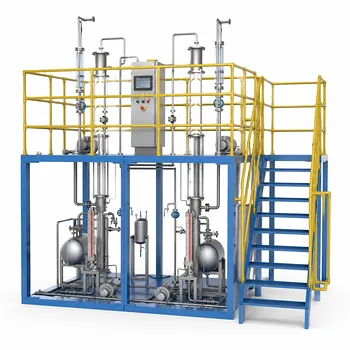
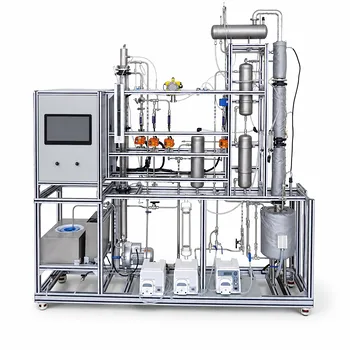
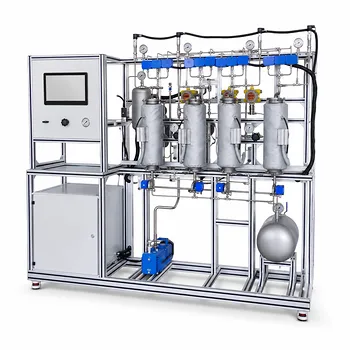
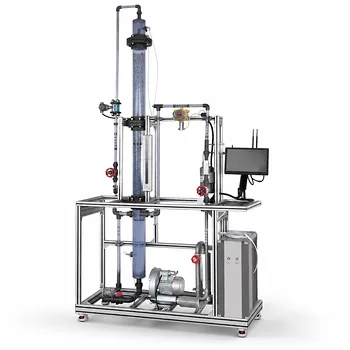
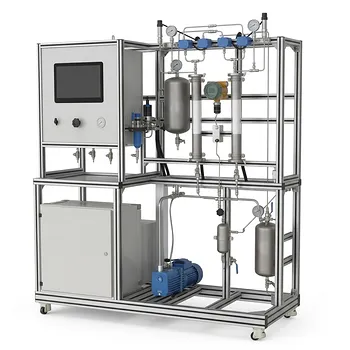
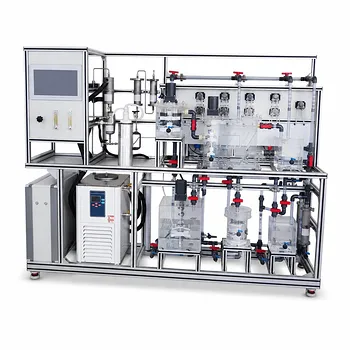
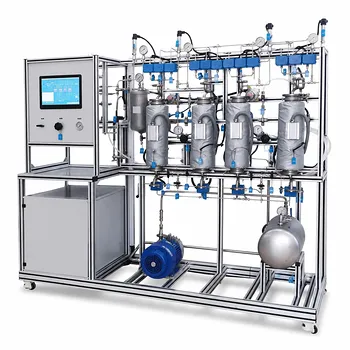
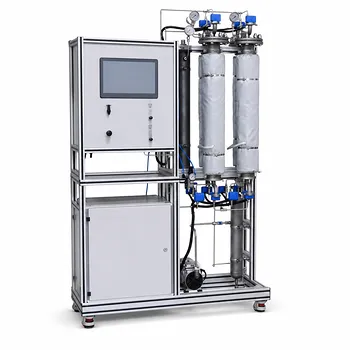
To accurately analyze mass transfer phenomena, your lab needs reliable, industry-grade hardware. LABPARK provides premium Educational and Vocational Unit Operations Pilot Plants in chemical engineering, bioprocess & biotech, and environmental & water treatment.
Designed specifically for universities, research institutes, and enterprises, our pilot plants deliver the precision, control, and durability required for rigorous experimental validation and scale-up studies.
Ready to upgrade your lab's capabilities? Contact LABPARK today to discuss your pilot plant requirements!
Related Products
- Dual-Mode Gas Absorption and Desorption Unit Operations Training Pilot Plant
- Carbon Dioxide Absorption and Desorption Educational Pilot Plant for Carbon Capture Studies
- Carbon Dioxide Adsorption and Capture Educational Unit Operations Pilot Plant
- Absorption and Desorption Educational Unit Operations Pilot Plant
- Packed Bed Absorption Educational Unit Operations Pilot Plant
People Also Ask
- How do two-film & penetration theories apply to gas absorption pilot plant teaching? Key pedagogical insights.
- How is the direction and driving force of mass transfer determined in a gas absorption unit operations pilot plant?
- How does partial pressure behavior influence gas absorption pilot plants? Master Mass Transfer
- How to model chemical absorption as physical absorption? The pilot plant simplification criterion.
- What are the limitations of Henry's Law in gas absorption pilot plants? Avoid critical lab errors.