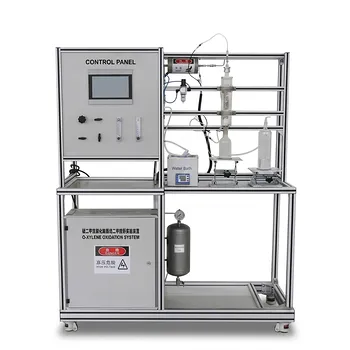
Raising the temperature, increasing the steam-to-carbon (S:C) ratio, and lowering the pressure all individually shift the chemical equilibrium of the steam methane reforming reaction forward, maximizing hydrogen yield. Conversely, high pressure is fundamentally detrimental to equilibrium but is a practical necessity in pilot plants to match downstream processing needs and reduce equipment size. Therefore, successful operation is not about pushing all parameters to an extreme but rather balancing thermodynamic ideals against kinetic realities and metallurgical limits.
The core challenge of operating a methane steam reforming pilot reactor is that perfect thermodynamic conditions are mutually exclusive with real-world constraints. While low pressure and very high temperatures are ideal for equilibrium, they introduce prohibitive safety risks, material failures, and energy costs. The art of pilot plant operation lies in leveraging the S:C ratio as a dynamic chemical "shield" to allow safe operation at the high temperatures required to overcome slow kinetics, all within a moderately pressurized environment.
Temperature as the Primary Conversion Driver
The main reforming reaction is highly endothermic (it absorbs heat). According to Le Chatelier’s principle, the system counteracts a temperature increase by consuming the added heat.
The Purity Ceiling: Equilibrium Methane Slippage
This is why temperature acts as the primary conversion knob. Higher temperatures force the equilibrium forward, consuming more methane and yielding more hydrogen. The residual methane concentration leaving your pilot reactor—often called "methane slippage"—is a direct indicator of this thermodynamic limit. At a system pressure of 30 bar, thermodynamic calculations show that achieving near-complete conversion requires temperatures exceeding 1400 K.
The Practical Limit: Why Not Just Crank Up the Heat?
You cannot simply operate at 1400 K. Metallurgical constraints of the reformer tube materials cap practical operating temperatures around 1200 K in both pilot and industrial scales. Furthermore, the primary reference highlights a key pilot-scale risk: exceeding 700°C without sufficient steam triggers methane thermal cracking. This uncontrolled decomposition path generates solid carbon, which deactivates the catalyst instantly.
Pressure as a Necessary Downstream Constraint
The reforming reaction results in a net increase in gas volume. Therefore, from a purely thermodynamic perspective, high pressure is counterproductive.
The Volume Paradox
Increased pressure shifts the equilibrium backward, raising the residual methane concentration in your product. If a pilot plant’s only goal was maximum single-pass conversion, you would operate at ambient pressure. However, because synthesis gas is usually destined for processes like methanol synthesis or Fischer-Tropsch (which operate at 5–15 MPa or 20–40 atm), utilizing a moderate reformer discharge pressure eliminates expensive interstage compression.
Why Low Pressure Isn't Always Practical
Pilot plants typically compromise at moderate pressures of 1 to 2 MPa. This minimizes the parasitic energy load of downstream compression while keeping the reactor equipment small. It introduces a manageable equilibrium penalty that is compensated for by adjusting the other two parameters.
The Steam-to-Carbon Ratio: The Stability Safeguard
Increasing the H2O/CH4 ratio does more than just shift equilibrium. It injects a surplus of reactant, but its most critical role in a pilot plant is defensive.
Prevention Beats Cure
A high S:C ratio acts as a powerful operational control to suppress carbon deposition on the catalyst bed. This is a direct response to the carbon formation risk mentioned with high temperature. From a thermodynamics perspective, the extra steam actively gasifies any carbon precursors, keeping the catalyst surface clean. This ensures your pilot plant can maintain stable temperature profiles without developing dangerous hot spots from coking.
A Clever Startup Strategy
During pilot plant cold start-up, temporarily spiking the S:C ratio—for example, to 24:1—is an intelligent thermal management strategy. This extremely high steam flow significantly reduces carbon monoxide (CO) concentration in the reformate, which lowers the conversion load on the downstream Water-Gas Shift (WGS) reactor before it warms up. Additionally, high-density steam carries substantial sensible heat, accelerating the preheating of the recuperative heat exchangers. Once the plant is thermally stable, the ratio is normalized to optimize energy efficiency.
Understanding the Hidden Trade-offs
Each parameter adjustment carries a secondary consequence that extends beyond the reformer tube. A pilot plant operator must see the whole system, not just the reactor.
The Kinetic vs. Equilibrium Conflict
Although a higher S:C ratio is thermodynamically favorable, the supplementary references reveal a kinetic penalty. A massive excess of steam reduces the partial pressure of methane, which can slow down the specific reaction rate. Additionally, the energy required to boil and superheat the extra water constitutes a significant process inefficiency, directly contradicting the goal of a net-energy-positive system.
The CO-to-CO2 Ratio Shift
Raising the temperature increases catalyst productivity, but it changes your product distribution. Higher temperatures favor formation of CO over CO2, increasing the CO:CO2 ratio in the product stream. This increases the purification load on downstream WGS reactors. You are essentially trading reformer efficiency for a larger, more complex cleanup section.
The Downstream Integration Mandate
Your pilot plant never operates in isolation. The choice of 1–2 MPa pressure, though a compromise, is specifically engineered to feed downstream reactors. The 24:1 startup S:C ratio specifically manipulates reformate CO levels to protect the unheated WGS catalysts. Every "equilibrium" decision is really a systems-integration decision.
Making the Right Choice for Your Experimental Goal
The response surface of temperature, pressure, and S:C ratio requires distinct optimization strategies depending on whether you are testing a catalyst or demonstrating a process.
- If your primary focus is maximizing hydrogen yield and conversion: Prioritize high temperature (with material safety limits) and a high S:C ratio, but accept the associated energy penalty for steam generation.
- If your primary focus is catalyst longevity and stability studies: Never sacrifice the S:C ratio. Operate it above the carbon formation isotherm, even if it constrains your maximum achievable temperature.
- If your primary focus is simulating an industrial-scale system: Do not operate at atmospheric pressure. Use the standard 1–2 MPa moderate pressure, as this forces the reactor to exhibit the same mass transfer and equilibrium methane slippage you would see in a commercial front-end.
- If your primary focus is cold-start thermal dynamics: Implement a transient, high-steam strategy (e.g., 24:1 S:C) to rapidly heat downstream units via convective steam flow, accepting the temporary decrease in hydrocarbon conversion until stable temperatures are reached.
Mastering this pilot reactor means recognizing that temperature provides the thermodynamic driving force, pressure defines the engineering boundary condition, and the steam-to-carbon ratio serves as the safety valve that makes high-efficiency operation possible without destroying the catalyst.
Summary Table:
| Parameter | Thermodynamic Effect on Equilibrium & Yield | Practical Constraints & Risks | Operational Strategy |
|---|---|---|---|
| Temperature | Higher temperature increases H₂ yield & conversion. | Tube metallurgy limits (~1200 K); carbon cracking risk >700°C. | Maximize within safety limits; balance against downstream CO cleanup. |
| Pressure | Lower pressure increases conversion. | Downstream units require high pressure; compressor costs. | Operate at moderate 1–2 MPa to balance equilibrium and utility costs. |
| Steam-to-Carbon (S:C) Ratio | Higher S:C ratio increases conversion. | High energy cost for steam; lowers methane partial pressure. | Maintain above carbon limit; spike to 24:1 for safe thermal cold-starts. |
Optimize Your Chemical Engineering Labs with LABPARK
Balancing complex thermodynamics and safety constraints in steam reforming requires precise, reliable equipment. LABPARK provides state-of-the-art Educational and Vocational Unit Operations Pilot Plants in chemical engineering, bioprocess & biotech, and environmental & water treatment.
We empower universities, research institutes, and enterprises with robust, highly controllable systems designed to simulate real-world industrial processes safely.
Ready to elevate your research and training capabilities? Contact us today to discuss your pilot plant requirements!
Related Products
- Steam Methane Reforming Hydrogen Production and Purification Educational Pilot Plant
- Methane Cracking Educational Unit Operations Pilot Plant
- Methanol Synthesis and Catalyst Performance Evaluation Educational Unit Operations Pilot Plant
- Carbon Dioxide Hydrogenation Methanol Synthesis Educational Unit Operations Pilot Plant
- Dual-Mode Rectification Pilot Plant for Practical Training Unit Operations
People Also Ask
- How to Integrate WGS & Purification in Steam Reforming Pilot Plants to Protect Fuel Cells from CO Poisoning
- What are the differences between steam reforming and ATR in pilot plants? Key Design Guide
- How is carbon deposition controlled in steam reforming? The Critical Role of S/C Ratio
- What is the difference between allothermal and autothermal steam reforming in pilot plants?
- How to suppress coking in a methane steam reforming pilot plant? Avoid risks & failures.