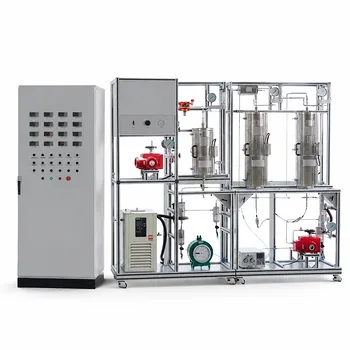
Carbon is the silent killer of a reforming catalyst. In a steam reforming pilot plant, carbon deposition—known as coking—is controlled primarily by operating with a deliberate excess of steam, quantified by the steam-to-carbon (S/C) ratio. Maintaining this ratio in the range of 2.5 to 4.5 moles of H2O per mole of carbon suppresses the two dominant coking reactions, methane pyrolysis and the Boudouard reaction, thereby protecting both the catalyst’s active sites and the physical integrity of the reactor tubes.
Carbon formation in a reformer is a thermodynamic and mechanical nightmare. The steam-to-carbon ratio is your most direct and powerful lever to prevent it—by shifting chemical equilibrium away from soot and protecting the catalyst from irreversible damage. Understanding exactly why this ratio matters is what separates a reliable, long-running pilot plant from one doomed to frequent shutdowns and ruined catalyst beds.
The Hidden Danger in Your Reformer Tubes
Coking is not just a minor performance dip. It is a cascading failure that can destroy an experiment and the reactor itself.
The Two Chemical Culprits
Carbon deposits form through two principal side reactions.
Methane pyrolysis cracks methane directly into solid carbon and hydrogen: CH4 ⇌ C + 2H2.
The Boudouard reaction disproportionates carbon monoxide: 2CO ⇌ C + CO2.
Both reactions are thermodynamically favored under low steam conditions and at the high temperatures typical of reforming.
From Active Sites to Hot Spots
When carbon blankets the catalyst’s active sites, the reaction rate plummets.
This carbon layer is not just chemically deactivating. It physically blocks gas flow through the bed, increasing pressure drop and creating thermal insulation. The result is localized “hot spots” that can exceed the tube’s design limits, causing metallurgical damage, catalyst pulverization, and forced shutdowns.
The Steam-to-Carbon Ratio: A Thermodynamic Shield
The S/C ratio is more than a process variable; it is a thermodynamic defense mechanism.
How Excess Steam Suppresses Soot
Adding steam pushes the equilibrium of both coking reactions backward.
For methane pyrolysis, excess steam increases the product water concentration, effectively reversing the reaction via steam gasification of carbon (C + H2O → CO + H2). For the Boudouard reaction, water-gas shift chemistry consumes CO, starving the soot-forming pathway.
Lowering Hydrocarbon Partial Pressure
Using more steam also dilutes the hydrocarbon feedstock. This lowers the partial pressure of the hydrocarbons, which thermodynamically improves overall hydrocarbon conversion and further reduces the driving force for carbon nucleation on the catalyst surface.
When Feedstock Demands More Protection
Heavier hydrocarbons like naphtha require higher S/C ratios. At the high temperatures needed for reforming (>920 K), these molecules readily undergo steam cracking to form olefins, which are potent coke precursors. Operating at the upper end of the ratio (3.5–4.5) is not optional—it’s essential to avoid catastrophic coking with such feedstocks.
The Art of Balancing the Ratio in a Pilot Plant
A pilot plant is not a fixed recipe; it is a research tool. The ratio must be tuned deliberately.
Startup Strategies: Run Wet to Heat Fast
During startup, a temporarily elevated S/C ratio (as high as 24:1) serves dual purposes. It suppresses CO formation, relieving the downstream water-gas shift reactor before it reaches its operating temperature, and carries substantial sensible heat to preheat recuperators and shift reactors. Once the system is thermally stable, the ratio is reduced to standard levels to save energy.
Catalyst Engineering as a Secondary Defense
While steam is the primary control, modern catalysts often incorporate alkaline promoters (such as potassium) that neutralize acidic sites on the support. These promoters accelerate the gasification of any carbon that does form, adding a crucial layer of resilience if the S/C ratio momentarily drifts low.
Understanding the Trade-offs
A higher S/C ratio is thermodynamically favorable, but it is not free.
The Energy Penalty and Residence Time Trap
Vaporizing excess water consumes significant energy, penalizing the overall thermal efficiency of the plant. Moreover, if the reactor volume is fixed, very high steam flows can reduce the residence time of the hydrocarbon, potentially decreasing conversion despite the thermodynamic advantage.
Reactor Temperature Interplay
Lowering the S/C ratio can increase thermal efficiency and reduce CO selectivity, especially if it allows the reactor to operate at lower temperatures (255–320°C range for some shift-adjacent studies). However, this pushes the system closer to the carbon-forming regime, requiring precise control to avoid crossing the coking boundary. The goal is not the lowest ratio, but the lowest safe ratio that prevents deactivation over the desired run length.
How to Select the Right S/C Ratio for Your Pilot Plant
Your optimal ratio depends on your specific research or production goal.
- If your primary focus is catalyst longevity and uninterrupted data collection: Operate at a conservative ratio of 3.5–4.0 for natural gas, and 4.0+ for heavier feeds, especially if temperature excursions are likely.
- If your primary focus is maximizing thermal efficiency and minimizing steam consumption: Start at 3.0 and use online analytics to carefully reduce the ratio stepwise, watching for the first sign of pressure drop increase or hot spot formation to define your operational floor.
- If your primary focus is studying the coking boundary itself: Program precise mass flow controllers to sweep ratios from a safe high value down to the threshold (never below 2.0 for natural gas) while monitoring catalyst activity and bed pressure drop in real time.
- If your primary focus is fast startup and downstream reactor heating: Use a temporarily boosted S/C ratio during the warm-up phase, then transition to your standard operational setpoint once all downstream reactors are at temperature.
Mastering the steam-to-carbon ratio is the difference between a pilot plant that teaches you about coking through an emergency shutdown, and one that teaches you how to harness thermodynamics for clean, reliable hydrogen production.
Summary Table:
| Operational Scenario | Recommended S/C Ratio | Key Objective & Effect |
|---|---|---|
| Natural Gas Reforming | 2.5 – 4.0 | Suppresses methane pyrolysis and the Boudouard reaction. |
| Heavy Feedstocks (Naphtha) | 3.5 – 4.5+ | Prevents steam cracking and olefin-induced coking. |
| Startup Phase | Up to 24:1 | Facilitates system preheating and prevents downstream CO buildup. |
| Efficiency Optimization | 3.0 (minimum 2.0) | Maximizes thermal efficiency while avoiding the coking boundary. |
Optimize Your Chemical Process Scale-Up with LABPARK
Controlling complex reactions like steam reforming requires precise, reliable, and highly controllable systems. LABPARK designs and manufactures high-quality Educational and Vocational Unit Operations Pilot Plants across chemical engineering, bioprocess & biotech, and environmental & water treatment.
We help universities, research institutes, and enterprises bridge the gap between theory and industrial application by providing robust pilot systems engineered for safety, longevity, and accurate data collection.
Ready to elevate your laboratory or training facility? Contact LABPARK today to find the perfect pilot plant solution for your needs!
Related Products
- Steam Methane Reforming Hydrogen Production and Purification Educational Pilot Plant
- Dual-Mode Rectification Pilot Plant for Practical Training Unit Operations
- Solid Waste Pyrolysis and Refining Educational Pilot Plant for Unit Operations
- Green Anhydrous Ethanol Refining Practical Training Pilot Plant
- Continuous Batch Extractive Distillation Educational Pilot Plant
People Also Ask
- How does temperature affect syngas equilibrium? Practical limits in steam reforming
- Why is the steam reforming of methane hindered at elevated pressures in a chemical engineering unit operations pilot plant?
- What thermodynamic principles govern methane reforming in pilot plants? Master equilibrium and coke control.
- What are the differences between steam reforming and ATR in pilot plants? Key Design Guide
- What is the difference between allothermal and autothermal steam reforming in pilot plants?