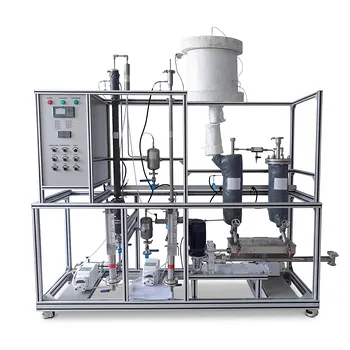
At its heart, methane reforming is a heat-hungry, carbon-forming balancing act.
The thermodynamic principles governing methane reforming in chemical engineering pilot plants center on managing highly endothermic reactions that shift equilibrium toward syngas at high temperature and low pressure, while suppressing the thermodynamically inevitable side reactions that deposit solid carbon. Students and researchers use pilot‑scale reactors to study how reactor temperature, pressure, and the steam‑to‑carbon feed ratio influence the equilibrium composition—and to witness firsthand how even a small deviation from optimal conditions can trigger catalyst‑killing coke formation.
Methane reforming’s success hinges on satisfying its enormous heat demand and exploiting Le Chatelier’s principle, all while carefully navigating a narrow thermodynamic window where the forward reaction is fast enough, but carbon‑forming side reactions remain manageable. Pilot plants are the ultimate teaching tool for this multi‑variable optimization.
The Thermodynamic Foundation: Endothermicity and Equilibrium
Why High Temperature is Non-Negotiable
The two dominant reforming routes—steam reforming (CH₄ + H₂O ⇌ CO + 3H₂, ΔH = +206 kJ/mol) and dry reforming (CH₄ + CO₂ ⇌ 2CO + 2H₂, ΔH = +247 kJ/mol)—are strongly endothermic.
This means the equilibrium constant K rises sharply with temperature. For a fixed feed composition, a hotter reactor will always shift the conversion curve further toward hydrogen and carbon monoxide. In a pilot plant, you visually experience this: the reactor’s skin temperature climbs to 500–900 °C, and the gas chromatograph shows syngas output soaring as soon as the furnace reaches its target setpoint.
The Role of Pressure According to Le Chatelier
Both steam and dry reforming increase the total number of moles, so lowering the total pressure pushes the equilibrium toward products.
Mathematically, Kp is fixed at a given temperature, and for a reaction that doubles or quadruples the mole count, a pressure drop shifts the extent of reaction forward. Pilot plants designed for teaching often run at near‑atmospheric pressure to maximize methane conversion and simplify equipment. However, many industrial reformers operate at 20–30 bar for downstream compression reasons, so educational facilities frequently add a back‑pressure regulator to let students explore the yield penalty of pressurized operation.
The Carbon Conundrum: Competing Side Reactions
The Dual Pathways to Coke Formation
Carbon deposition is the thermodynamic spoiler. It arrives via two primary routes:
- Methane decomposition (CH₄ ⇌ C + 2H₂) – endothermic, so high temperatures favor it.
- Boudouard reaction (2CO ⇌ C + CO₂) – exothermic, meaning lower temperatures make carbon formation more favorable.
The result is a U‑shaped coking envelope: carbon activity can be high at very low temperatures (due to Boudouard) and again at very high temperatures (due to methane cracking). A reactor that is too cool plugs with carbon; one that is too hot suffers rapid catalyst deactivation. The pilot plant’s thermocouple array and online gas analyzer are essential for finding the safe operating window where syngas production outruns these side reactions.
How Feed Ratios Tip the Thermodynamic Scales
The steam‑to‑carbon (S/C) ratio is the operator’s primary lever. Excess steam drives the water‑gas shift reaction (CO + H₂O ⇌ CO₂ + H₂), which consumes part of the CO and reduces the driving force for Boudouard carbon.
From a thermodynamic perspective, a high S/C ratio suppresses carbon activity by lowering the CO partial pressure. The trade‑off is that all that extra steam must be heated to reaction temperature, intensifying the already massive energy demand. Pilot plants let students trace this relationship in real time: gradually increasing the water pump speed creates a cleaner, coke‑free outlet stream, but the furnace duty spikes.
From Theory to Pilot Plant: Translating Thermodynamics into Practical Control
Matching Heat Duty with Reactor Design
The endothermicity numbers aren’t just abstract values; they translate directly into furnace power requirements. In a closed pilot‑scale system, the energy balance becomes:
MCp(dT/dt) = UA(Tjacket − Treactor) + Rrxn·ΔHrxn
This lumped heat flow includes the reforming reaction, but also heats of mixing and any side reactions. Students learn that the reactor’s thermal time constant can mask fast kinetics, which is why modern pilot plants often use deconvolution algorithms to extract true reaction rates from calorimetry data.
Material selection follows directly from these thermal demands: reactor tubes must withstand 500–1000 °C, and catalyst carriers like α‑Al₂O₃ or MgAl₂O₄ spinel are chosen for their high‑temperature stability and resistance to sintering.
Pressure Control: A Deliberate Compromise
While low pressure is thermodynamically ideal for conversion, many pilot plants operate at modest gauge pressure to replicate industrial conditions. A counter‑intuitive reality students discover is that a pressure increase, while hurting equilibrium, can improve per‑pass conversion in a recycle loop—the lower single‑pass yield is compensated by feeding the unconverted methane back to the reactor.
Thus the pilot plant’s back‑pressure valve and recycle compressor become tools for exploring the delicate balance between thermodynamic favorability and overall process economics.
Understanding the Trade‑offs
Every thermodynamic lever you pull has a cost. The table below captures the essential conundrums that a pilot plant illustrates better than any textbook.
- High temperature → more syngas, but also more methane decomposition carbon. The catalyst may suffer from both sintering and coking.
- Excess steam → coking suppressed, but heat demand skyrockets. You quickly hit the furnace’s maximum duty limit, especially at high flow rates.
- Low pressure → highest conversion, but largest equipment and recompression work. For a teaching unit, this often means slower throughput or larger tube diameters.
- High nickel content catalyst → high activity, but also catalyzes coke formation. The reaction becomes “hot” near the inlet, creating a thermal spike that the cooling jacket must manage.
These negative feedback loops are not apparent from equilibrium thermodynamics alone; only by running the pilot plant and analyzing the gas and carbon samples do students appreciate how kinetic limitations and heat transfer gradients modify the ideal equilibrium picture.
Making the Right Choice for Your Pilot Plant Objective
Your operating strategy must align with the phenomenon you want to study. The following decision points can guide a pilot‑plant program:
- If your primary focus is maximizing syngas yield: Run near‑atmospheric pressure, use a high furnace temperature (700–800 °C), and feed steam at an S/C of 2.5–3.0 to balance carbon formation against heat load.
- If your primary focus is studying catalyst deactivation by coking: Operate deliberately in a “harsh” thermodynamic regime—lower S/C ratio and elevated temperature—to accelerate carbon deposition and quantify deactivation rates.
- If your primary focus is teaching process control and heat integration: Maintain a moderate pressure and use the calorimetry system to demonstrate thermal run‑away prevention, showing how adjusting the jacket temperature can compensate for the endothermic load.
- If your primary focus is scaling up to industrial conditions: Implement a pressurized loop (5–20 bar) with gas recycle, and validate that the commercial NiO/Al₂O₃ catalyst survives the thermal cycling typical of a start‑up/shut‑down campaign.
A methane reforming pilot plant is far more than a scaled‑down industrial reactor—it is a thermodynamic battlefield where the abstract rules of equilibrium and energy balance become vividly tangible with every degree of temperature, every bar of pressure, and every mole percent of CO₂ in the exit stream.
Summary Table:
| Parameter | Ideal Condition | Practical Challenge | Coke Risk |
|---|---|---|---|
| Temperature | High (500–900°C) | High heat duty and furnace power demands | High temp favors cracking; low temp favors Boudouard |
| Pressure | Low (Atmospheric) | Compressing gas for industrial replication | Elevated pressure decreases equilibrium yield |
| Steam/Carbon | High (Excess steam) | Massive energy required to vaporize water | Low S/C ratio accelerates catalyst coking |
Bridge Chemical Engineering Theory and Practice with LABPARK
Translating abstract thermodynamic principles into hands-on skills requires reliable, industrial-grade training systems. LABPARK provides advanced Educational and Vocational Unit Operations Pilot Plants in chemical engineering, bioprocess & biotech, and environmental & water treatment. Tailored for universities, research institutes, and enterprises, our pilot plants allow students and researchers to safely study reaction kinetics, heat balances, and process control.
Ready to upgrade your laboratory capabilities? Contact LABPARK today to request a quote or customize your pilot plant!
Related Products
- Steam Methane Reforming Hydrogen Production and Purification Educational Pilot Plant
- Methane Cracking Educational Unit Operations Pilot Plant
- Methanol Synthesis and Catalyst Performance Evaluation Educational Unit Operations Pilot Plant
- Carbon Dioxide Hydrogenation Methanol Synthesis Educational Unit Operations Pilot Plant
- Dual-Mode Rectification Pilot Plant for Practical Training Unit Operations
People Also Ask
- How Do Temp, Pressure & S:C Ratio Affect Methane Reforming? Optimize Your Pilot Reactor
- How to Integrate WGS & Purification in Steam Reforming Pilot Plants to Protect Fuel Cells from CO Poisoning
- What are the differences between steam reforming and ATR in pilot plants? Key Design Guide
- How is carbon deposition controlled in steam reforming? The Critical Role of S/C Ratio
- What is the difference between allothermal and autothermal steam reforming in pilot plants?