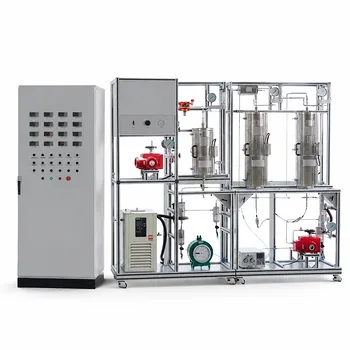
Higher temperatures exponentially increase the yield of hydrogen and carbon monoxide in a steam reforming pilot plant because the main reforming reaction is highly endothermic. While thermodynamic equilibrium demands temperatures above 1400 K (1127°C) for complete methane conversion at high pressure, you cannot simply crank up the heat. The practical limit is strictly capped at approximately 1200 K (927°C) by the metallurgical failure point of the reformer tube alloys.
The core takeaway: High temperature is your primary lever to maximize synthesis gas yield, but your operating ceiling isn't thermodynamic equilibrium—it's the physical integrity of the reactor. Your real-world limit is roughly 1200 K, and balancing the risk of tube rupture against marginal yield gains defines the operational art of this unit.
The Thermodynamic Drivers of Synthesis Gas Equilibrium
The production of synthesis gas from methane is a classic chemical equilibrium easily manipulated by temperature. In a pilot plant setting, where the goal is to demonstrate and quantify these fundamental principles, understanding the "why" is just as critical as knowing the "how."
The Endothermic Heart of the Reaction
The dominant reaction—methane reacting with steam (CH₄ + H₂O ⇌ CO + 3H₂)—sucks in a massive amount of heat. Le Chatelier's Principle dictates that the equilibrium absorbs this added energy to drive the reaction forward.
This means the breakdown of methane into carbon monoxide and hydrogen is fundamentally a product of high-energy conditions. If you fail to deliver continuous, intense heat, the reaction simply won't proceed to any meaningful degree. The equilibrium composition swings directly with the energy input.
Why the CO and H₂ Curves Rise Together
As you increase the temperature, the equilibrium concentrations of hydrogen (H₂) and carbon monoxide (CO) increase in lockstep. This is because they appear on the same side of the equilibrium equation. The endothermic nature of their formation means their mole fractions don't just increase linearly; they increase significantly as you push the system past the point where methane and steam are stable. A high-temperature environment is their preferred thermodynamic habitat.
The Real-World Temperature Ceiling in a Pilot Plant
Any chemical engineering student or researcher can calculate the theoretical sweet spot on paper. Operating a pilot plant forces a confrontation with physical reality. This is where the lesson shifts from a textbook equation to a hard engineering compromise.
The Metallurgical Bottleneck
The primary reference highlights a stark disparity: at a system pressure of 30 bar, complete equilibrium conversion demands temperatures exceeding 1400 K. However, the practical ceiling sits at just 1200 K.
This is not a suggestion but a hard stop dictated by material science. The nickel-chromium alloys in your reformer tubes lose tensile strength and begin to creep rapidly as they approach their failure point. Operating beyond this limit isn't a process optimization problem; it's a catastrophic safety event waiting to happen.
The Kinetic Intensification Effect
Even within the safe sub-1200 K window, temperature remains a powerful tool for process intensification. An increase from 650°C to 850°C doesn't just shift equilibrium—it slingshots the reaction kinetics forward.
In a pilot plant utilizing microchannel architectures, this temperature jump can triple the allowable space velocity (GHSV from 83,000 to 257,000 hr⁻¹). This directly translates to a dramatically smaller reactor core volume (from 12.7 liters to just 4.1 liters for an equivalent output), a critical demonstration of how heat transfer innovation enables compact reformer design.
Understanding the Operational Trade-Offs
Pushing your pilot plant to its maximum temperature limit is not a cost-free decision. It introduces a cascade of secondary effects that must be carefully managed, often for reasons of catalyst longevity and product specification.
The Coking Danger Zone: Above 700°C, the risk profile changes. If you are operating with insufficient steam, the high temperature can trigger the thermal cracking of methane. This deposits solid carbon directly onto your catalyst bed, an event that rapidly deactivates the catalyst and raises the pressure drop in a matter of hours. A high steam-to-carbon ratio is your insurance policy against the destructive potential of these temperatures.
Shifting Product Ratios: As you increase temperature, you also alter the CO:CO₂ ratio in the product gas, pushing selectivity toward carbon monoxide. While CO is a desired component of synthesis gas, an excessively high CO:CO₂ ratio can create an unbalanced feed for downstream units, increasing the purification load and complexity of a subsequent water-gas shift reactor.
The Energy Penalty: Running at the ragged edge of 1200 K demands an enormous energy input, not only to heat the reactants but also to vaporize the enormous volumes of steam needed to suppress coking. This creates a significant operating cost penalty that must be justified by the corresponding gain in product yield.
Making the Right Choice for Your Pilot Plant Goal
Your target temperature setting depends entirely on what research or teaching objective you are demonstrating. Use the following goals to calibrate your operational envelope.
- If your primary focus is demonstrating thermodynamic principles: Operate across a wide temperature sweep (e.g., 650-850°C), measuring equilibrium compositions at each stage to plot the conversion curve against the theoretical maximum.
- If your primary focus is maximizing catalyst productivity and throughput: Run at the highest safe temperature your catalyst allows (subject to the 1200 K metallurgical limit), while ensuring your heat exchange architecture can sustain the kinetic limits.
- If your primary focus is catalyst longevity and stable operation: Avoid the high-temperature peak entirely; operate in a moderate range of 800-850°C with a generously high steam ratio to suppress carbon deposition and prevent sintering.
- If your primary focus is demonstrating process intensification with microchannels: Compare the space velocity achievable at a low 650°C benchmark against a high-temperature 850°C run, visually quantifying the reduction in required reactor volume.
The key to unlocking the educational and research value of a steam reforming pilot plant lies in treating temperature not as a setpoint, but as a calculated trade-off between the thermodynamic ideal and the physical durability of the system.
Summary Table:
| Operational Parameter | Value / Range | Operational Impact |
|---|---|---|
| Thermodynamic Demand | >1400 K (1127°C) | Required for complete methane conversion at 30 bar |
| Metallurgical Limit | ~1200 K (927°C) | Critical ceiling to prevent reformer tube rupture |
| Kinetic Intensification | 650°C - 850°C | Triples GHSV, significantly reducing reactor size |
| Coking Threshold | >700°C | Requires high steam-to-carbon ratio to prevent carbon buildup |
Bring Advanced Engineering to Your Lab with LABPARK
Ready to explore chemical equilibrium and reaction kinetics in action? LABPARK provides high-quality Educational and Vocational Unit Operations Pilot Plants in chemical engineering, bioprocess & biotech, and environmental & water treatment.
Specifically designed for universities, research institutes, and enterprises, our systems offer the metallurgical safety, control precision, and durability needed for cutting-edge training and research.
Contact LABPARK today to find the perfect pilot plant solution for your institution!
Related Products
- Steam Methane Reforming Hydrogen Production and Purification Educational Pilot Plant
- Dual-Mode Rectification Pilot Plant for Practical Training Unit Operations
- Dual Mode Heat Transfer Pilot Plant for Unit Operations Training
- Three-Tube Heat Transfer Educational Pilot Plant for Unit Operations Training
- Multi-Modal Distillation Unit Operations Training Pilot Plant
People Also Ask
- How Do Temp, Pressure & S:C Ratio Affect Methane Reforming? Optimize Your Pilot Reactor
- How to Integrate WGS & Purification in Steam Reforming Pilot Plants to Protect Fuel Cells from CO Poisoning
- What are the differences between steam reforming and ATR in pilot plants? Key Design Guide
- How is carbon deposition controlled in steam reforming? The Critical Role of S/C Ratio
- What is the difference between allothermal and autothermal steam reforming in pilot plants?