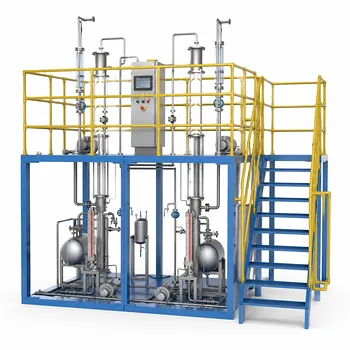
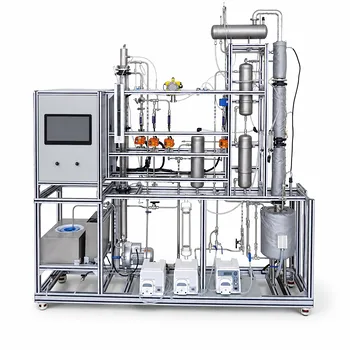
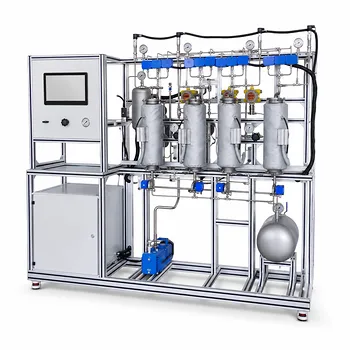
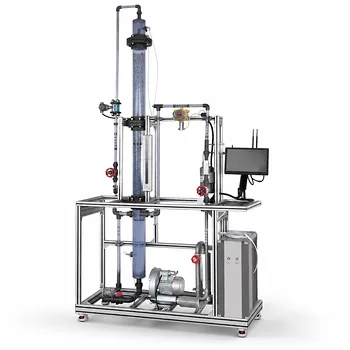
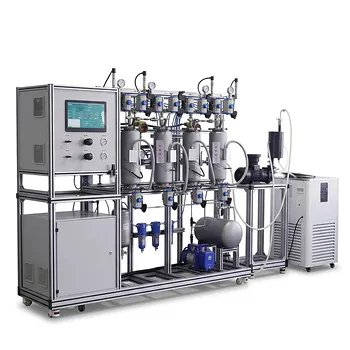
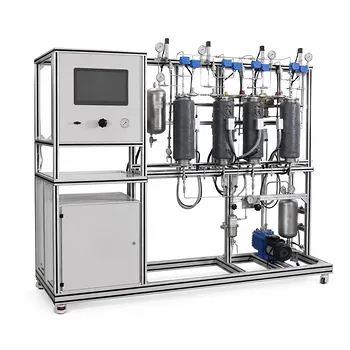
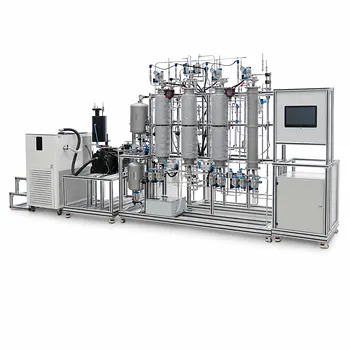
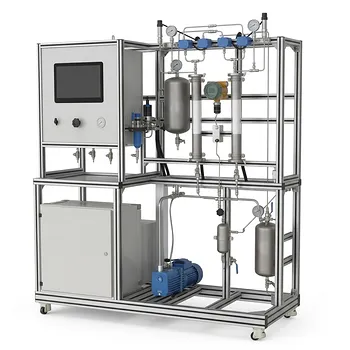
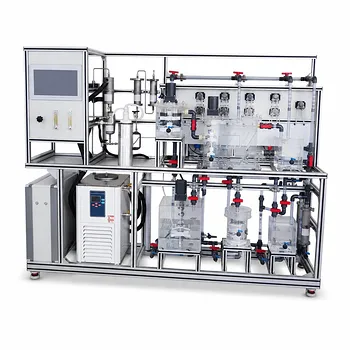
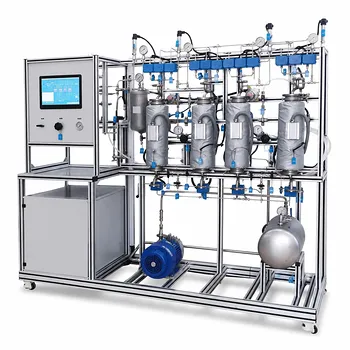
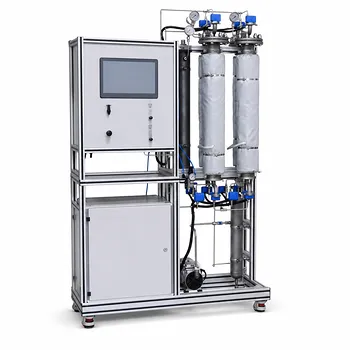
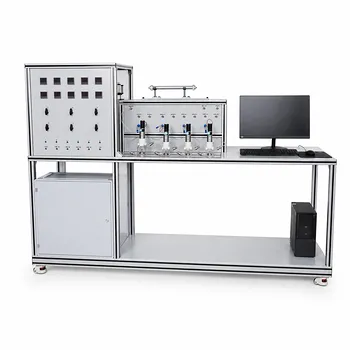
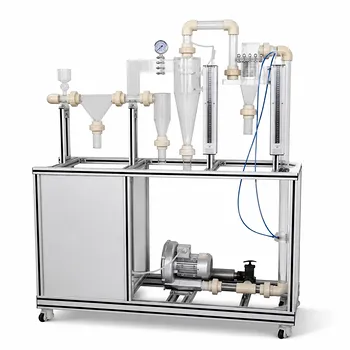
The fundamental answer is straightforward: Gas solubility decreases as temperature rises and increases as partial pressure increases. In a gas absorption pilot plant, these effects are studied by precisely manipulating the solvent's temperature and the system's gas pressure, then measuring the resulting concentration changes in both liquid and gas streams.
Understanding these phase-equilibrium shifts is the bedrock of designing scrubbing, degassing, and solvent regeneration processes. In a pilot plant, students and engineers don’t just memorize the curves—they see how a cold, high-pressure column drives absorption and how a hot, low-pressure column drives stripping, then use that data to build and validate mass-transfer models.
How Temperature Governs Solubility in Absorption
The Thermodynamic Link
Gas solubility in a liquid almost always decreases as temperature increases. This is a direct consequence of Henry’s Law for dilute mixtures: the Henry’s coefficient ((E)) rises with temperature, meaning the liquid holds less gas at equilibrium for the same partial pressure.
When the solvent inlet temperature is chilled via a heat exchanger, more of the target gas (like ammonia or CO₂) transfers from the gas phase into the liquid. You can measure this directly by sampling the outlet streams and watching the solute concentration in the liquid climb.
Using Temperature to Strip
Raising the solvent temperature reverses the driving force. The dissolved gas becomes less stable in the liquid phase and migrates back into the gas stream. This is exactly how pilot plants simulate industrial solvent regeneration loops.
By sweeping the temperature across a set range and holding all other parameters steady, students map out the solubility curve for a specific gas-solvent pair. They quantify how much extra energy (heating) is needed to release a given amount of solute—a direct economic input for full-scale design.
How Pressure Dictates the Driving Force
Partial Pressure as the Engine of Mass Transfer
According to Dalton’s law, increasing the total pressure of the gas phase increases the partial pressure of the solute gas. Higher partial pressure simultaneously raises the equilibrium concentration in the liquid and steepens the concentration gradient across the gas-liquid interface.
The result: a larger mass-transfer driving force. This is why pilot plants equipped with back-pressure regulators show a near-linear gain in absorption rate when the column pressure is raised, as long as the gas film resistance is the limiting factor.
A Critical Clarification: Solubility vs. Diffusion
Raising system pressure does something counterintuitive to another key parameter: it lowers the gas-phase diffusion coefficient ((D \propto 1/p)). Slower diffusion can partially offset the gain from higher solubility.
In a pilot-plant run, you might see absorption efficiency plateau at very high pressures because molecules can’t reach the liquid interface as quickly. This trade-off is a central teaching moment—the net mass-transfer rate is a dance between thermodynamic solubility and kinetic transport.
How Gas Absorption Pilot Plants Turn Theory into Measurable Data
Instrumentation That Reveals the Invisible
A properly set up gas absorption pilot plant is a living phase-equilibrium calculator. Gas mass flow controllers and precision back-pressure valves hold the gas-side conditions constant. Coriolis or magnetic flow meters track the liquid solvent rate, while heat exchangers and thermocouples control and record inlet and outlet temperatures.
The magic happens at the sampling points. Students take liquid-phase samples (often via in-line conductivity probes for ionic solutes, or gas chromatography for organic vapors) and gas-phase samples at the column’s inlet and outlet. Comparing the two gives a direct measurement of the number of moles transferred.
From Steady-State Data to Henry’s Coefficients
By running the column at steady state with at least three different temperatures—and then three different pressures—you can calculate the apparent Henry’s coefficient under each condition. Plotting (\ln(E)) against (1/T) gives the exponential relationship, confirming the van’t Hoff-like dependence.
These experiments make abstract thermodynamic equations tactile. Students see that a (10^\circ\text{C}) drop in solvent temperature might double the absorber capacity, a fact that directly informs cooling utility sizing in a real plant.
Simulating Both Absorption and Stripping in One Loop
Educational pilot plants often integrate both columns in a closed-loop system. In the absorption column, you run low temperature, high pressure to load the solvent. The rich solvent then passes through a heater and enters a stripping column operating at high temperature, low pressure.
By measuring the gas released in the stripper versus what was absorbed, students close the material balance and learn how plant engineers optimize the energy penalty of solvent regeneration—the single largest operating cost in post-combustion carbon capture, for example.
Understanding the Trade-offs and Common Pitfalls
The Solubility-Rate Paradox
A common beginner’s error is to chase the highest solubility by using the coldest possible solvent and the highest possible pressure. While this maximizes the equilibrium driving force, it can cripple the mass-transfer rate if the solvent viscosity rises sharply at low temperature.
Thick, cold liquid reduces the liquid-film mass-transfer coefficient, potentially leading to a poorer overall removal despite a favorable equilibrium. In a pilot plant, you measure the actual outlet gas concentration, not just theoretical solubility, so the impact of viscosity and diffusion is baked into the results.
Ignoring the Heat of Absorption
Absorption is rarely isothermal in practice. The solution enthalpy released when gas dissolves can raise the liquid temperature inside the column, locally eating away the solubility advantage you thought you had by chilling the inlet.
Pilot plants with temperature sensors at multiple column heights reveal this thermal profile. Without that data, full-scale designs risk undersizing the cooling demand and overestimating performance.
Pressure as a Double-Edged Sword
While making the solubility driving force stronger, higher system pressure also demands thicker column walls, higher-rated pumps, and more expensive flange seals. The pilot plant can demonstrate that beyond an economically optimal pressure, the marginal gain in solubility doesn’t pay for the capital-cost jump.
Similarly, running stripping at too low a pressure requires a vacuum system that pulls in a massive volumetric flow of low-density gas, raising the column diameter drastically. The pilot plant lets you find the economic breakpoint where a little extra steam (higher temperature) is cheaper than a giant vacuum vessel.
Making the Right Choice for Your Pilot Plant Study
Your experimental plan should be shaped by what you’re trying to understand or prove. Here’s how to align your approach with your goal.
- If your primary focus is demonstrating the fundamental solubility relationships: Run a sweep of at least five temperatures while holding pressure and flow rates constant, then repeat the sweep at three different pressures. Plot the equilibrium loading data to build Henry’s law curves and compare against literature values.
- If your primary focus is optimizing an absorption process for maximum removal: Start at a baseline, then lower the solvent temperature stepwise while monitoring outlet gas concentration. Identify the point where viscosity penalties stall progress. Then increase pressure incrementally to find the economic ceiling.
- If your primary focus is studying solvent regeneration for a carbon capture or scrubbing process: Operate the absorber at fixed optimal conditions and vary the stripper’s temperature and pressure. Use the gas evolved in the stripper to calculate the energy per kilogram of gas released, creating a parametric map of regeneration efficiency.
- If your primary focus is building a rigorous mass-transfer model: Collect local concentration data along the column at multiple temperature-pressure combinations. Use these profiles to extract the volumetric mass-transfer coefficients and confirm whether the liquid- or gas-side resistance dominates under your chosen conditions.
By treating temperature and pressure not as obstacles but as deliberate knobs, your pilot plant work moves from a simple demonstration to a predictive design tool—giving you the data to size real-world absorbers with confidence.
Summary Table:
| Parameter | Variation | Effect on Solubility | Mass-Transfer Impact | Pilot Plant Control |
|---|---|---|---|---|
| Temperature | Increase | Decreases | Reduces absorption capacity; drives stripping | Heat exchangers & heaters |
| Temperature | Decrease | Increases | Boosts absorption capacity; may increase viscosity | Chiller units |
| Pressure | Increase | Increases | Drives absorption via higher partial pressure | Back-pressure regulators |
| Pressure | Decrease | Decreases | Facilitates solute release during stripping | Vacuum systems |
Bring Chemical Engineering Theory to Life with LABPARK
Are you looking to equip your lab with state-of-the-art training systems? LABPARK provides premium Educational and Vocational Unit Operations Pilot Plants in chemical engineering, bioprocess & biotech, and environmental & water treatment.
Designed specifically for universities, research institutes, and enterprises, our pilot plants feature precise instrumentation to help students and researchers accurately study phase equilibrium, mass transfer, and thermodynamics in real-world scenarios.
Contact us today to discover how LABPARK can elevate your engineering curriculum and research capabilities!
Related Products
- Dual-Mode Gas Absorption and Desorption Unit Operations Training Pilot Plant
- Carbon Dioxide Absorption and Desorption Educational Pilot Plant for Carbon Capture Studies
- Carbon Dioxide Adsorption and Capture Educational Unit Operations Pilot Plant
- Absorption and Desorption Educational Unit Operations Pilot Plant
- Packed Bed Absorption Educational Unit Operations Pilot Plant
People Also Ask
- How do two-film & penetration theories apply to gas absorption pilot plant teaching? Key pedagogical insights.
- How is the direction and driving force of mass transfer determined in a gas absorption unit operations pilot plant?
- How does partial pressure behavior influence gas absorption pilot plants? Master Mass Transfer
- What are the limitations of Henry's Law in gas absorption pilot plants? Avoid critical lab errors.
- How to model chemical absorption as physical absorption? The pilot plant simplification criterion.