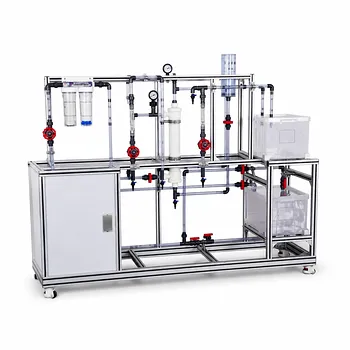
Single-loop systems are simpler, while multi-loop systems are usually more membrane-area efficient. In a continuous feed-and-bleed membrane filtration plant, a single-loop configuration processes material at the final target retentate concentration throughout the membrane module. A multi-loop configuration divides the duty across stages, allowing earlier modules to operate at lower concentrations and higher average permeate flux, which can significantly reduce the total membrane area required.
The central trade-off is simplicity versus efficiency: single-loop systems are easier to operate and teach, while multi-loop systems better demonstrate industrial optimization of flux, membrane area, energy use, and process footprint.
How Feed-and-Bleed Configurations Maintain Continuous Operation
The Basic Operating Principle
A feed-and-bleed system continuously adds feed to a process loop while withdrawing a controlled retentate or bleed stream. Permeate passes through the membrane, and the remaining retentate is recirculated or directed to the next processing stage.
This balance allows the plant to approach a steady-state operating condition rather than relying on repeated batch cycles.
Why Steady State Matters in Training
Steady-state operation lets students observe how feed rate, bleed rate, concentration, pressure, and permeate flux interact over time. It also creates a practical setting for comparing laboratory measurements with process-design assumptions.
For bioprocessing, this can represent continuous cell or biomass removal from fermentation broth. For chemical engineering, it demonstrates how a separation behaves when material continuously enters, leaves, and recirculates within a process.
How Single-Loop Systems Work
One Loop at the Final Concentration
In a single-loop configuration, the membrane module operates with material near the final target retentate concentration. The system is conceptually straightforward because the entire separation duty is performed under one primary set of concentration conditions.
The feed-and-bleed balance determines the amount of material retained, removed as permeate, and discharged as bleed.
The Effect on Permeate Flux
As concentration increases, membrane performance can become less favorable because the concentrated retentate presents greater resistance to transport. Concentration polarization and fouling may also become more influential, depending on the feed and membrane.
Consequently, the single-loop module may operate at a relatively low permeate flux, even though it must process the full continuous throughput.
The Membrane-Area Consequence
A lower average flux means that more membrane surface area is needed to achieve a given permeate production rate. This can increase equipment size, capital cost, footprint, and the amount of membrane that must be cleaned and maintained.
The single-loop design therefore provides a clear teaching example of how operating at a difficult final concentration can drive equipment requirements.
How Multi-Loop Systems Work
Dividing the Separation Into Stages
A multi-loop configuration divides the overall concentration or separation duty into several feed-and-bleed loops. Each loop operates with a different concentration range, and the material moves progressively toward the final target concentration.
The first loop receives the least concentrated process stream, while later loops handle progressively more concentrated material.
Preserving Higher Flux in Earlier Loops
The earlier loops operate at lower feed concentrations than the final single-loop system. Their membranes can therefore maintain a higher average permeate flux, allowing them to process material more efficiently per unit of membrane area.
Later loops still face the challenging high-concentration conditions, but the overall system benefits from distributing the duty across stages.
Reducing Total Membrane Area
Because the earlier loops operate at higher flux, the combined membrane area required for the multi-loop plant can be significantly lower than that of an equivalent single-loop system. The improvement comes from the distribution of flux across the concentration profile rather than from eliminating the high-concentration separation step.
This makes multi-loop operation especially valuable for demonstrating industrial process intensification and footprint reduction.
What Students Learn From the Comparison
Flux Distribution and System Optimization
A single-loop plant helps students see the direct relationship between target concentration and membrane performance. A multi-loop plant adds the more advanced concept that where a membrane operates can matter as much as the total separation duty.
Students can compare flux in each loop and evaluate how staging changes the average performance of the complete system.
Equipment Sizing
The two configurations illustrate why membrane area cannot be selected from throughput alone. The required area also depends on concentration, flux, and the operating conditions assigned to each module.
This gives learners a practical basis for connecting laboratory data to pilot-scale equipment sizing.
Energy and Footprint
Multi-loop systems can reduce the total membrane area and associated equipment footprint. They can also support more efficient process layouts, although the complete energy balance must include recirculation, pumping, pressure requirements, and cleaning.
The comparison therefore teaches students to assess both separation performance and whole-system resource use.
Bioprocess Applications
In fermentation, membrane filtration can continuously separate cells or biomass from broth and can concentrate heat-sensitive products such as enzymes before further purification. A pilot plant allows students to examine how continuous membrane operation can replace slower manual harvesting steps.
The setup also highlights the importance of preserving product activity when concentration methods must avoid thermal damage.
Choosing Membrane Modules for Training Plants
Polymeric Membranes
Polymeric membranes made from materials such as cellulose acetate, nylon, PTFE, PVDF, and polysulfone are widely available for microfiltration and ultrafiltration. They generally offer a lower initial cost, making them practical for standard biological separations and budget-sensitive training systems.
Their suitability depends on compatibility with the process fluid, cleaning chemicals, temperature, pressure, and required membrane performance.
Ceramic Membranes
Ceramic modules provide high chemical resistance, mechanical strength, and thermal stability. These properties make them well suited to harsh cleaning cycles and processes requiring high-temperature sterilization.
Their higher cost can be justified in pilot plants that require repeated intensive use, aggressive cleaning, or long service life.
Matching the Module to the Educational Objective
For basic demonstrations of flux, concentration, and feed-and-bleed control, polymeric modules may provide a cost-effective platform. For advanced training involving chemical cleaning, steam sterilization, durability, or demanding chemical separations, ceramic modules expose students to a broader range of industrial design considerations.
The module material should support the learning objective without obscuring the main comparison between single-loop and multi-loop operation.
Understanding the Trade-offs
Single-Loop Simplicity
The main advantage of a single-loop system is operational simplicity. It requires fewer modules, fewer interconnections, and fewer concentration-control points, making it easier to install, troubleshoot, and explain.
Its limitation is that the entire membrane duty is performed near the final concentration, where flux is comparatively low and membrane area requirements can be larger.
Multi-Loop Complexity
A multi-loop system offers better flux distribution and can reduce total membrane area. It also provides richer training opportunities because students can examine how operating conditions change from one loop to the next.
The trade-off is increased system complexity, including additional pumps, controls, modules, sampling points, and operating decisions.
Misinterpreting Area Reduction
Multi-loop staging does not guarantee lower total energy consumption in every design. Additional loops can introduce pressure losses, recirculation demands, and control requirements that must be evaluated alongside the membrane-area reduction.
Students should compare the full process, not judge the configuration from membrane area alone.
Ignoring Cleaning and Materials Compatibility
A membrane that performs well during filtration may still be unsuitable if it cannot tolerate the required cleaning or sterilization procedure. Chemical resistance, thermal stability, mechanical strength, and expected service life are part of the practical design decision.
This is particularly important in bioprocess training, where hygiene and repeatable cleaning are central operating requirements.
Making the Right Choice for Your Goal
The best configuration depends on whether the plant is intended primarily to teach basic operation or to demonstrate industrial process optimization.
- If your primary focus is introductory unit-operation training: Choose a single-loop feed-and-bleed system to make steady-state balances, concentration control, and basic membrane behavior easier to understand.
- If your primary focus is membrane-area reduction: Choose a multi-loop system so learners can study staged concentration, flux distribution, and the effect of operating conditions on equipment sizing.
- If your primary focus is bioprocess harvesting: Use a configuration and membrane material that support reliable biomass separation, product concentration, cleaning, and preservation of heat-sensitive product activity.
- If your primary focus is advanced chemical engineering design: Use multi-loop operation to evaluate membrane area, recirculation, pressure, energy demand, control complexity, and process footprint together.
A single-loop plant teaches the fundamentals clearly, while a multi-loop plant shows how those fundamentals are used to design a more efficient continuous separation process.
Summary Table:
| Comparison factor | Single-loop configuration | Multi-loop configuration |
|---|---|---|
| Operating principle | Processes material near the final target concentration in one loop | Divides concentration duty across multiple staged loops |
| Main advantage | Simple operation, installation, and teaching | Higher average flux and lower potential membrane area |
| Membrane flux | Often lower because the module handles concentrated retentate | Higher in earlier loops operating at lower concentrations |
| Equipment requirements | Fewer modules, pumps, controls, and sampling points | More modules, interconnections, controls, and operating decisions |
| Training value | Teaches steady-state balances, concentration control, and basic membrane behavior | Demonstrates staging, process optimization, equipment sizing, and flux distribution |
| Key limitations | May require more membrane area and a larger footprint | Greater complexity, recirculation demands, pressure losses, and control requirements |
| Suitable applications | Introductory unit-operation and basic membrane training | Advanced chemical engineering, process intensification, and optimization training |
Design a membrane filtration training plant that matches your teaching, research, or production goals with LABPARK. We provide Educational and Vocational Unit Operations Pilot Plants for universities, research institutes, and enterprises, including continuous feed-and-bleed systems for bioprocess and biotech, chemical engineering, and environmental and water treatment applications. Our configurable pilot plants help learners and technical teams study steady-state operation, flux behavior, concentration control, membrane-area sizing, energy use, cleaning, and process scale-up in a practical environment. Contact LABPARK to discuss a single-loop system for straightforward fundamentals or a multi-loop system for advanced process optimization, and receive guidance on modules, membrane materials, controls, and pilot-plant configuration.
Related Products
- Ultrafiltration Membrane Separation Educational Pilot Plant
- Constant Pressure Filtration Educational Unit Operations Pilot Plant
- Multifunctional Membrane Separation Educational Pilot Plant with Ultrafiltration, Nanofiltration, Reverse Osmosis
- Hollow Fiber Ultrafiltration Membrane Separation Educational Pilot Plant
- Multi Functional Membrane Crystallization Educational Unit Operations Pilot Plant
People Also Ask
- Pervaporation vs. Vapor Permeation: Handling Suspended Solids in Membrane Pilot Plants
- How do PEI, PVDF, and PSU membranes compare in pilot plants? Find the best fit.
- Why Use a Membrane Separation Pilot Plant vs. Lab Testing? Avoid Costly Scale-Up Failures
- How do membrane pilot plants demonstrate synthetic vs biological membrane advantages?
- Isotropic vs. Anisotropic Membranes: How to Choose the Best Pilot Plant Modules