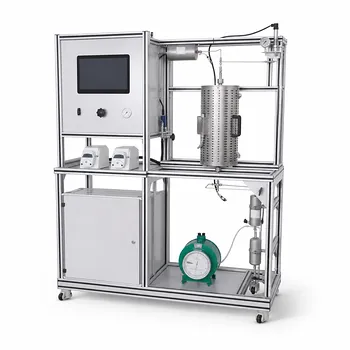
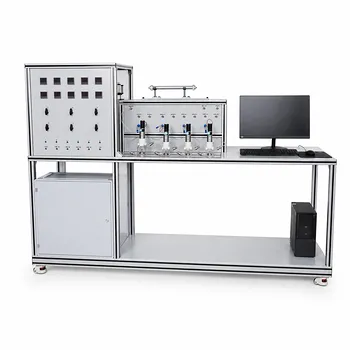
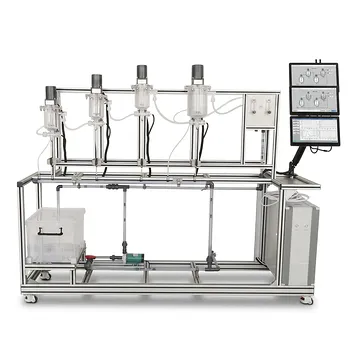
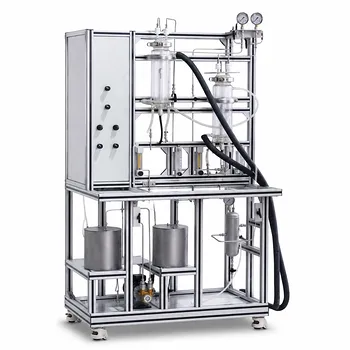
Understanding screening configurations is the difference between a qualitative catalyst survey and a predictive scale-up study. Primary screening in parallel reactors emphasizes high throughput (often over 100 samples) but sacrifices individual sample control, leading to results that are often qualitative due to undefined space velocities and potential cross-talk between reactors. Secondary screening, by contrast, uses a smaller reactor matrix (16–80 reactors) with near-plug-flow operation, absolute elimination of cross-talk, and independent control of temperature, pressure, and flow rates for every unit. This distinction directly determines whether pilot plant data is good enough for accurate kinetic modeling, catalyst deactivation studies, and reliable scale-up.
The core difference is a trade-off between sample volume and data fidelity. Primary screening casts a wide net for discovery but yields data that cannot be directly translated to process design. Secondary screening replicates pilot plant conditions, delivering the quantitative, representative data that makes scale-up predictable and safe. Your pilot plant’s success hinges on knowing which mode to use at which stage.
The Core Difference: Throughput vs. Data Fidelity
Primary Screening: High-Volume Discovery
Primary screening units are built for speed. They routinely test over 100 catalyst candidates in parallel, generating a broad landscape of activity trends. Because individual reactor environmental control is minimal, space velocities are often undefined and reactors can influence each other (“cross-talk”). This yields qualitative ranking data, not precise kinetic parameters. This approach is excellent for triaging large libraries, but results cannot be used to design a pilot plant or predict long-term catalyst behavior.
Secondary Screening: Mimicking Pilot Plants
Secondary screening units contain 16 to 80 reactors, each operated as a plug-flow-like micro-reactor with independent process control. There is zero cross-talk between reactors, and sampling is truly representative of each catalyst’s performance under well‑defined conditions. By decoupling temperature, pressure, and flow rates for every cell, these units behave like miniature pilot reactors—capturing activation curves, deactivation patterns, and intrinsic kinetics with quantitative accuracy.
Why This Distinction Matters for Pilot Plant Design
The Need for Quantitative Kinetic Data
A pilot plant is fundamentally an experiment in scale-up predictability. It must reduce uncertainty in reaction kinetics, heat management, and catalyst lifetime. Primary screening’s qualitative nature cannot provide the intrinsic rate constants, activation energies, or deactivation models required to design and operate a pilot unit safely. Secondary screening, by contrast, delivers mass-balance-quality data that plugs directly into reactor models, making it the only rational front end for a pilot plant campaign.
Avoiding Cross-Talk and Control Limitations
Cross-talk in primary arrays can mimic activity where none exists, or mask a superior catalyst due to thermal or atmospheric bleed from an adjacent reactor. When you can’t set a precise space velocity for each sample, you lose the ability to compare turnover frequencies or normalize kinetics across candidates. A pilot plant demands individual reactor fidelity. Secondary configurations enforce that decoupled control, ensuring that every data point is a trustworthy building block for scale-up calculations.
Automation and Unattended Operation
Modern secondary screening platforms integrate with automation and informatics modules—often using software like LabVIEW—to run fully unattended, multi-step test protocols. Real-time monitoring of temperatures, flow rates, pressures, and sampling sequences, along with safety alarm triggers, lets a single pilot plant study mimic weeks of continuous operation autonomously. Automation elevates secondary units from a simple catalyst test to a robust process development tool, generating dense, time-resolved data sets for kinetic model validation.
Catalyst Retention Configurations in Pilot Units
When the pilot plant involves catalytic membrane reactors or immobilized catalysts, secondary screening units can incorporate specific retention strategies that mirror industrial operation. These include ultrafiltration or nanofiltration membranes to retain mobile catalysts (e.g., enzymes, homogeneous catalysts), immobilization of the catalyst directly within the membrane pore structure, or the use of a membrane that is itself catalytically active (e.g., Pd or zeolite membranes). Testing these configurations in a secondary screening format connects lab kinetics with real separation-integrated processes, teaching researchers and engineers how reaction and separation couple in a single unit operation.
Understanding the Trade-offs
Primary screening shines when speed and sample breadth outweigh data depth. It consumes fewer resources per data point and quickly identifies promising leads. However, that speed comes at the cost of reliability and quantitative rigor—exactly the attributes that pilot plant design cannot compromise. Secondary screening requires more capital, higher per-sample cost, and lower total throughput. Yet for any study that must feed directly into a pilot plant or kinetic model, this investment is non-negotiable. Further, the complexity of independent flow controllers, thermocouples per reactor, and full automation means longer setup times and more demanding maintenance routines.
Making the Right Choice for Your Pilot Plant
Choosing between primary and secondary screening isn’t about which is “better”—it’s about matching the method to your development phase and final goal.
- If your primary focus is rapid catalyst discovery and library narrowing: Deploy primary screening to eliminate inactive candidates quickly. But treat the output as a ranking tool that requires later quantitative verification.
- If your primary focus is detailed kinetic modeling, scale-up, or catalyst deactivation studies: Invest exclusively in secondary screening configurations with individual reactor control, plug-flow behavior, and zero cross-talk. This is the only path to data you can trust for pilot plant design.
- If your primary focus is integrated reaction-separation processes (e.g., membrane reactors): Choose secondary screening units designed to accommodate catalyst retention—membrane housings, immobilization options, or catalytically active membranes—so that your data directly represents the intended pilot-scale operation.
By aligning your screening methodology with the inherent fidelity demands of pilot plant design, you replace guesswork with a solid engineering foundation.
Summary Table:
| Feature | Primary Screening | Secondary Screening |
|---|---|---|
| Throughput | High (100+ samples) | Medium (16–80 reactors) |
| Control Type | Minimal individual control | Independent T, P, and flow |
| Cross-Talk | Risk of cross-contamination | Zero cross-talk |
| Data Quality | Qualitative ranking | Quantitative kinetic data |
| Best For | Rapid library discovery | Scale-up & kinetic modeling |
Transitioning from catalyst screening to a complete pilot scale-up? LABPARK provides state-of-the-art Educational and Vocational Unit Operations Pilot Plants in chemical engineering, bioprocess & biotech, and environmental & water treatment. We help universities, research institutes, and enterprises bridge the gap between laboratory research and industrial-scale production. Contact us today to discuss your pilot plant needs!
Related Products
- Multi Functional Catalytic Reaction and Reactor Evaluation Educational Unit Operations Pilot Plant
- Methanol Synthesis and Catalyst Performance Evaluation Educational Unit Operations Pilot Plant
- Educational Unit Operations Pilot Plant for Intraparticle Diffusion Effective Factor Measurement
- Fixed-Bed Chemical Reaction and Gas Dust Tar Removal Unit Operations Pilot Plant
- Ethylbenzene Dehydrogenation Educational Unit Operations Pilot Plant
People Also Ask
- What reaction engineering principles are shown in a catalytic reactor pilot plant? SO2 Oxidation Guide
- Why is FTIR integration in catalytic pilot plants important? Real-Time Student Insights
- How to analyze active metal distribution & identify catalyst poisoning in pilot plants? Expert Diagnostic Guide
- How do temperature limits and WHSV influence catalytic reactor optimization? Scale-Up Guide
- What operational insights do catalyst pellet concentration profiles provide? Optimize Reactor Yield