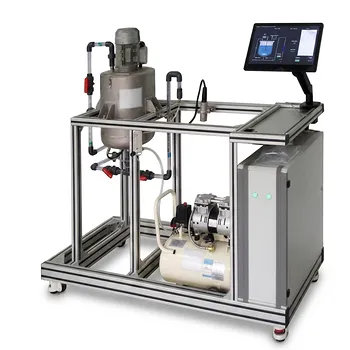
The gap between a laboratory curiosity and a commercial reality is bridged by the pilot-scale milling unit.
Pilot-scale milling units directly assist in evaluating size reduction technologies by allowing you to process small, representative batches under conditions that simulate full-scale production. You can quantitatively verify critical quality attributes like particle size distribution and observe how different mill mechanisms—from high-shear rotor-stators to heat-free jet mills—respond to your specific material. This hands-on evaluation turns abstract specifications into actionable data, de-risking the scale-up journey.
The fundamental value of a pilot-scale milling unit is not just producing a sample; it is building a validated, empirical bridge between a promising lab-scale result and a robust, predictable commercial process. It transforms scale-up from a guessing game into a controlled, data-driven exercise.
The Pilot-Scale Unit as a Technology Screening Ground
Testing Small Batches, Confirming Big Decisions
A pilot mill’s primary function is to generate tangible proof. By running small test batches, typically 10–100 g, you can verify whether a chosen technology delivers the target particle size distribution on your actual product. This immediate physical verification is far more reliable than theoretical calculations or data from dissimilar materials.
Differentiating Technology Mechanisms on Real Material
The true character of a milling technology emerges only when it meets your compound. Jet mills, for instance, are ideal for heat-sensitive compounds because their mechanism generates no heat. Conversely, high-shear rotor-stator wet mills excel at directly processing needle-like morphologies from crystallization slurries. A pilot trial lets you see these distinct mechanisms in action, preventing a catastrophic mismatch at scale.
Deconstructing the Critical Scale-Up Parameters
Translating Technology-Specific Variables to Commercial Success
Scale-up is less about size and more about controlling the physics of particle attrition. Pilot units make these physics transparent by isolating key parameters. The goal is to build a multivariate model you can trust, and that requires real data, not just assumptions.
Gas Pressures and Feed Rates
For jet mills, the relationship between gas pressure, feed rate, and final fineness can be non-linear. Pilot testing exposes the true operating window, showing you exactly how changes in pressure or throughput affect your product's PSD before you lock in compressor specifications for the plant.
Rotor Speeds and Slurry Concentrations
In wet milling, variables like rotor speed and slurry concentration are profoundly material-dependent. A pilot unit reveals the exact energy input required to achieve your target without over-processing or creating fines, and it validates that your slurry’s rheology remains manageable through the mill at production-consistent solid loadings.
Mitigating Technical Risk Beyond the Particle Size
Identifying Weak Points Before They Become Production Failures
A pilot plant is a failure-prevention tool. By running the milling process at a meaningful scale, you can uncover hidden risks such as screen blinding, unexpected heat buildup, or abrasive wear on mill internals. These weak points are cheap to fix during development and devastating to discover after startup.
Validating Process Models and Upset Scenarios
Pilot-scale experiments allow you to safely introduce process upsets—like fluctuating feed rates or momentary power drops—and observe the mill’s response. This empirical data validates your mathematical process models and proves that your interlocks and backup unit operations will prevent hazardous deviations in the commercial facility.
Understanding the Trade-offs and Limitations
No Pilot Unit is a Perfect Replica
It is critical to acknowledge that a pilot mill is a scaled-down version, not an identical miniature of a production machine. Certain geometric or energy-density factors may not scale linearly. The data it generates is a powerful predictor, not a perfect crystal ball. Discrepancies between pilot and full-scale thermodynamics can still exist.
The Cost of Certainty
Pilot-scale work requires an investment of time, material, and money. However, these costs must be weighed against the staggering financial and reputational risks of a failed scale-up. For processes involving difficult solids handling or unfamiliar continuous technologies, the technical risk is high enough that bypassing the pilot plant is rarely justifiable.
Making the Right Choice for Your Scale-Up Strategy
Your approach to pilot-scale milling should be defined by your primary business and technical objective. Use the following guide to frame your testing strategy.
- If your primary focus is technology selection: Use the pilot unit to run head-to-head trials of different mill types (e.g., jet vs. wet milling) on your actual compound, letting PSD and morphology data be the decisive factor.
- If your primary focus is de-risking scale-up: Design your pilot trials to systematically vary gas pressures, feed rates, and rotor speeds while introducing deliberate process upsets to validate your failure-prevention strategies.
- If your primary focus is building team capability: Leverage the pilot-scale training environment to help your engineers and operators develop a practical, intuitive understanding of how these mill parameters influence final product specifications before they touch the commercial system.
The smartest scale-up strategies are built not on hope, but on the solid, empirical foundation that only a wise investment in pilot-scale milling can provide.
Summary Table:
| Evaluation Aspect | Key Parameters Analyzed | Risk Mitigated |
|---|---|---|
| Jet Milling | Gas pressure, feed rate | Product degradation, heat buildup |
| Wet Milling | Rotor speed, slurry concentration | Screen blinding, rheology changes |
| Scale-up Physics | Energy input, particle attrition | Mismatched commercial PSD |
Ready to De-Risk Your Process Scale-Up?
Bridging the gap between laboratory research and commercial production requires reliable data and robust equipment. LABPARK provides premium Educational and Vocational Unit Operations Pilot Plants in chemical engineering, bioprocess & biotech, and environmental & water treatment. Designed specifically for universities, research institutes, and enterprises, our systems enable hands-on training, precise parameter evaluation, and reliable scale-up modeling.
Contact LABPARK today to discuss your pilot plant needs and accelerate your path to commercial success!
Related Products
- Agitation and Mixing Educational Unit Operations Pilot Plant
- Multi-Functional Drying Educational Unit Operations Pilot Plant
- Supercritical High-Gravity Flash Evaporation Educational Unit Operations Pilot Plant
- Multi-Modal Distillation Unit Operations Training Pilot Plant
- Methanol Synthesis and Catalyst Performance Evaluation Educational Unit Operations Pilot Plant
People Also Ask
- Why is the Reynolds number ($Re_M$) critical in mixing? Master N_P for pilot plants.
- What are the four guiding principles of process intensification? Educational Equipment Guide
- How do educational unit operations pilot plants support process analysis? Connect theory with real data
- How does the pseudobinary diffusion approximation simplify mass transport equations in educational pilot plants?
- Why is post-implementation performance evaluation and gap analysis critical when deploying educational unit operations pilot plants?