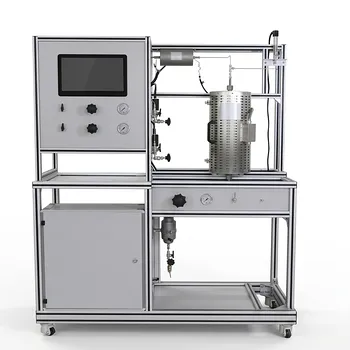
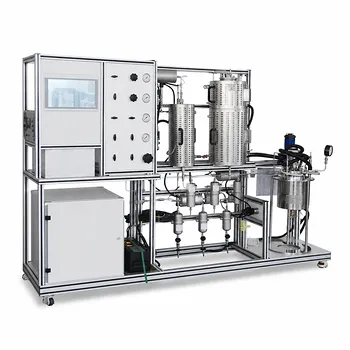
A pilot plant for chemical engineering education is a carefully designed, scaled-down replica of an industrial process flow sheet. It doesn’t just isolate single pieces of equipment; it links them into a continuous, functional chain of unit operations—from raw material preparation through reaction and separation to final product purification. By letting students manipulate temperature, pressure, and flow rates and instantly see the effects cascade through downstream units, these plants turn theoretical process design into a tangible, interactive learning experience.
The core insight is that educational pilot plants compress an entire industrial process flow into a modular, integrated system. This approach teaches not just each unit operation in isolation, but the system-level cause-and-effect relationships that define real chemical engineering—making the hidden interactions between reaction kinetics, mass transfer, and separation efficiency visible and measurable under safe, controlled conditions.
The Physical Re-Creation of an Industrial Flow Sheet
An industrial chemical process rarely succeeds on the strength of a single reactor or distillation column. It’s the orchestrated sequence—pretreatment, conversion, purification, and recycle—that delivers economic viability. A well-designed educational pilot plant mirrors this sequence physically.
More Than a Collection of Equipment
Traditional bench-top labs might demonstrate heat exchange or a simple distillation in isolation. That’s valuable, but it misses the bigger picture. A pilot plant puts these operations in series, exactly as they would appear on a piping and instrumentation diagram (P&ID). Students don’t just learn what a pump does; they learn what happens to the downstream distillation column when that pump’s flow rate fluctuates.
The Three Core Phases Reproduced at Scale
Every chemical process can be boiled down to three stages. An educational pilot plant gives each a dedicated, modular section:
- Physical Pretreatment Unit: This brings the raw feed to the right condition. Depending on the process, it might involve a vaporizer, a filtration skid, or a preheater. Students learn that without this step, reaction performance often craters.
- Reaction Unit (The Heart): A catalytic fixed-bed reactor, a continuous stirred tank, or a batch vessel. Here, students control space velocity, temperature, and pressure, directly measuring conversion and selectivity—the metrics that define an economic process.
- Separation and Purification Train: The crude product stream flows into a sequence of distillation columns, liquid-liquid extractors, crystallizers, or membrane units. The goal is to demonstrate how a complex mixture gets fractionated into on-spec product, side streams, and recycle loops.
The Closed Loop: Recycling and Post-Treatment
Industrial plants rarely send everything out as product. Educational pilot plants incorporate recycle streams and post-treatment (adsorption, scrubbing) to mirror the energy and mass integration that makes modern processes sustainable. This forces students to grapple with the accumulation of inerts, side-reaction byproducts, and the all-important “purge” concept.
From Blackboard to Real-Time Process Insight
The most profound learning happens when the ideal equations meet physical reality. A pilot plant creates exactly that moment—deliberately and safely.
Real-Time Parameter Manipulation Creates a Living Process
In a simulation, doubling the reactor temperature changes a number on a screen. In a pilot plant, the downstream distillation column immediately receives a hotter, possibly different-composition feed. Students watch the pressure drop across the column shift, reboiler duty chase the new conditions, and top-product purity drift. These real-time cause-and-effect relationships cannot be taught purely through theory.
Closing the Gap Between Model and Measurement
Students collect a stream of live data: flow rates, inlet/outlet temperatures, pressures, and concentration readings from inline analyzers or grab samples. They then perform systematic mass and energy balances. The exercise is revelatory. The numbers rarely balance perfectly. A 10% mass loss isn’t a mistake; it’s an invitation to investigate solvent evaporation in the vent line or a side reaction forming a heavy residue. This transforms abstract error analysis into a forensic process optimization skill.
Validating Simulation Models with Empirical Data
Modern process modeling software is powerful, but its correlations need validation. Educational pilot plants let students run an actual separation, measure real heat transfer coefficients, and then tune their Aspen or COMSOL models. They discover firsthand why “film theory” misses wall effects in a small column, or why a pressure drop correlation over-predicts for a particular packing material. This experience is what bridges the gap between a fresh graduate and a confident process engineer.
The Modular Architecture That Makes It Possible
The reason educational pilot plants can simulate such diverse industrial flows is their inherently modular design. They are not monolithic devices; they are building blocks.
Designing for Flexibility and Integration
A single pilot plant skid might offer interchangeable reactor types (fixed bed, fluidized bed), multiple separation options (distillation, extraction, membrane filtration), and jumper connections that allow students to reconfigure the flow path. This modularity lets one setup simulate the front-end of a refinery, a pharmaceutical intermediate synthesis, or a solvent recovery loop.
The Critical Role of Process Control and Instrumentation
An industrial process flow isn’t just pipes and vessels; it’s a controlled, automated system. Educational pilot plants embed programmable logic controllers (PLCs), distributed control system (DCS) interfaces, and process analytical technology (PAT). Students learn to set cascading control loops—like adjusting a steam valve to maintain a column’s batch composition—and witness the oscillatory consequences of a poorly tuned PID loop, reinforcing control theory in a way no textbook can.
Understanding the Trade-offs and Limitations
No scaled-down plant is a perfect replica. Being transparent about these limitations builds a more complete engineer.
The Scale-Down Penalty
A pilot-scale distillation column has a lower liquid holdup and a much higher surface-to-volume ratio than its industrial counterpart. This changes fluid dynamics, heat loss, and even the relative importance of wetted-wall effects. Students must learn to recognize when a performance metric (like plate efficiency) is being governed by small-scale physics, not intrinsic chemistry. A pilot plant teaches scale-down analysis as much as scale-up.
Simplified Material Handling and Safety
Educational plants operate at benign pressures and temperatures, often using benign simulant fluids (water, ethanol, acetic acid) instead of hazardous petrochemicals. This ensures safety and fast turnover but can mask challenges like catalyst coking, high-temperature corrosion, or fouling in heavy slurries. The compromise is accepted because the pedagogical goal is mastering the process architecture and unit interactions first.
Not a Direct Economic Predictor
Using a pilot plant to predict the full capital and operating cost of a commercial unit requires extensive correction factors. The educational goal is not to generate a precise economic forecast but to teach the principle of process intensification: showing how a reactive distillation column can slash both energy and equipment footprint versus a reactor-plus-separator train.
Making the Right Choice for Your Educational Goal
A well-designed pilot plant curriculum can target different learning outcomes. Your focus should drive how the plant is used.
- If your primary focus is teaching process integration: Configure the plant in a closed-loop sequence with recycle, and have students map the mass and energy balance across every unit under steady state and transient conditions.
- If your primary focus is bridging theory and physical reality: Run a single unit operation—like distillation—at multiple flow rates, compare measured tray efficiencies with the Fenske-Underwood-Gilliland predictions, and let the students tune the model until it matches.
- If your primary focus is modern process intensification: Use the modular reactor-separation skids to demonstrate reactive distillation or membrane-assisted synthesis, and quantify the simultaneous reduction in energy use and equipment volume compared to the traditional sequential setup.
- If your primary focus is scale-up methodology: Start at bench scale, move to the kilo lab, then to the pilot plant, and have students identify exactly which dimensionless numbers (Re, Nu, Da) break down at each stage and why.
A chemical engineering pilot plant is, in essence, the physical manifestation of your curriculum’s process design philosophy—it transforms a flow sheet from a drawing into a cause-and-effect engine that leaves no student wondering what actually happens between the arrows.
Summary Table:
| Process Phase | Educational Pilot Plant Function | Industrial Equivalence |
|---|---|---|
| Pretreatment | Vaporization, filtration, and preheating of raw feeds | Raw feed preparation and conditioning |
| Reaction | Control of kinetics, conversion, and selectivity in reactors | Commercial reaction systems (CSTR, Fixed-Bed) |
| Separation | Fractionation of mixtures via distillation or extraction | Product purification and solvent recovery |
| Recycle & Control | Closed-loop feedback, PLC/DCS automation, and mass recycling | Industrial process optimization and automation |
Bring Industrial-Scale Learning to Your Laboratory
Ready to bridge the gap between textbook chemical engineering and hands-on industrial reality? LABPARK designs and delivers premier Educational and Vocational Unit Operations Pilot Plants across chemical engineering, bioprocess & biotech, and environmental & water treatment.
We empower universities, research institutes, and enterprises to train future-ready engineers using safe, modular, and highly interactive systems.
Contact LABPARK today to find the perfect pilot plant configuration for your training and research needs!
Related Products
- Multimodal Absorption and Desorption Pilot Plant for Unit Operations Training
- Three-Tube Heat Transfer Educational Pilot Plant for Unit Operations Training
- Solid Waste Pyrolysis and Refining Educational Pilot Plant for Unit Operations
- Multi Pump Fluid Transport Process Piping Unit Operations Training Pilot Plant
- Carbon Dioxide Hydrogen Methanol Synthesis Educational Unit Operations Pilot Plant
People Also Ask
- How do predictive thermodynamic models integrate into pilot plants? Bridging Theory and Practice
- Which cross-validation strategy should be selected for pilot plant time-series & batch data? Avoid Data Leakage
- How can process control schemes be configured to teach basic and advanced control?
- Why Use Center Points in Process Analyzer Calibration? Key Benefits Explained
- How does polyphosphate hydrolysis affect scale and corrosion in pilot plants? Essential Monitoring Guide