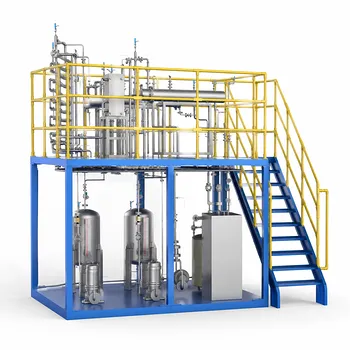
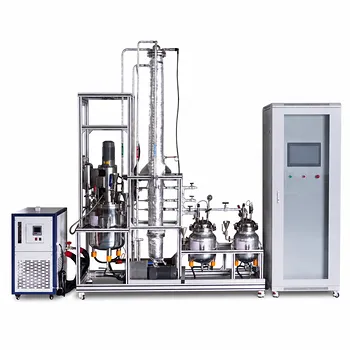
Pilot plants demonstrate exothermic temperature control and interstage quenching by physically splitting the reaction across multiple catalyst beds and introducing a colder fluid—often a reactant or inert gas—between them. This creates distinct, measurable temperature peaks and drops. By watching real-time sensor data along the reactor height, you can directly observe how each cold shot absorbs heat and resets the temperature for the next stage, keeping the whole system within a safe, selective window.
A multi-stage pilot plant makes the invisible visible. It transforms abstract thermodynamic limits into a live temperature profile you can monitor and manipulate, showing that quenching isn't just about cooling—it's a kinetic and equilibrium management tool that prevents runaway reactions, protects catalysts, and maximizes yield.
The Thermodynamic Challenge of Exothermic Reactions
In a single adiabatic bed, an exothermic reaction will cause the temperature to spike uncontrollably. This spike immediately creates two problems.
Heat Release Outpaces Heat Removal
Without staged cooling, the reaction front can exceed safe material limits. For benzene nitration, going past 80–120°C risks decomposition, pressure build‑up, and a runaway. That’s why a single stage isn’t enough.
High Temperatures Punish Selectivity and Equilibrium
For equilibrium-limited reactions like SO₂ oxidation to SO₃, higher temperatures slash the maximum possible conversion. A single bed may only hit 60–70% because the adiabatic rise pushes you into a thermodynamic corner. For MTBE synthesis, the exotherm (–37.5 kJ/mol) similarly forces you to balance fast kinetics with a cool exit.
How Multi-Stage Reactors Solve the Problem
Multi-stage pilot plants mimic industrial reality by breaking the reaction into adiabatic beds separated by cooling zones. Each bed adds conversion, and the cooling zones reset the thermodynamic starting point.
Adiabatic Beds with Intermediate Cooling
In a four‑bed sulfuric acid pilot plant, the gas leaves the first bed at a high temperature, then passes through a heat exchanger or air quench. This drop in temperature between beds shifts the equilibrium back in favor of SO₃ formation—enabling overall conversions of 98–99%.
Kinetic and Thermodynamic Balancing
For MTBE, the first reactor can run hotter (320–360 K) to exploit fast kinetics, while a downstream bed—cooled by a quench or recycle stream—drives the conversion higher. The pilot plant shows you this compromise in action through adjustable feed temperatures and flow rates.
Interstage Quenching: The Primary Cooling Mechanism
Quenching injects a cold fluid directly into the hot process stream between catalyst beds, absorbing heat instantly.
Cold Gas Injection in Action
In benzene hydrogenation, cold hydrogen gas is injected as the quench medium. The pilot plant lets you see how this rapid mixing pulls the temperature back below 300°C, protecting the catalyst from sintering and minimizing side products. Temperature sensors placed along the reactor height plot a saw‑tooth profile—rise, quench, rise, quench.
Quench Design Lessons
A pilot plant also teaches the downside of quenching: if the quench isn’t properly mixed, you can create cold spots that freeze the reaction, or if you over‑quench, you waste energy and may dilute reactants. These systems often include automated flow control valves tied to real‑time temperature readings, demonstrating how industrial safety logic (like high‑temperature interlocks) functions.
How Pilot Plants Visualize and Control Temperature Profiles
Educational and research pilot plants are designed to make thermodynamic principles tangible.
Instrumentation and Real‑Time Feedback
Temperature sensors along the axis of a multi‑bed reactor generate a live temperature profile. In a benzene alkylation setup, students watch the exothermic peak in each bed and then see the immediate drop when cold ethene quench is introduced. This direct observation turns a theoretical heat balance into a dynamic, controllable system.
Heat Transfer System Demonstrations
Not all cooling is direct quenching. Fluidized bed pilot plants for nitrobenzene hydrogenation use internal heat transfer tubes with thermal fluids to remove heat continuously. Multi‑tubular fixed‑bed reactors for propylene oxidation circulate molten salt in jackets to keep the whole bed nearly isothermal, even generating steam. By measuring flow rates and temperature differentials, you can calculate heat transfer coefficients and verify energy balances.
Process Integration and Safety Logic
Some pilot plants combine multiple unit operations—like distillation trains for olefin purification—so you can see how reactor temperature control affects downstream separation. Automated cooling systems with interlocks show exactly how a plant prevents a nitration runaway: if a thermocouple exceeds a safety limit, the quench flow instantly increases or the feed shuts off.
Real‑World Examples from Pilot‑Plant Curriculum
Sulfuric Acid and SO₂ Oxidation
The four‑bed SO₂ reactor demonstrates the classic “cool then convert” strategy. You can observe that after each cooling step, the conversion jumps, and with double absorption (removing SO₃ between beds), you push past 99.7%. This visually cements the link between temperature, equilibrium, and separation.
Benzene Hydrogenation and Gas‑Phase Alkylation
Both use direct quench with a cold reactant. In the pilot plant, you can vary the quench flow rate and immediately see the peak temperature changes on a strip chart. This teaches proportionality—how much cooling is needed per unit of conversion—a critical scale‑up skill.
Liquid‑Phase Exothermic Nitration
While the primary demonstration uses jackets and internal coils, the principle is the same: the heat generation rate (~134 kJ/mol) must be matched by heat removal. The pilot plant’s automated control loops and safety alarms demonstrate the margin between normal operation and thermal runaway, making risk tangible.
Understanding the Trade‑offs and Limitations
Quench Dilution and Reactant Consumption
Injecting cold reactant as quench changes the composition: it can shift the reaction equilibrium backwards or dilute the product stream. In the pilot plant, you’ll see that too much cold hydrogen reduces the overall benzene conversion per pass, requiring a larger recycle loop.
Pressure Drop and Bed Complexity
Each bed and quench zone adds pressure drop and mechanical complexity. A pilot plant might show you how a four‑bed configuration offers higher conversion but demands a larger compressor, teaching you to weigh capital cost against yield.
Scale‑Down Distortion
Pilot‑scale heat losses are higher relative to volume than in industrial units. An adiabatic pilot bed may not be truly adiabatic, so you must correct your data. Good pilot plants include insulation and heat tracing to minimize this, but the discrepancy is itself a teaching moment about scaling laws.
Control Sophistication
Automated quenching with cascade control loops is excellent for safety demonstrations, but it can mask the manual intervention that operators performed in older plants. A balanced pilot curriculum will let you try both—automated safety and manual setpoint adjustments—so you understand the role of human judgment.
Making the Right Choice for Your Learning or Research Goal
Depending on what you need to prove or learn, the configuration you prioritize in a pilot plant will change.
- If your primary focus is teaching basic thermodynamic and kinetic principles: Select a pilot plant with a straightforward two‑bed quench system (like benzene hydrogenation) and rich, real‑time temperature profiling. It makes the saw‑tooth heat profile unforgettable.
- If your goal is process optimization for high equilibrium conversions: Choose a four‑bed SO₂ oxidation unit with intermediate heat exchangers and the option for double absorption. It teaches you how to squeeze the last few percent of yield through combined cooling and product removal.
- If your priority is safety and thermal runaway prevention: Work with a nitration or highly exothermic liquid‑phase system that uses jackets/coils and advanced interlocks. You’ll learn to identify the onset of runaway and test emergency quenching responses.
- If you are validating a scale‑up design: Focus on a versatile pilot plant that allows you to switch between direct quenching, internal heat transfer tubes, and molten salt jackets. Collecting heat transfer coefficients and pressure drop data under these different modes is invaluable for engineering.
What you take away from the pilot plant is a mental model: you see every industrial reactor as a sequence of controlled heat releases, and you instinctively know where to place a cooling stage to keep a reaction safe, selective, and profitable.
Summary Table:
| Cooling Mechanism | Example Reaction | Key Benefit & Observation |
|---|---|---|
| Interstage Quenching | Benzene Hydrogenation / Alkylation | Injects cold reactant/inert gas; creates a visible saw-tooth temperature profile. |
| Intermediate Heat Exchangers | SO₂ Oxidation (Sulfuric Acid) | Shifts thermodynamic equilibrium back to favor high overall conversion (98-99%). |
| Internal Heat Transfer | Nitrobenzene Hydrogenation | Uses coils or molten salt jackets to maintain near-isothermal conditions. |
Bring Thermodynamic Principles to Life with LABPARK
Looking to demonstrate complex exothermic reactions, runaway prevention, and interstage quenching in your facility?
LABPARK provides state-of-the-art Educational and Vocational Unit Operations Pilot Plants in chemical engineering, bioprocess & biotech, and environmental & water treatment. We help universities, research institutes, and enterprises bridge the gap between theory and industrial reality with safe, highly instrumented, and reliable pilot systems.
Ready to elevate your engineering curriculum or research capabilities? Contact LABPARK Today to discuss your custom pilot plant requirements!
Related Products
- Multi-Reactor Educational Pilot Plant for Reaction Engineering Unit Operations
- Multi Functional Catalytic Reaction and Reactor Evaluation Educational Unit Operations Pilot Plant
- Crude Benzene Hydrogenation Educational Unit Operations Pilot Plant
- Fixed-Bed Chemical Reaction and Gas Dust Tar Removal Unit Operations Pilot Plant
- Methanol Synthesis and Catalyst Performance Evaluation Educational Unit Operations Pilot Plant
People Also Ask
- How do educational unit operations pilot plants address safety and waste management when scaling up?
- How do educational unit operations pilot plants bridge theory and design? Bridge the Engineering Gap
- Why Compare Predicted and Experimental Excess Enthalpy? Key to Accurate Pilot Plant Scale-up
- How to study gasification in pilot plants? Compare exit gas composition & efficiency
- Why Use PTFE & Hastelloy in Chemical Pilot Plants? Prevent Corrosion & Ensure Safety