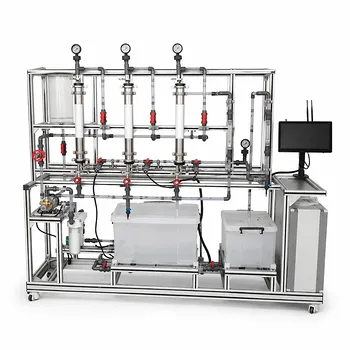
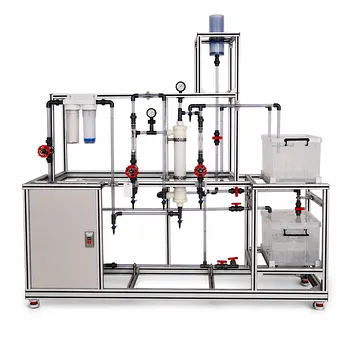
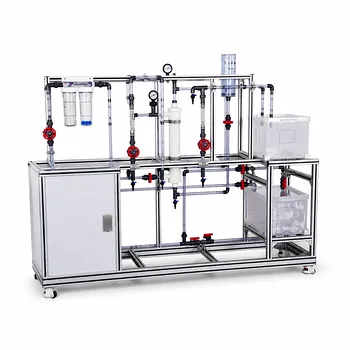
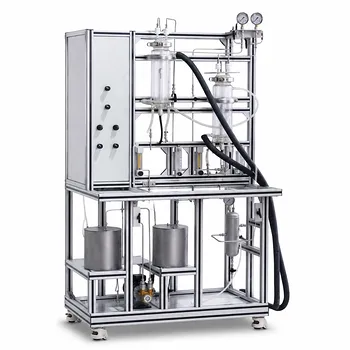
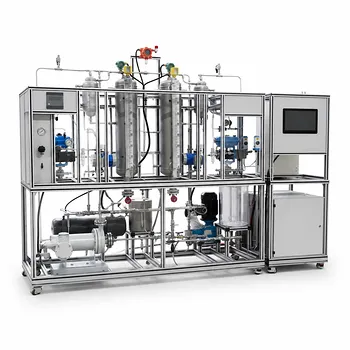
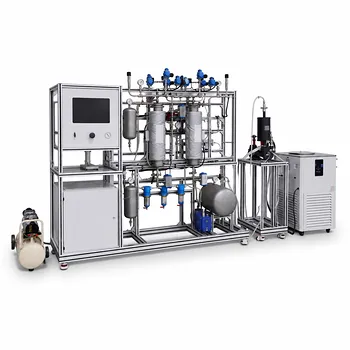
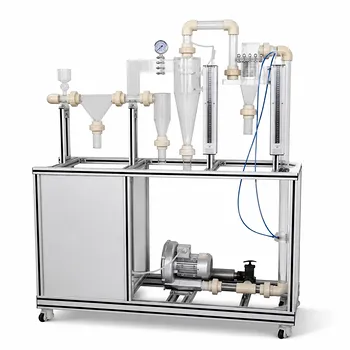
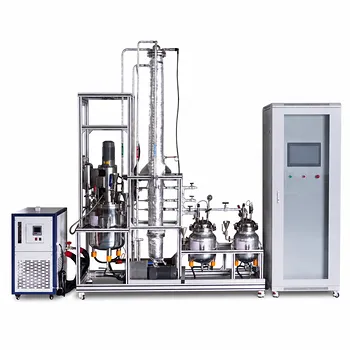
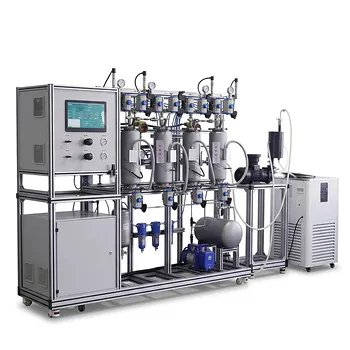
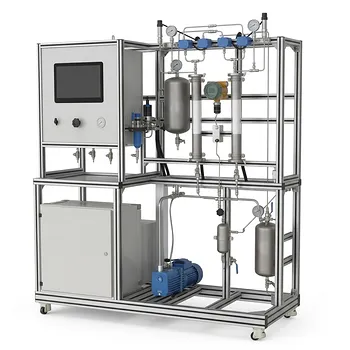
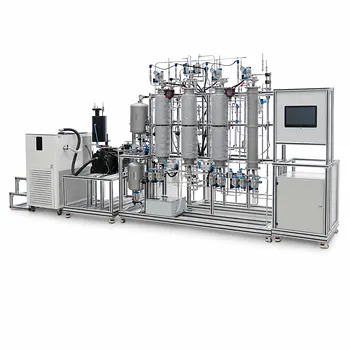
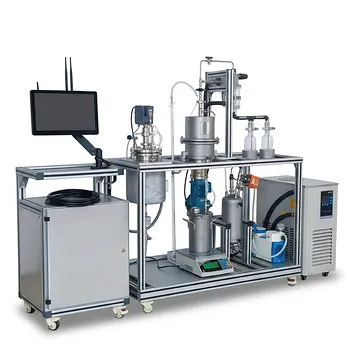
The leap from textbook osmosis to running a desalination plant is immense—and that’s where membrane separation pilot plants come in.
They prepare students for modern industrial water treatment by turning abstract theory into operational reality. Through hands-on work with reverse osmosis, ultrafiltration, and electrodialysis systems, students directly confront the dominant field problems—concentration polarization and membrane fouling—and learn to manipulate pressure, cross-flow, and pretreatment to sustain permeate flux and salt rejection over time.
Modern water treatment is not a chemistry problem alone; it is a fight against declining performance. Pilot plants teach students that every operating decision—pressure, flow rate, cleaning cycle—is a lever to outmaneuver fouling and polarization, building the diagnostic instinct that no simulation can provide.
The Real Operational Battleground of Industrial Water Treatment
Industrial water treatment today faces tighter discharge limits, higher salinity feeds, and relentless pressure to reduce energy and chemical footprints.
Students must master not just how a membrane works, but how it fails—and how to keep it alive.
Why Classroom Theory Falls Short
Textbooks describe ideal salt rejection and perfect cross-flow, but real plants never see ideal conditions.
Feedwater swings in turbidity, temperature, and organic load, triggering fouling layers that choke output within hours.
A pilot plant introduces that unpredictability in a controlled setting, forcing students to shift from “designing a process” to “managing a dynamic system.”
The Trio of Foundational Membrane Technologies
The primary reference highlights three workhorses:
- Reverse osmosis (RO) for ionic-level separation—simulating seawater and brackish water desalination.
- Ultrafiltration (UF) for removing macromolecules and colloids, often as RO pretreatment.
- Electrodialysis (ED) for salt removal under an electrical driving force, illustrating an alternative to pressure-driven desalination.
Working with all three gives students a comparative understanding of where each fits in a full-scale treatment train, from raw intake to final permeate.
How Pilot Plants Forge Critical Process-Control Skills
Pilot-scale rigs replicate the exact knobs engineers turn in a plant: feed pressure, cross-flow velocity, and pretreatment chemistry.
By turning these knobs, students see immediate, measurable consequences on permeate flux and salt passage.
Linking Operating Pressure to Salt Rejection
Increasing pressure raises the driving force—more water through the membrane, higher flux.
But too much pressure accelerates compaction and concentration polarization, actually hurting rejection.
Students learn to locate the inflection point where energy input stops paying back in permeate quality—a skill that directly translates to minimizing industrial energy costs.
Mastering Cross-Flow Velocity
Cross-flow sweeps rejected salts and foulants off the membrane surface, disrupting the boundary layer that causes polarization.
Students observe that a higher velocity boosts flux stability, but at the cost of greater pumping energy and pressure drop along the module.
The pilot plant becomes a live trade-off simulator: you dial up velocity until the energy penalty exceeds the fouling benefit.
Pretreatment: The Gatekeeper of Membrane Life
In the pilot hall, students can spike feeds with iron, silica, or organic surrogates and then test acid dosing, antiscalants, or UF prefiltration.
They quickly learn that poor pretreatment kills membranes faster than any other mistake.
The data—pressure drop rises, flux curves sag—teaches that upstream chemistry is the real linchpin of reliable downstream separation.
Beyond Single-Unit Performance: Systems Thinking and Resource Recovery
Industrial water treatment is moving rapidly toward minimum liquid discharge and resource extraction.
Pilot plants prepare students for this shift by enabling closed-loop testing and brine valorization studies.
Concentration Polarization as a Teachable Moment
Polarization isn't just a footnote—it’s the precursor to scaling and irreversible fouling.
Students measure conductivity buildup near the membrane surface and correlate it with flux decline, ingraining the link between fluid dynamics and chemical precipitation.
This awareness is essential when later designing brine concentrators or crystallizer feed loops.
Integrating Membrane Distillation and Nanofiltration
While the core reference emphasizes RO, UF, and ED, many pilot platforms now include nanofiltration (NF) for selective divalent ion removal and membrane distillation for hypersaline brines.
NF pilot trials let students compare its lower energy footprint against RO for brackish waters.
Membrane distillation exposes them to heat-driven transport, teaching thermal efficiency metrics and scaling behavior in zero-liquid-discharge scenarios.
Understanding the Inherent Limitations and What They Teach
Pilot plants don’t just showcase strengths—they make limitations painfully visible.
Embracing these constraints gives students the maintenance mindset that prevents plant shutdowns.
Fouling: The Inevitable Performance Sink
No matter how well you pretreat, some flux decline over time is guaranteed.
Students monitor pressure drops daily and learn to identify the “knee” where chemical cleaning becomes urgent.
The lesson: operate ahead of the fouling curve, not behind it.
Chemical Resistance and Lifespan Management
Polymeric membranes in these systems degrade when exposed to extreme pH or aggressive cleaning chemicals.
In a pilot plant, students witness accidental damage—embrittlement, delamination—and internalize the need to respect manufacturer chemical compatibility tables.
They also track gradual permeability loss over hundreds of hours, building a real sense of membrane replacement cycles and lifecycle costing.
The Gap Between Pilot and Full Scale
Pilot plants use small modules and stable lab feeds, so they can’t perfectly mimic the hydraulic dead zones or biological swings of an outdoor plant.
Acknowledging this gap teaches students to apply safety factors and to treat pilot data as a foundation, not a carbon copy, for industrial design.
It instills the caution that every scale-up requires conservative overdesign and vigilant commissioning.
Making the Right Choice for Your Learning or Curriculum
Pilot plants are not one-size-fits-all training tools.
The key is to align the system’s capabilities with the specific competencies you want to build.
- If your primary focus is desalination process optimization: Prioritize a rig that includes RO and NF capabilities, permits variable feed salinities, and logs pressure and flux data in real time. Use it to run “stress tests” that mimic seasonal seawater changes.
- If your primary focus is industrial wastewater reuse: Ensure the pilot plant includes UF and, if possible, ED. Run fouling studies with synthetic oily or high-organic feeds to practice pretreatment selection and CIP (clean-in-place) protocol design.
- If your primary focus is cutting-edge brine management: Seek a system that adds membrane distillation to the mix. Focus your experiments on thermal energy input, polarization coefficients, and crystal seeding dynamics to prepare for next-generation zero-liquid discharge plants.
There is no substitute for physically wrestling with a fouled membrane or racing to troubleshoot a pressure spike. That direct encounter is what transforms a chemical engineering student into a water treatment professional.
Summary Table:
| Membrane Technology | Primary Industrial Function | Key Hands-on Skills Taught |
|---|---|---|
| Reverse Osmosis (RO) | Ionic-level separation & desalination | Balancing feed pressure, salt rejection, and energy costs |
| Ultrafiltration (UF) | Macromolecule, colloid, and RO pretreatment | Managing fouling layers, cross-flow velocity, and CIP cycles |
| Electrodialysis (ED) | Electrical-driven salt removal | Controlling electrochemical driving forces & membrane scaling |
Ready to equip your students or research team with industry-ready process control skills? LABPARK provides state-of-the-art Educational and Vocational Unit Operations Pilot Plants in chemical engineering, bioprocess & biotech, and environmental & water treatment. Designed specifically for universities, research institutes, and enterprises, our systems bridge the gap between classroom theory and real-world operational challenges. Contact us today to find the perfect pilot plant configuration for your lab or curriculum!
Related Products
- Multifunctional Membrane Separation Educational Pilot Plant with Ultrafiltration, Nanofiltration, Reverse Osmosis
- Ultrafiltration Membrane Separation Educational Pilot Plant
- Multi-Functional Membrane Separation Educational Pilot Plant for Unit Operations Lab
- Hollow Fiber Ultrafiltration Membrane Separation Educational Pilot Plant
- Photocatalytic Membrane Separation and Degradation Unit Operations Pilot Plant
People Also Ask
- How do PEI, PVDF, and PSU membranes compare in pilot plants? Find the best fit.
- Pervaporation vs. Vapor Permeation: Handling Suspended Solids in Membrane Pilot Plants
- What are the trade-offs of polymer vs inorganic membranes in teaching pilot plants? Key laboratory comparison.
- What are the advantages of membrane separation in pilot plants? Efficient Organic Vapor Recovery
- How can operators optimize operating conditions and cleaning protocols in membrane separation pilot plants to mitigate fouling?