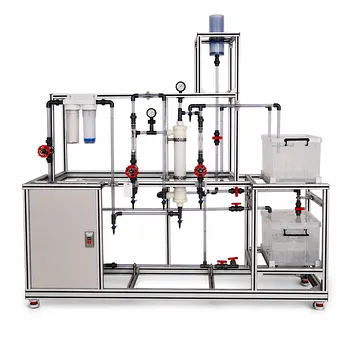
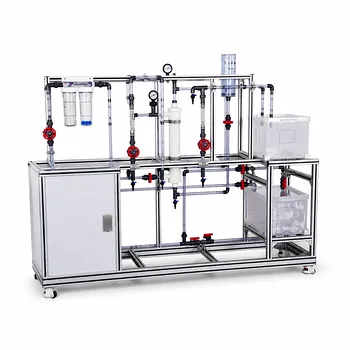
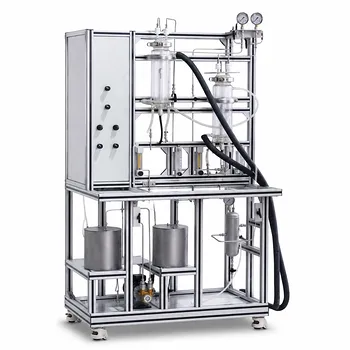
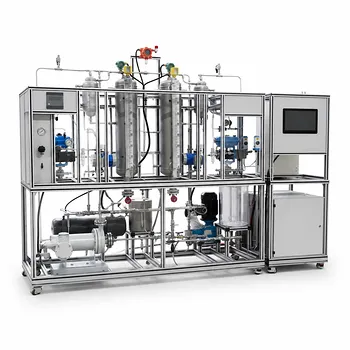
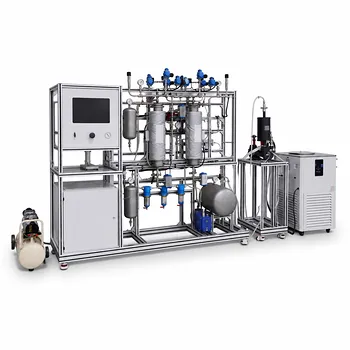
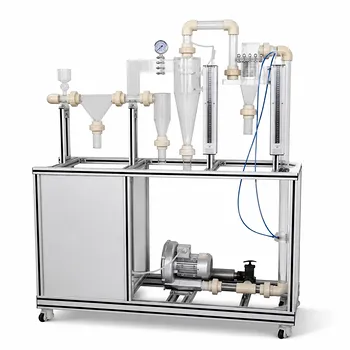
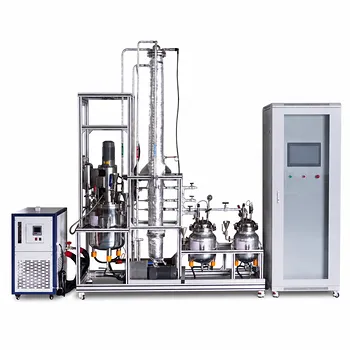
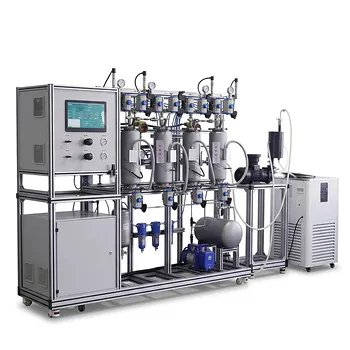
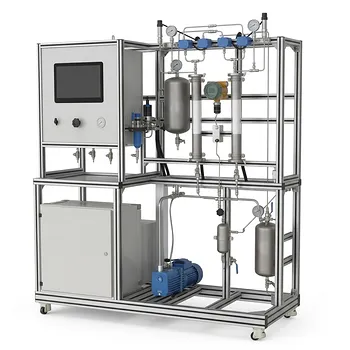
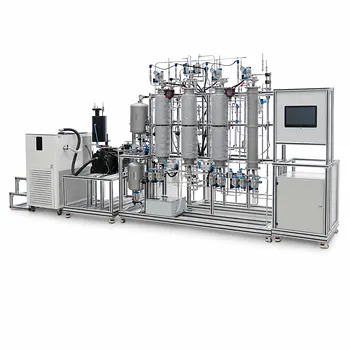
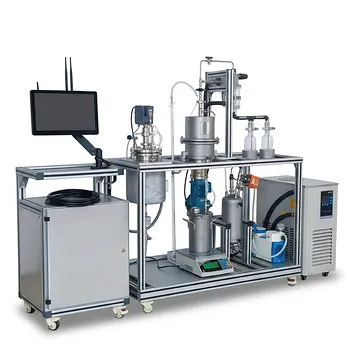
The true departure point is the separation principle itself: traditional filtration uses a physical sieve, extraction leverages solubility differences, while membrane processes harness molecular‑level discrimination through size exclusion, affinity, or electrochemical gradients.
Traditional filtration pilot plants rely on a porous medium to strain out solid particles from a fluid. Extraction pilot plants work by transferring a solute from one liquid phase to another based on solubility. In sharp contrast, membrane separation pilot plants employ semi‑permeable membranes that sort chemical species not merely by size but also by chemical affinity or charge, enabling separations far beyond simple particle removal.
While traditional filtration physically traps particles and extraction redistributes solutes between immiscible phases, membrane pilot plants achieve separation through semi‑permeable barriers that discriminate at the molecular level—making them uniquely capable of handling dissolved ions, gases, and organics with high precision and low energy input.
How Traditional Filtration and Extraction Pilot Plants Work
Traditional Filtration: The Physical Barrier
Traditional filtration pilot plants operate on a straightforward mechanical principle. A porous medium, such as a filter cloth or sintered metal, captures solid particles larger than its pore size. The driving force is typically a pressure differential, and the mechanism is purely size‑exclusion—particles larger than the pores are retained, while the liquid passes through.
This process excels at bulk solid‑liquid separation, but it cannot differentiate between dissolved species. Anything smaller than the pores, including ions, molecules, and even some colloids, will pass unimpeded. The separation is based solely on particle dimensions, not chemical identity.
Extraction: Phase Partitioning
Extraction pilot plants separate by exploiting the difference in solubility of a target solute between two immiscible solvents (often an aqueous phase and an organic phase). The feed contacts the extraction solvent, and the solute partitions preferentially into that solvent phase. This is a mass‑transfer operation governed by equilibrium distribution coefficients, not by size.
Extraction can isolate a specific chemical compound from a complex mixture. However, it requires additional downstream steps to recover the solute from the solvent, often involving distillation or evaporation. It also generates a raffinate stream and consumes solvents, posing environmental and cost challenges.
The Membrane Separation Mechanism: Beyond Simple Sieving
Semipermeable Membranes as Selective Gates
Membrane pilot plants replace the inert porous medium or solvent contactor with a semipermeable membrane. This membrane acts as a selective barrier: it allows certain species to permeate while retaining others. The key distinction is that separation can be driven by several mechanisms—size exclusion, solution‑diffusion, and charge repulsion—all within a single unit.
In pressure‑driven liquid filtration (microfiltration, ultrafiltration, nanofiltration, reverse osmosis), the principle may appear similar to traditional filtration, but the pore sizes are vastly smaller (from 0.1 to 10 μm in MF down to 0.1 to 1 nm in RO). At the nanofiltration and RO scales, simple sieving is supplemented by chemical interactions: membrane charge and solute polarity play a significant role in rejection, especially for ions.
Solution‑Diffusion: The Key for Dense Membranes
When membranes are non‑porous (dense), as in gas separation or pervaporation, the mechanism shifts entirely. There is no physical sieving. Instead, the solution‑diffusion model governs transport. Permeating molecules first dissolve into the membrane material, diffuse through the polymer matrix, and then desorb on the permeate side.
This is fundamentally different from both traditional filtration and extraction. It is not about particle size or phase partitioning between two liquids. The separation depends on the product of solubility (S) and diffusivity (D) of each species in the membrane. For example, in pervaporation, an azeotropic mixture of ethanol and water can be broken because water has a higher solubility and diffusivity in the hydrophilic membrane, even though the two liquids have the same boiling point. Traditional VLE‑limited processes like distillation cannot achieve this without additives.
Electrically Driven Processes: Adding Charge Discrimination
Membrane pilot plants can also use an electrical potential gradient as the driving force, as in electrodialysis. Here, ion‑exchange membranes selectively pass cations or anions, separating dissolved ions from water. This mechanism is absent in traditional filtration and extraction. It allows desalination without phase change and with high specificity for charged species—something no simple mesh or solvent switch can do.
How These Differences Play Out in a Pilot Plant Setting
Demonstrating Size‑Selective Filtration Ranges
In a membrane pilot plant, interchangeable modules let users toggle between MF, UF, NF, and RO. Researchers can feed a yeast suspension (for MF), a protein mixture (for UF), or a salt solution (for NF/RO) and measure flux and rejection. The sharp cut‑off contrasts with traditional depth filters, which trap particles within the medium and often display broader removal ranges. Membrane systems provide a more predictable, narrow molecular weight cut‑off.
Gas Separations and Pervaporation: Going Beyond Basic Filtration
A traditional filtration pilot plant cannot separate gases based on chemical nature; it would capture only particulate matter. An extraction pilot plant would require a liquid solvent to absorb the target gas, followed by regeneration. A membrane gas separation unit, however, directly uses a dense polymer membrane. By adjusting feed pressure, students can observe how the flux of CO₂ versus N₂ changes according to Fick’s law, verifying that selectivity arises from differences in permeability, not just pore size. This hands‑on experience illustrates a fundamentally different separation regime.
Handling Azeotropes – A Practical Limit Overcome
Distillation pilot plants hit a wall with azeotropes. Extraction might succeed but at the cost of solvent recovery. Membrane pervaporation simply bypasses the phase equilibrium issue. The pilot plant demonstrates the three‑step sequence of sorption, diffusion, and desorption, showing how even tightly boiling mixtures can be separated without entrainers. This capability is impossible in traditional filtration and cumbersome in extraction.
Understanding the Trade‑offs
When Membrane Systems Shine
Membrane separation pilot plants offer modular design, low energy footprint (no phase change for most processes), and high selectivity for specific molecules. They are ideal for sensitive biological products, heat‑labile compounds, and dilute streams where distillation would be energy‑prohibitive. The ambient‑temperature operation preserves product integrity.
Limitations to Keep in Mind
However, membranes are not universal solutions. They are susceptible to fouling by particulates, scaling by sparingly soluble salts, and chemical degradation by aggressive solvents or extremes of pH. Regular cleaning and pre‑treatment are obligatory. The capital cost of high‑performance membranes and modules can be significant for single‑use research. Also, achieving very high purity may require multiple stages or a downstream polishing step, as a single pass often yields an enriched stream, not absolute purity.
In contrast, traditional filtration is generally cheaper and more rugged for straightforward solid removal, and extraction can handle very high concentrations of solutes that would foul a membrane rapidly. The choice must consider feed characteristics, desired purity, and scale.
Making the Right Choice for Your Research or Process Goal
Selecting the appropriate pilot plant depends on what you need to separate and why. Use these goal‑oriented guidelines:
- If your primary focus is simple solid‑fluid clarification: A traditional filtration pilot plant will serve you well, offering simplicity and lower cost with robust operation.
- If your primary focus is isolating a target compound from a liquid mixture into a recoverable solvent phase: An extraction pilot plant is the logical choice, especially for solutes with a favorable distribution coefficient.
- If your primary focus is energy‑efficient, high‑selectivity separations of dissolved species—whether desalination, gas purification, or breaking azeotropes: A membrane separation pilot plant is indispensable, enabling molecular‑level discrimination with minimal thermal input.
- If your primary focus is teaching the principles of advanced separation mechanisms and process intensification: Membrane pilot plants provide a compact, multifunctional platform to demonstrate sieving, solution‑diffusion, and electro‑driven processes in a single integrated unit.
Ultimately, membrane separation pilot plants are not merely a scaled‑up filter; they represent a paradigm shift from mechanical straining and liquid‑liquid partitioning to engineered, semi‑permeable barriers that can selectively sort molecules on demand.
Summary Table:
| Feature | Traditional Filtration | Extraction | Membrane Separation |
|---|---|---|---|
| Separation Principle | Mechanical physical sieving | Phase partitioning (solubility) | Size exclusion, solution-diffusion, or charge |
| Driving Force | Pressure differential | Concentration / equilibrium | Pressure, concentration, or electrical gradient |
| Separation Range | Suspended solids & particles | Specific dissolved compounds | Ions, gases, organics, macromolecules |
| Key Advantage | Simple, robust bulk removal | High solute selectivity | Molecular-level precision, low energy footprint |
Ready to advance your separation research or training? LABPARK provides state-of-the-art Educational and Vocational Unit Operations Pilot Plants in chemical engineering, bioprocess & biotech, and environmental & water treatment. Designed specifically for universities, research institutes, and enterprises, our systems bring advanced separation mechanisms to life. Contact us today to find the perfect pilot plant for your facility!
Related Products
- Multifunctional Membrane Separation Educational Pilot Plant with Ultrafiltration, Nanofiltration, Reverse Osmosis
- Ultrafiltration Membrane Separation Educational Pilot Plant
- Multi-Functional Membrane Separation Educational Pilot Plant for Unit Operations Lab
- Hollow Fiber Ultrafiltration Membrane Separation Educational Pilot Plant
- Photocatalytic Membrane Separation and Degradation Unit Operations Pilot Plant
People Also Ask
- How do PEI, PVDF, and PSU membranes compare in pilot plants? Find the best fit.
- Pervaporation vs. Vapor Permeation: Handling Suspended Solids in Membrane Pilot Plants
- What are the trade-offs of polymer vs inorganic membranes in teaching pilot plants? Key laboratory comparison.
- How can operators optimize operating conditions and cleaning protocols in membrane separation pilot plants to mitigate fouling?
- What are the advantages of membrane separation in pilot plants? Efficient Organic Vapor Recovery