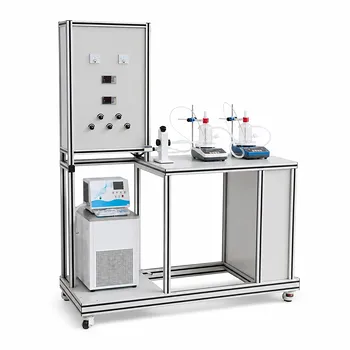
Liquid-phase reactor pilot plants overcome the cage effect by ruthlessly eliminating mass transfer resistance. They achieve this through deliberate engineering—high-efficiency agitation, baffles, and static mixers—that ensures the reaction operates in the kinetics-controlled regime. By making diffusive transport so fast that it becomes irrelevant, the pilot plant lets researchers measure the true, intrinsic chemical reaction rate free from physical interference.
Mass transfer limitations like the solvent cage mask a reaction’s real speed. A well-designed pilot plant uses intense, controlled mixing to strip away these diffusion constraints, ensuring that the measured kinetics reflect only the chemistry, not the physics of transport. This is the foundation of scalable, predictive reaction models.
The Cage Effect and Why It Distorts Kinetic Data
How the Solvent Cage Traps Reactants
In a liquid-phase reaction, reactant molecules are not free-floating; they are constantly surrounded by a shell of solvent molecules. This solvent cage restricts their movement, trapping them in close proximity for extended periods.
Rather than colliding and reacting instantly as in a gas, two reactants must first diffuse into the same cage. Once inside, they may bump into each other multiple times before either reacting or escaping. The observed reaction rate, then, is often a convolution of diffusion into the cage and the actual chemical transformation.
Why Diffusion Hides the True Reaction Rate
If the chemical reaction is fast relative to the pace at which molecules find one another, the entire process becomes diffusion-limited. In that state, your kinetic data measures how quickly molecules move through the solvent, not how quickly they react.
This is a critical failure for scale-up and modeling. Intrinsic rate constants—the numbers that go into reactor design equations—must be decoupled from fluid properties like viscosity and stirring speed. Without separating them, you cannot predict performance in a different sized vessel.
Core Engineering Solutions to Eliminate Mass Transfer Resistance
A pilot plant’s job is to push the system so that transport happens on a timescale far shorter than the reaction. The following tools work together to achieve that.
High-Efficiency Agitation — Breaking the Cage
The most direct weapon against diffusion limitation is an impeller designed for high power input and turbulent flow. By injecting mechanical energy, the agitator constantly disrupts the solvent cages and rapidly homogenizes the reactor contents.
Turbulent eddies bring fresh reactants together and sweep away products before reverse reactions can complicate the measurement. When the mixing time becomes orders of magnitude smaller than the reaction half-life, the observed rate stabilizes at the true kinetic value—a clear signal that you are in the kinetics-controlled regime.
Baffles — Directing Flow and Maximizing Shear
Simply spinning a shaft in a smooth-walled tank often leads to vortexing and poor vertical turnover. Baffles are vertical strips mounted to the vessel wall that break this swirling pattern, converting tangential flow into chaotic, high-shear turbulence.
This directed chaos ensures that no dead zones persist where diffusion could become rate-limiting again. The result is uniform exposure for every reactant molecule, making the well-mixed assumption a physical reality rather than a hopeful approximation.
Static Mixers — Precision without Moving Parts
For fast, continuous, or tubular reactor setups, a static mixer provides an elegant alternative. Fixed internal elements repeatedly split and recombine the fluid stream, achieving radical micro-mixing without a motor.
This is especially valuable when studying very rapid reactions. The mixer ensures that reactants are brought into intimate contact in milliseconds, decisively outrunning the cage effect. The narrow residence time distribution in a static mixer also sharpens kinetic data, as every fluid parcel experiences nearly the same mixing history.
Verifying You’ve Reached the Kinetic Regime
A rigorous pilot plant protocol doesn’t just assume the problem is solved; it proves it. Researchers perform a mixing-speed test: they run the reaction at several agitation rates while measuring the observed rate constant.
In the diffusion-limited zone, increasing stirrer speed makes the reaction appear faster. Once flat—where further mixing no longer changes the rate—you have definitive evidence that mass transfer resistance is gone. Only data collected in this plateau are valid for kinetic parameter estimation.
Understanding the Trade-offs of Intense Mixing
Pushing a reactor deep into the kinetic regime isn’t free. Being aware of these downsides prevents data artifacts of a different kind.
Shear Degradation — High-shear zones near an impeller tip can unwind proteins, shred polymers, or fragment delicate catalysts. A blinded pursuit of turbulence can damage the very chemistry you intend to study. For fragile systems, a lower-shear impeller (like a marine propeller) or a static mixer may be the better compromise.
Adiabatic Heating — The mechanical energy input that breaks solvent cages ends up as heat. Without sufficient jacketed cooling, the reactor temperature can climb, artificially accelerating the reaction and ruining the Arrhenius analysis. Pilot plants must balance mixing power with heat removal capacity.
Surface Aeration and Vortexing — In gas-sensitive reactions (e.g., oxygen poisoning a catalyst), a vortex that entrains headspace gas can introduce an uncontrolled impurity. Baffles suppress vortexing, but they also increase power draw. The design must reconcile these conflicting needs.
Scale-Down Mismatch — The exact mixing configuration used in a pilot plant might not be geometrically reproducible at manufacturing scale. If the full-scale vessel cannot achieve the same specific power input, the “kinetic” data from the pilot plant may still mislead. A thoughtful scale-down methodology recreates the anticipated large-scale mass transfer environment, not just maximum intensity.
Making the Right Choice for Your Kinetic Study
Your reactor configuration should match the sensitivity of your reaction and the purpose of your data.
- If your primary focus is measuring pure, intrinsic rate constants: Commit to high-efficiency agitation with baffles, and always validate the plateau with a speed-variation test. The confidence in your kinetic model depends on it.
- If your reaction contains shear-sensitive molecules or catalysts: Consider a static mixer in a continuous flow reactor, which achieves rapid micro-mixing with minimal shear history, or use a low-shear impeller and accept a slightly narrower operating window.
- If your goal is to generate data directly for scale-up: Do not simply run at maximum mixing. Characterize the mass transfer coefficient (kLa) at both pilot and production scale, then match them. This gives you a process-relevant kinetic set that accounts for the inevitable return of some mass transfer limitation in the larger vessel.
- If you operate a fast, exothermic reaction: Prioritize concurrent heat transfer design. Use a jacketed vessel with a high ratio of surface area to volume, and confirm that the agitator’s pumping capacity ensures rapid turnover across the heat exchange surface, preventing hot spots that mimic cage-free kinetics.
With a deliberate equipment strategy and a disciplined experimental protocol, you trap the chemistry—not the transport—and produce kinetic data that build a bridge from the lab bench to the real world.
Summary Table:
| Engineering Solution | Mechanism for Overcoming Mass Transfer | Key Trade-off / Limitation |
|---|---|---|
| High-Efficiency Agitation | Disrupts solvent cages via high power input & turbulent flow | Risk of shear degradation of delicate catalysts |
| Baffles | Converts tangential flow to high-shear vertical turbulence | Can cause adiabatic heating and vortexing issues |
| Static Mixers | Radical micro-mixing by splitting and recombining fluid streams | Potential scale-down mismatch at production scale |
Accelerate Your Reaction Kinetics & Scale-Up Success
To achieve highly accurate, kinetics-controlled data, your laboratory needs precision-engineered equipment. LABPARK provides premium Educational and Vocational Unit Operations Pilot Plants in chemical engineering, bioprocess & biotech, and environmental & water treatment. Tailored for universities, research institutes, and enterprises, our pilot plants are designed to eliminate mass transfer limitations and streamline your scale-up processes.
Ready to optimize your reactor setups? Contact LABPARK today to consult with our engineering experts and find the ideal solution for your facility.
Related Products
- Fluidized Bed Gas Solid Catalytic Reaction Educational Pilot Plant
- Ternary Liquid-Liquid Equilibrium Educational Pilot Plant
- Comprehensive Liquid-Liquid Extraction Pilot Plant for Engineering Education
- Multi-Reactor Educational Pilot Plant for Reaction Engineering Unit Operations
- Liquid-Liquid Mass Transfer Coefficient Determination Educational Pilot Plant
People Also Ask
- Why is the bed height-to-diameter ratio (L/dt) critical? Fluidized bed pilot plant selection guide.
- How do dimensionless numbers guide heat transfer in pilot plants? Optimize Scale-Up
- How is the minimum fluidization velocity (U_mf) determined and utilized? A Unit Operations Guide
- Fixed-Bed vs. Fluidized-Bed Reactor: How to Choose the Right Pilot Plant for Gas-Solid Catalytic Reactions
- How to determine catalyst pore radius & porosity? Optimize your chemical engineering pilot plant.