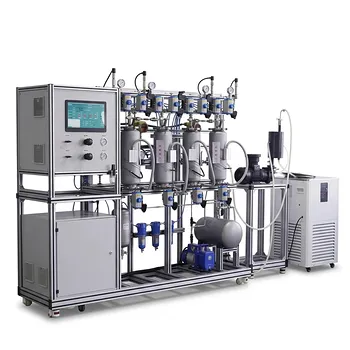
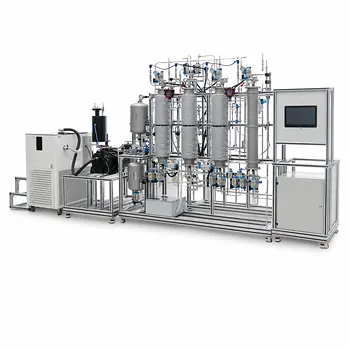
The presence of carbon dioxide (CO2) in a gas stream does more than simply dilute the mixture—it chemically and physically reshapes how water distributes between phases. In gas purification pilot plants, CO2 increases the solubility of water in the vapor phase and alters the system’s phase envelope, meaning that dew points, hydrate formation conditions, and equilibrium water content deviate sharply from ideal-behavior predictions. If you treat the system as a simple binary of dry gas and water, your experimental water content determinations will be systematically wrong, and your phase-behavior maps will misrepresent the true thermodynamic reality.
Core Insight: CO2 acts as a phase-behavior modifier, not a bystander. To accurately measure water content and predict phase transitions, you must embed temperature-dependent CO2–water interaction parameters into your thermodynamic models. Ignoring this coupling leads to erroneous conclusions about dehydration needs, hydrate risk, and corrosion potential—the very problems a gas purification pilot plant is built to solve.
Why CO2 Changes the Game for Water Behavior
Water Volatility Ceases to Be a Simple Function of Temperature
In a pure methane or nitrogen stream, the equilibrium water content in the gas phase follows predictable, well-characterized curves based primarily on temperature and pressure. CO2 disrupts that simplicity.
CO2 molecules possess a significant quadrupole moment that interacts strongly with the dipole of water. This non-ideal, energetic affinity pulls more water molecules into the vapor phase than would be expected from pure-component vapor pressure alone. The effect is measurable even at moderate CO2 concentrations and becomes dominant in high-CO2 natural gas or syngas streams.
The Gas Phase Becomes a Chemically Active Mixture
Rather than seeing the gas as an inert carrier, you must view it as a solvent that actively competes for water. In a pilot plant, this means the “wet gas” leaving a contactor or entering a dehydration unit may carry significantly more water than a standard chart would indicate.
The primary reference correctly emphasizes that acid gases like CO2 significantly alter water solubility in both gas and hydrocarbon liquids. The consequence for an experimenter is direct: if you base your mass balance on ideal or uncorrected equations of state, you will under-report the true water load and over-estimate the efficiency of your separation step.
The Thermodynamic Complexity: Why Simple Models Break
The Non-Negotiable Need for Interaction Parameters
Equations of state (EoS) such as Peng–Robinson or Soave–Redlich–Kwong are the workhorses of pilot-plant data interpretation. But their raw form treats CO2 and water as if they mix ideally—an assumption that fails immediately.
To capture reality, you must introduce binary interaction parameters (kij) that quantify the energetic asymmetry between CO2 and water. These parameters are not universal constants; they are regressed from experimental vapor-liquid equilibrium data and, crucially, depend on temperature. The primary reference’s call for “temperature-dependent interaction parameters” is not a theoretical nicety—it is an operational necessity for pilot-plant accuracy.
Critical Constants and Combining Rules Are Just the Beginning
Supplementary references highlight that critical constants (Tc, Pc) and derived constants for CO2, water, and host gases are essential inputs. While correct, this is only the starting grid. The real predictive power comes from how the EoS’s mixing rules translate pure-component criticals into mixture behavior. For CO2–water, conventional van der Waals one-fluid mixing rules often require an asymmetric treatment of the interaction parameter, especially near the critical region of CO2. In a pilot plant exploring wide pressure and temperature ranges, using a single, temperature-independent kij can lead to water content errors exceeding 50%.
How It Manifests in the Pilot Plant: Measurements and Mistakes
Dew Points Move, and Hydrate Curves Shift
A CO2-laden gas mixture will typically exhibit a higher water dew point at a given pressure compared to a sweet gas of similar bulk composition. This is because the effective volatility of water increases—condensation occurs sooner upon cooling.
More critically, CO2 participates in hydrate structures as a guest molecule. It can form hydrates at lower pressures or higher temperatures than methane alone. When you operate a pilot plant to validate hydrate inhibition strategies, failing to account for CO2 means you are testing against the wrong phase boundary. You may conclude that a certain inhibitor dosage is sufficient, only to see hydrate plugs form in the real, CO2-containing field gas.
Analytical Water Determination Gets Confounded
Many pilot plants use chilled-mirror dew-point analyzers or tunable diode laser absorption spectroscopy (TDLAS) to measure water. CO2 does not necessarily cause a direct spectral interference in all methods, but it can shift the phase equilibrium in the sample line. If the sample gas cools even slightly, CO2–water interactions can lead to condensation or hydrate formation within the sampling system itself, giving a false low reading of water content (because water has dropped out upstream of the analyzer). You must design heated, regulated sampling lines that keep the gas well above its CO2-adjusted water dew point—a subtle but vital detail easily missed.
Understanding the Trade-offs in Pilot Plant Strategy
The Upstream Removal Dilemma
Supplementary data on Fischer-Tropsch synthesis note that up to 20% CO2 may not harm catalyst performance, suggesting the costly CO2 removal step could be bypassed. For a gas purification pilot plant, a similar calculus emerges: you can either remove CO2 upstream (simplifying water-content measurements and phase predictions) or leave CO2 in and invest in the thermodynamic modeling rigor required to interpret the data correctly.
The trade-off is cost and representativeness versus complexity. Removing CO2 adds capital equipment and energy costs, and changes the gas composition so fundamentally that the pilot plant no longer mimics the real field case. Keeping CO2 in yields a more authentic test but demands that your team possess the expertise and software tools to model the highly non-ideal CO2–water system. The wrong choice turns the pilot plant into a source of misleading data rather than insight.
Model Calibration vs. Experimental Simplicity
Another trade-off lies in how you design your experimental matrix. If you run the plant at many CO2 concentrations, you can regress your own interaction parameters and build a predictive model. That approach is scientifically rigorous but consumes significant time and budget—a conflict for a teaching pilot plant that needs to convey clear principles quickly. Conversely, using literature parameters without validation risks systematic errors. The most common pitfall is to assume the model that worked for a low-CO2 case will scale linearly to high-CO2 conditions, which it will not.
Making the Right Choice for Your Pilot Plant Goals
The right approach hinges on the purpose of your pilot plant and the decisions it must support.
- If your primary focus is accurate hydrate and corrosion risk assessment: Do not remove CO2. Invest in an equation-of-state package that includes validated, temperature-dependent binary interaction parameters for CO2–water. Validate the model against published equilibrium data at your range of interest before interpreting your own measurements.
- If your primary focus is demonstrating the gas purification process chain (e.g., absorption column efficiency): Consider operating the pilot with both a CO2-loaded and a CO2-free gas to contrast performance. This helps isolate the effect of the acid gas on water behavior and highlights the thermodynamic challenge, directly serving educational and design objectives.
- If your primary focus is minimizing capital cost and model complexity for a proof-of-concept: An upfront CO2 separation step can remove the phase-behavior variable, allowing you to use simpler water-content calculations. Just be transparent that the results strictly apply to sweet gas and will require adjustment for field conditions.
- If your primary focus is teaching chemical engineering thermodynamics: Run the plant with a deliberate CO2 spike. Let students compare raw experimental water-content data with ideal-based predictions, observe the deviation, and then introduce the interaction parameters. No lecture conveys the importance of non-ideality as powerfully as a mis-predicted hydrate plug in a transparent sight glass.
Accurate gas purification pilot-plant work does not just tolerate the presence of CO2—it demands that you actively model its strange and powerful influence on water. Mastering this dependency transforms a routine measurement into a genuine prediction of field performance.
Summary Table:
| CO2 Impact Factor | Physical/Chemical Effect | Pilot Plant Consequence | Recommended Mitigation |
|---|---|---|---|
| Water Solubility | Quadrupole-dipole interactions pull more water into the gas phase. | Under-reported water load; prediction errors can exceed 50%. | Embed temperature-dependent binary interaction parameters ($k_{ij}$) in EoS. |
| Phase Boundaries | Raises water dew points and shifts hydrate formation conditions. | Risk of premature condensation and unexpected hydrate plugging. | Validate EoS thermodynamic models; install heated sampling lines. |
| Upstream Removal | Eliminates acid gas before dehydration/separation stages. | Simplifies modeling but reduces field-test representativeness. | Align pilot plant design with final field-application objectives. |
Optimize Your Process Engineering Research with LABPARK
Accurately modeling non-ideal thermodynamic behavior requires robust, reliable experimental setups. LABPARK designs and provides high-quality Educational and Vocational Unit Operations Pilot Plants in chemical engineering, bioprocess & biotech, and environmental & water treatment.
We empower universities, research institutes, and enterprises to bridge the gap between complex thermodynamic theory and practical industrial application.
Ready to elevate your laboratory’s capabilities? Contact LABPARK today to discuss your pilot plant requirements!
Related Products
- Fixed-Bed Chemical Reaction and Gas Dust Tar Removal Unit Operations Pilot Plant
- Bench Scale Carbon Dioxide Capture Educational Unit Operations Pilot Plant
- Green Anhydrous Ethanol Purification Extractive Distillation Unit Operations Training Pilot Plant
- Electrolyte Distillation Purification and Formulation Educational Pilot Plant
- Ion Exchange Water Purification Educational Pilot Plant for Engineering Unit Operations
People Also Ask
- When to transition from PID to adaptive control in pilot plants? Key process indicators.
- How do deviations in estimating latent heat impact pilot plant thermal systems? Avoid hardware mis-sizing.
- Why Compare Predicted and Experimental Excess Enthalpy? Key to Accurate Pilot Plant Scale-up
- Why are particle density, bulk density & voidage critical in pilot plants? Master Bed Fluid Dynamics
- How to study gasification in pilot plants? Compare exit gas composition & efficiency