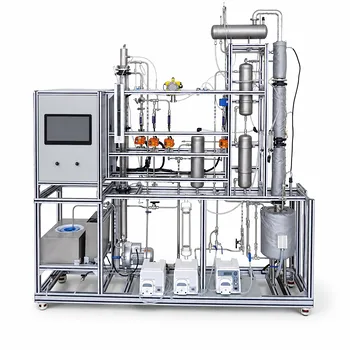
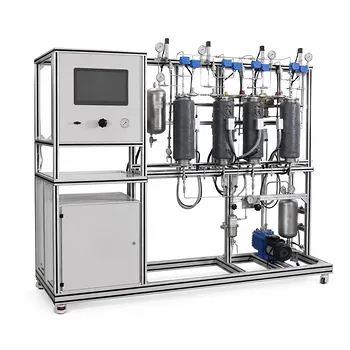
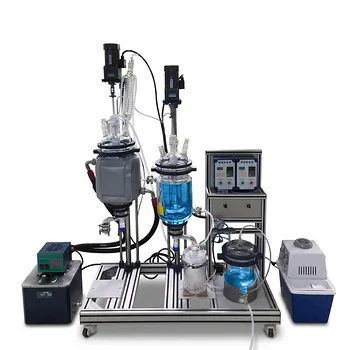
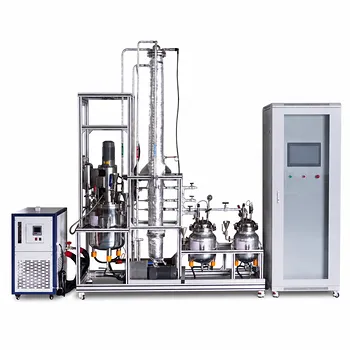
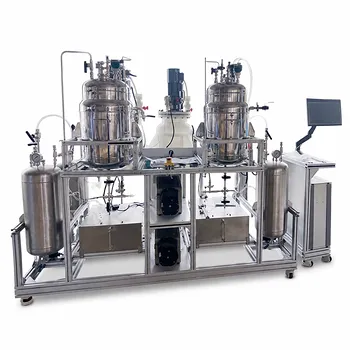
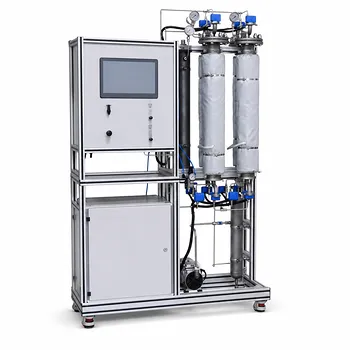
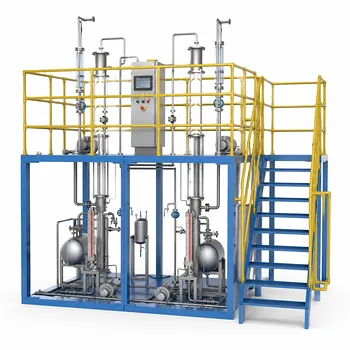
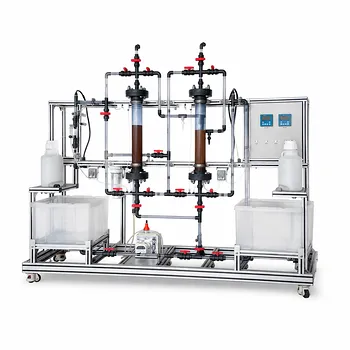
Your most direct path to understanding VOC and solvent waste control is seeing how a pilot plant physically demonstrates the reduction. Instead of just theory, you can operate a once-through gas system, measure its high emissions, and then switch to a closed-loop gas recycling and solvent recovery system to witness the dramatic drop in VOC release and solvent consumption firsthand.
The core value of a pilot plant is its ability to make abstract environmental concepts tangible and measurable. It transforms the challenge of minimizing VOC emissions from a textbook problem into a comparative, data-driven experiment, showing precisely how process design and chemical choice directly control waste generation.
The Hands-On Demonstration of Emission Control
A pilot plant’s power lies not in a single technique, but in its ability to let you physically configure and compare different approaches. This direct experimentation builds an intuitive, deep understanding of how to minimize waste.
Directly Comparing Gas Handling Configurations
The most immediate demonstration involves running two distinct process loops. You start with a standard, wasteful baseline.
In a once-through gas system, a carrier gas like nitrogen sweeps VOCs out of a reactor and vents them into the atmosphere (or a fume hood). You can measure the high concentration of solvent being lost and calculate the total mass of VOC emissions per hour, seeing the problem in real-time.
You then reconfigure the plant to a closed-loop recycling system. Here, the VOC-laden gas is sent to a separation unit—like a condenser or a membrane—instead of being vented. The system recovers liquid solvent for reuse and recirculates the clean gas back to the reactor. By measuring solvent consumption and emissions before and after, you quantify a near-elimination of the waste stream.
Evaluating Advanced Treatment Technologies
Pilot plants also let you test cutting-edge gas treatment methods that non-experts rarely see. A powerful example is the membrane contactor.
This device uses a microporous, hydrophobic membrane as a stable interface. The contaminated gas flows on one side, while an aqueous solution with biodegrading bacteria circulates on the other. VOCs diffuse across the membrane and are destroyed by the biofilm, without the liquid and gas ever mixing directly.
This setup circumvents the common headaches—channeling, flooding, and foaming—that plague traditional bio-scrubbers. It offers precise control over pH and nutrients, showcasing a highly efficient, compact way to destroy VOCs like toluene and xylenes rather than just releasing them.
Proving the Power of Chemical Substitution
Minimizing waste isn't just about capturing emissions; it’s often smarter to avoid creating them at all. A water treatment pilot plant makes the concept of E-factor (kg of waste per kg of product) a physical reality.
You can run a traditional reaction catalyzed by a mineral acid. The subsequent neutralization step with a base generates a huge volume of aqueous effluent containing inorganic salts. You collect this heavy, salty wastewater and calculate a high E-factor, often several kilograms of waste for a single kilogram of product.
You then run the same reaction using a solid zeolite catalyst, a route that requires no neutralization. By performing a mass balance on both processes, you directly measure the staggering reduction in aqueous waste—often dropping from kilograms down to just grams. This turns green chemistry principles into irrefutable, hands-on proof.
Simulating the Full Industrial Picture
To understand the true impact, you need to see these unit operations as part of an integrated system. A sophisticated pilot plant replicates the interconnected processes of a modern refinery.
You can simulate an entire treatment train, starting with pH neutralization of acidic effluents, moving to sulfur recovery, and finishing with bio-filtration of off-gases. By analyzing the composite wastewater streams—which contain condensed water, fly ash, dissolved hydrogen sulfide, and phenols—you learn how to use gravity separation, filtration, and gas stripping sequentially to treat the complex mixture before any recycling or disposal.
Understanding the Trade-offs and Limitations
True expertise requires a clear-eyed view of the downsides. A pilot plant also teaches you where these techniques fall short.
Biological Methods Are Not a Quick Fix
The membrane contactor and bio-filtration systems are powerful but require careful biological stewardship. The microbial consortia are sensitive to shock loads of toxins, pH swings, and nutrient depletion. A pilot plant shows you that maintaining a healthy biofilm is a continuous process, not a set-it-and-forget-it solution.
Recovery Has an Energy Penalty
A closed-loop solvent recovery system dramatically reduces waste but has a hidden cost. Whether you use gas-separation membranes or condensation, you are trading liquid waste for electrical or thermal energy consumption. The pilot plant allows you to measure this energy input, forcing a critical analysis of the trade-off between eliminating solvent waste and increasing the carbon footprint.
Catalysis Shifts the Problem
Swapping a liquid acid for a solid zeolite eliminates aqueous salt waste, but it introduces other questions. The solid catalyst will eventually deactivate and become a solid waste stream itself. A thorough pilot plant study involves not just the reaction step, but evaluating the entire catalyst lifecycle, including its synthesis and ultimate disposal or regeneration.
Making the Right Choice for Your Goal
The way you configure and run a pilot plant should directly reflect your primary objective. The lesson isn't that one technique is universally superior, but that the right tool depends entirely on your desired outcome.
- If your primary focus is zero solvent loss: A closed-loop system with a membrane contactor for biodegradation is the definitive path. It sacrifices simplicity for near-total destruction of fugitive VOCs.
- If your primary focus is source reduction and green chemistry: Directly compare two reaction pathways—a traditional route and a catalytic one—to measure the E-factor. This approach tackles waste at its origin, often eliminating the need for downstream treatment.
- If your primary focus is simulating real-world industrial complexity: Run an integrated treatment train that includes pH neutralization, gravity separation, and biological polishing. This provides the systems-level thinking needed to manage a dozen interconnected processes simultaneously.
The ultimate lesson from a pilot plant is that minimizing VOC emissions and solvent waste isn't a single decision; it's a continuous, quantitative process of comparing, measuring, and choosing the least impactful practical pathway.
Summary Table:
| Demonstration Method | How It Works | Key Benefit |
|---|---|---|
| Closed-Loop Recycling | Routes VOCs to a separation unit (condenser/membrane) to recover solvent | Near-elimination of waste emissions |
| Membrane Contactor | Bio-destructs VOCs via a microporous hydrophobic membrane | Avoids traditional scrubbing issues (foaming, flooding) |
| Chemical Substitution | Swaps liquid acids for solid zeolite catalysts | Drastically lowers the process E-factor |
| Integrated Treatment Train | Connects neutralization, separation, and filtration sequentially | Simulates real-world industrial complexity |
Bring Hands-On VOC & Waste Control to Your Institution
Are you looking to bridge the gap between environmental theory and practical industrial application? LABPARK provides state-of-the-art Educational and Vocational Unit Operations Pilot Plants in chemical engineering, bioprocess & biotech, and environmental & water treatment.
Designed for universities, research institutes, and enterprises, our pilot systems allow users to physically configure process loops, measure E-factors, and evaluate real-world trade-offs in waste minimization.
Contact LABPARK today to discover how our tailored pilot plants can enhance your hands-on training and research capabilities!
Related Products
- Carbon Dioxide Absorption and Desorption Educational Pilot Plant for Carbon Capture Studies
- Bench Scale Carbon Dioxide Capture Educational Unit Operations Pilot Plant
- Fixed-Bed Chemical Reaction and Gas Dust Tar Removal Unit Operations Pilot Plant
- Potassium Salt Thermal Dissolution and Crystallization Separation Educational Unit Operations Pilot Plant
- Solid Waste Pyrolysis and Refining Educational Pilot Plant for Unit Operations
People Also Ask
- How does operating pressure influence the transition between absorption and desorption in a CO2 pilot plant?
- How do temperature variations affect CO2 transport models in pilot plants? Model vs Reality
- What unit operations are critical for CCUS training pilot plants? Build hands-on engineering expertise.
- How do electrolytes affect phase equilibrium in absorption pilot plants, and how to calculate it?
- Why is critical surface tension key in column internals? Optimize gas absorption pilot plant efficiency