Chemical reactions accelerate gas absorption by consuming the dissolved solute at the gas-liquid interface, which sustains a steep concentration gradient and effectively slashes the liquid-phase mass transfer resistance. In a pilot plant this is quantified through an enhancement factor (β)—directly decreasing the liquid-film resistance term in the overall mass transfer coefficient. For the reaction of CO₂ with NaOH under pseudo-first-order conditions, β simplifies to √M, and the overall resistance becomes 1/K_G = 1/k_g + H'/(β·k_l), letting operators experimentally pinpoint when reaction kinetics take over from physical diffusion.
The core insight: Chemical reactions don’t just speed up absorption—they fundamentally rearrange where the resistance lies. By consuming CO₂ the moment it dissolves, the liquid film transforms from a barrier into an active partner, making the process limited by gas-film diffusion or reaction kinetics instead of slow physical dissolution. In a pilot plant, comparative runs between physical and chemical absorption reveal this shift and allow you to extract the enhancement factor directly from measured concentration profiles.
The Two‑Fold Mechanism of Chemical Enhancement
Immediate Consumption at the Interface
In physical absorption, the dissolved gas builds up in the liquid film, gradually reducing the concentration gradient that drives mass transfer.
A chemical reaction (e.g., CO₂ + NaOH → NaHCO₃) immediately consumes the solute. This keeps the interfacial concentration far below saturation—even if the bulk liquid contains unreacted NaOH. The result is a permanently steep driving force.
Reduction of Liquid‑Phase Resistance
The resisting effect of the liquid film is captured by the liquid‑film mass transfer coefficient k_l.
Chemical reaction adds a parallel path for solute removal within the film itself. This makes the liquid appear far more “conductive,” so the effective liquid‑side coefficient becomes β·k_l (where β > 1). Because the overall resistance is the sum of gas and liquid contributions, dividing the liquid term by β directly lowers the total barrier.
Quantifying the Effect: The Enhancement Factor (β)
Definition and Experimental Determination
β is defined as the ratio of the chemical absorption rate to the physical absorption rate under the same driving force.
In a pilot plant, you determine β by running two experiments:
- Physical absorption: Carbon dioxide into water.
- Chemical absorption: Carbon dioxide into an alkaline solution (e.g., NaOH).
By measuring inlet/outlet gas and liquid concentrations and calculating the overall mass transfer coefficients for both cases, you isolate the contribution of the reaction. The difference directly yields β.
The Simplified Pseudo‑First‑Order Case
When the liquid reactant (like NaOH) is in large excess, the reaction becomes pseudo‑first‑order in dissolved CO₂. In this regime, β depends on a single dimensionless group M, where M involves the reaction rate constant, the diffusivity of CO₂, and the physical mass transfer coefficient.
Under these conditions, β = √M. This elegant relationship means that by measuring or estimating the kinetic and transport parameters, you can predict the enhancement—and by measuring β, you can back out the effective reaction kinetics inside the column.
Why the Film Model Works for Pilot Plants
Models like the penetration or surface renewal theories can also calculate β. However, for irreversible pseudo‑first‑order reactions, the differences among models are typically less than 10%.
The mathematically simpler two‑film model therefore provides accurate estimates without the need for complex transient profiles. In a teaching or industrial pilot plant, this simplicity is a major practical advantage.
How Pilot Plants Capture the Enhancement
From Concentration Profiles to Overall Coefficients
Pilot‑scale packed or tray columns let you sample gas and liquid streams at multiple heights.
These measurements give you:
- Gas‑phase mole fractions (y) and liquid‑phase concentrations (x).
- Local deviations from equilibrium (Δy = y − y*), which are the driving forces.
By integrating over the column, you calculate the experimental overall mass transfer coefficient K_G or K_L. The ratio of these coefficients between chemical and physical runs yields β directly.
Illustrating the Shift in Rate‑Limiting Step
Without reaction, the liquid‑film resistance often dominates for slightly soluble gases like CO₂. With a chemical reaction, that resistance collapses, and the gas‑film or the reaction kinetics themselves may become the bottleneck.
Pilot‑plant experiments let you watch this transition in real time: as the solvent reactivity increases (higher β), the absorber performance becomes increasingly sensitive to gas flow and interfacial area rather than liquid residence time. This teaches operators where to focus design improvements.
Understanding the Limitations and Trade‑offs
Chemical Enhancement Only Helps Where Liquid Resistance Matters
If the gas‑film resistance already controls absorption (e.g., for highly soluble gases), adding a reactive solvent does little to improve the overall rate. The enhancement factor only applies to the liquid‑film term; it cannot reduce k_g.
Thus, identifying which phase limits your specific system is essential before investing in reactive chemistry. Pilot‑plant runs with physical absorption first can diagnose the baseline resistance split.
Practical Consequences of Higher β
A larger β means higher absorption rates, but it also brings challenges:
- Solvent management: Reactive solvents require regeneration and may suffer from degradation or salt precipitation.
- Corrosivity: Strong alkaline solutions (e.g., NaOH) are highly corrosive, demanding more expensive materials of construction.
- Operation windows: Pseudo‑first‑order conditions rely on excess reactant; if the reactant depletes locally, β drops drastically.
Pilot plants help quantify these limits, showing how β decays with reactant concentration along the column height and how to adjust liquid flow rates to maintain effectiveness.
Making the Right Choice for Your Pilot‑Plant Study
Your goal will determine how you leverage chemical enhancement in the pilot plant. Use these guidelines to focus your experiments:
- If your primary focus is demonstrating the fundamental principle: Start with a side‑by‑side comparison of CO₂ in water versus CO₂ in NaOH. Calculate K_G for both cases and extract β. This vividly shows how a reaction transforms the mass transfer resistance.
- If your primary focus is solvent screening: Maintain a constant, large excess of alkaline solution to stay in the pseudo‑first‑order regime. Then measure β for each solvent candidate under identical hydrodynamics. A higher β paired with acceptable degradation and cost points to better real‑world performance.
- If your primary focus is scale‑up or design: Run the column at multiple gas and liquid loads to see when gas‑film resistance starts outweighing the liquid enhancement. Use these runs to fix the bottleneck before you build a larger unit—often by increasing interfacial area or reducing bubble size rather than chasing a higher β.
Chemical reactions in gas absorption aren’t magic; they are a precise, tunable tool that shifts resistance from the liquid film to the gas side or to kinetics. A well‑designed pilot‑plant experiment dissects this interplay and gives you the hard numbers you need to choose between a faster reactive process and the simplicity of physical dissolution.
Summary Table:
| Key Concept | Description | Pilot Plant Impact |
|---|---|---|
| Enhancement Factor (β) | Ratio of chemical to physical absorption rates | Quantifies the reduction in liquid-film resistance (effective coefficient becomes $\beta \cdot k_l$). |
| Interfacial Consumption | Rapid reaction (e.g., $CO_2 + NaOH$) consumes solute at the interface | Maintains a steep concentration gradient, driving faster mass transfer. |
| Pseudo-First-Order Regime | Solute reaction when liquid reactant is in excess | Simplifies calculation to $\beta = \sqrt{M}$, enabling easier kinetic extraction. |
| Rate-Limiting Shift | Shift from liquid-film diffusion to gas-film or kinetic control | Helps operators identify column bottlenecks and optimize flow parameters. |
Accelerate Your Mass Transfer Research and Teaching with LABPARK
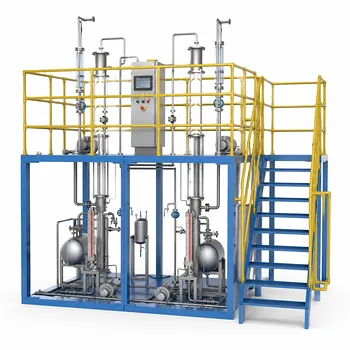
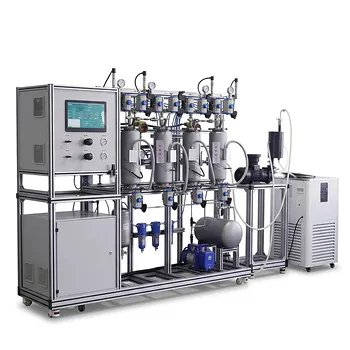
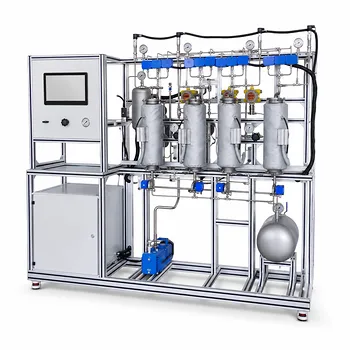
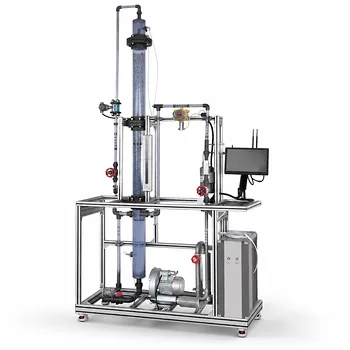
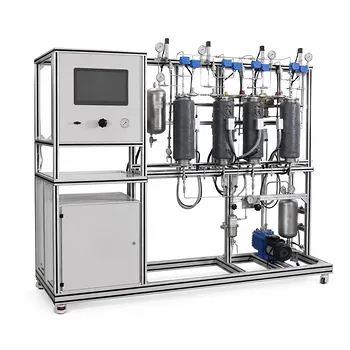
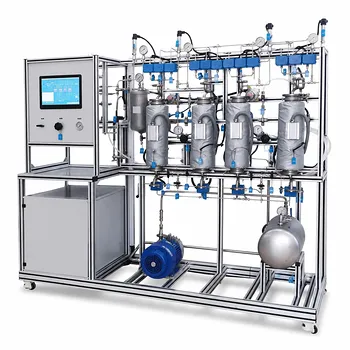
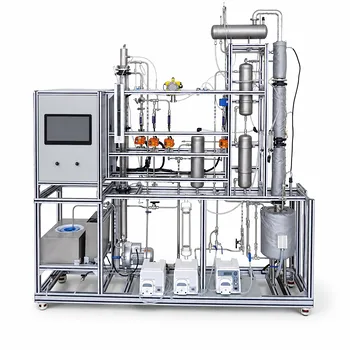
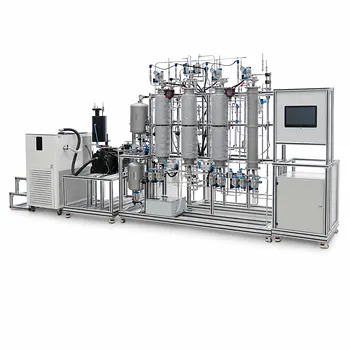
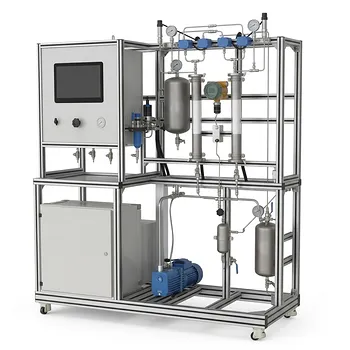
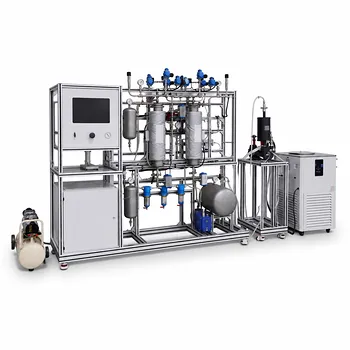
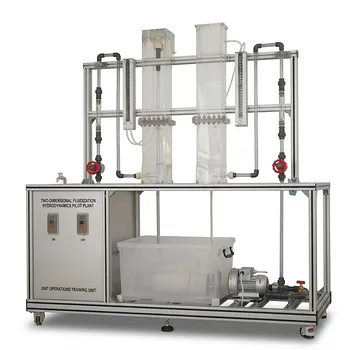
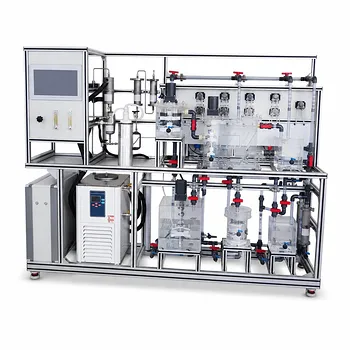
Ready to bring chemical engineering theory to life? LABPARK provides advanced Educational and Vocational Unit Operations Pilot Plants in chemical engineering, bioprocess & biotech, and environmental & water treatment. Designed specifically for universities, research institutes, and enterprises, our pilot plants enable users to safely and accurately study gas absorption, calculate enhancement factors, and model real-world industrial processes.
Enhance your laboratory capabilities—contact us today to find the perfect pilot plant solution for your institution!
Related Products
- Dual-Mode Gas Absorption and Desorption Unit Operations Training Pilot Plant
- Multi-Component Gas Pressure Swing Adsorption Pilot Plant for Unit Operations Education
- Carbon Dioxide Adsorption and Capture Educational Unit Operations Pilot Plant
- Packed Bed Absorption Educational Unit Operations Pilot Plant
- Absorption and Desorption Educational Unit Operations Pilot Plant
People Also Ask
- How do two-film & penetration theories apply to gas absorption pilot plant teaching? Key pedagogical insights.
- How does partial pressure behavior influence gas absorption pilot plants? Master Mass Transfer
- How is the direction and driving force of mass transfer determined in a gas absorption unit operations pilot plant?
- How to model chemical absorption as physical absorption? The pilot plant simplification criterion.
- What are the limitations of Henry's Law in gas absorption pilot plants? Avoid critical lab errors.