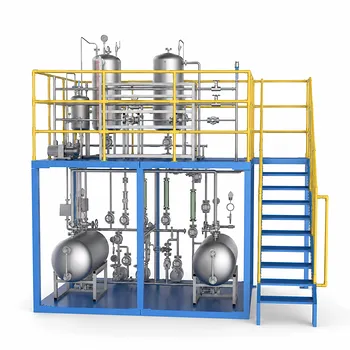
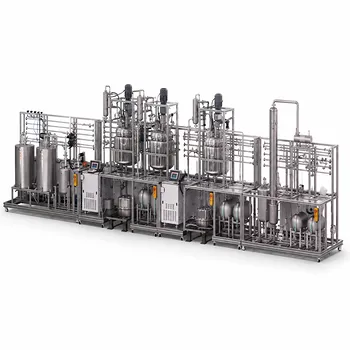
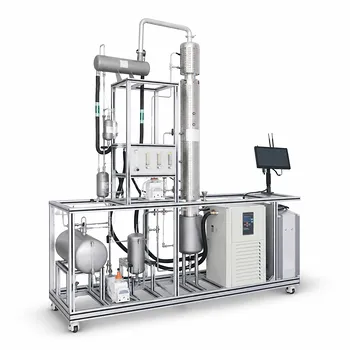
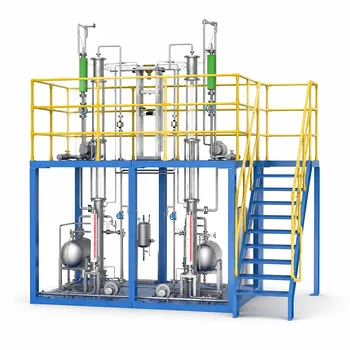
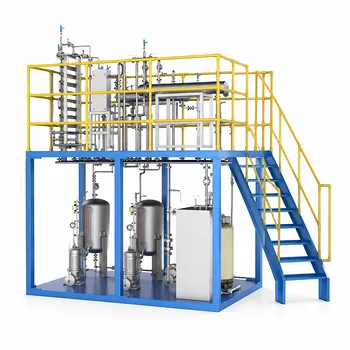
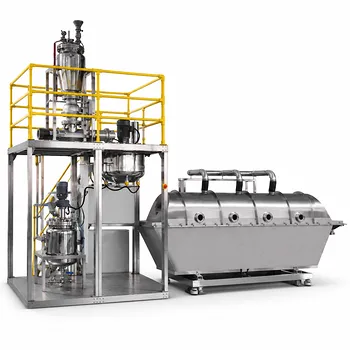
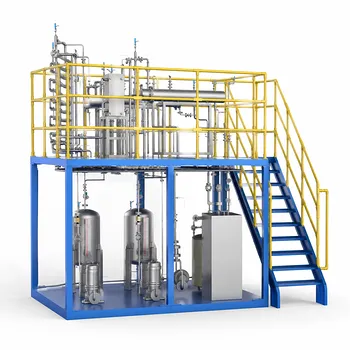
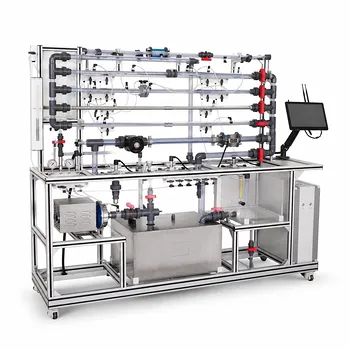
Pilot plants transform abstract thermodynamic criteria of criticality and phase stability into tangible, observable separation phenomena. By deliberately operating at conditions where the stability determinant ((A_{n+1})) approaches zero, students and researchers can watch a single-phase system become metastable, then spontaneously split into multiple phases. These pilot-scale systems—whether distillation columns, liquid-liquid extractors, or supercritical fluid rigs—provide the precise control over temperature, pressure, and composition needed to map phase envelopes, validate equations of state, and demonstrate that efficient industrial separation directly depends on understanding the exact limits of a mixture’s stability.
The critical point and spinodal surface define the boundary where a phase loses its stability and separation becomes inevitable. Chemical engineering pilot plants exploit these thermodynamic guardrails to teach, model, and safely control processes ranging from simple distillation to high-pressure supercritical extraction, ultimately bridging the gap between molecular-level physics and scalable unit operations.
The Thermodynamic Foundation: Criticality and Phase Stability
Before a pilot plant can demonstrate a separation, it must first create the conditions for instability. The underlying thermodynamic criteria are mathematical safeguards that predict exactly when a phase will split.
The Stability Determinant and the Spinodal Surface
A single phase remains stable only as long as its internal energy retains a positive definite character. This is quantified by the stability determinant ((A_{n+1})), where (n) is the number of components.
When (A_{n+1} = 0), the system reaches the spinodal surface—the absolute limit of stability. At this point, even infinitesimal fluctuations in composition cause the phase to split.
From Metastable to Unstable: The Path to Separation
Between the equilibrium binodal curve (where two phases can coexist) and the spinodal surface lies a metastable region. Here, a single phase can persist without visible change but will eventually separate if nucleation sites or sufficient disturbance are provided.
Pilot plants allow direct observation of this metastable-to-unstable transition. By incrementally adjusting temperature or pressure, the system passes through the spinodal threshold, turning a clear, single-phase liquid into a turbulent, two-phase mixture in real time.
The Critical Point: Where Differences Vanish
Gibbs’ criteria of criticality define the critical point as the state where phase boundaries disappear. At this singular point, the properties of the coexisting phases become identical, and the stability determinant is also zero.
In supercritical fluid extraction pilot plants, operating near this critical state is deliberate. Fluid density, solvent power, and viscosity become exquisitely sensitive to tiny pressure or temperature changes—a dramatic physical demonstration of the power of criticality.
How Pilot Plants Bring Stability Theory to Life
Unit operations pilot plants are not passive displays; they are active experimental platforms that let users manipulate the very variables that govern phase stability.
Mapping Phase Envelopes with Real-Time Measurements
By systematically varying (T), (P), and composition, a pilot distillation or vapor-liquid equilibrium (VLE) setup generates a full phase envelope. Students measure coexisting liquid and vapor compositions, then compare these to predictions from an equation of state (EOS).
When experimental data points align with the EOS-calculated binodal and spinodal curves, the abstract concept of (A_{n+1} = 0) gains physical meaning. The plant becomes a validation tool for theoretical models.
Visualizing Metastable States and Nucleation
Liquid-liquid extraction training pilot plants make the invisible visible. Because many industrial systems have low interfacial tension and small density differences, phase separation is naturally slow.
Students can watch as a metastable dispersion persists due to emulsification or axial mixing, then gradually coalesce once conditions shift past the spinodal limit. This visual feedback cements the link between stability criteria and the actual kinetics of separation.
Demonstrating Phase Instability as a Safety Principle
In high-pressure gas-liquid interaction pilot plants, stability criteria are a critical safety net. A system operated unknowingly near its spinodal surface can undergo sudden phase separation or rapid pressure fluctuations.
By monitoring the stability determinant in real time (calculated from process measurements), operators learn to predict phase envelope boundaries and avoid unstable regions. This turns thermodynamic equations into a proactive operational strategy rather than post-hoc analysis.
Connecting Stability to Measurable Separation Performance
Theoretical stability criteria directly influence the engineering metrics that matter most—recovery, purity, and energy consumption.
From Fugacity Equality to Tray Efficiency
The thermodynamic criterion for phase equilibrium ((f_i^L = f_i^V)) is the foundation of all distillation. Pilot columns demonstrate that this equality is only satisfied on each theoretical stage.
By measuring actual compositions, calculating activity coefficients from the liquid phase and fugacity coefficients from the vapor phase, students verify that the Gibbs free energy minimization (which underlies the stability determinant) translates to a practical driving force for separation.
The Role of Stability in Droplet Coalescence
For liquid-liquid extraction, phase instability is not the end of the story; the separation must proceed to completion. The physical properties—density difference, viscosity, interfacial tension—determine coalescence rates.
A pilot plant allows the measurement of these properties under controlled conditions. When a system is taken just past the spinodal threshold, the resulting droplet size distribution and settling velocity become a direct function of how far the system was pushed into the unstable region.
Enthalpy Coupling and Energy Balances
Phase equilibria and enthalpy are inextricably linked. An accurate EOS-based stability analysis directly feeds into the energy balance for a distillation column.
When researchers calculate reflux ratios and column sizing from an EOS, they are implicitly relying on the stability determinant to define the phase envelope. Pilot plant data then validates whether the theoretical energy demand matches reality.
Understanding the Trade-offs: Operating Near the Edge
Exploiting criticality and phase stability for demonstration purposes is powerful, but it introduces distinct challenges that a pilot plant must manage.
Hypersensitivity Near the Critical Point
Operating a supercritical extraction pilot plant too close to the mixture’s critical point makes the process extremely sensitive to minor fluctuations. A temperature change of a fraction of a degree can send the system from complete miscibility to catastrophic phase separation.
This creates a steep learning curve. The same physics that makes for a compelling demonstration also demands sophisticated control systems.
Metastability Can Mask True Equilibrium
In a pilot plant, a liquid-liquid mixture may linger in a metastable single-phase state for longer than expected, especially in clean, vibration-free environments.
Students can misinterpret this as a stable condition unless they explicitly calculate (A_{n+}) and understand that they are inside the metastable zone. The plant must be equipped to disturb the system and trigger the expected separation.
Measurement Uncertainty at the Stability Limit
As the spinodal surface is approached, thermodynamic properties like the isothermal compressibility and heat capacity diverge. Near-critical opalescence can make optical measurements unreliable.
Pilot plant instrumentation must be carefully selected to handle these non-ideal behaviors, or the very data meant to validate the theory can become misleading.
Making the Right Choice for Your Goal
How you prioritize stability criteria within a pilot plant depends entirely on your primary objective. The plant is a flexible tool—its thermodynamic control can be tuned for education, research, or process development.
- If your primary focus is education and conceptual understanding: Operate the pilot plant with transparent systems (like liquid-liquid extraction) and deliberately walk through the binodal and spinodal boundaries. Let students observe metastability, coalescence, and the sudden onset of a second phase.
- If your primary focus is research into new separation processes: Use the pilot plant to map detailed phase envelopes for novel mixtures. Rely on the stability determinant to predict spinodal curves and then validate the EOS against precise (P)-(T)-(x) data, ensuring your model holds even near critical points.
- If your primary focus is industrial scale-up and safety: Concentrate on defining safe operating margins away from the spinodal surface. Use the pilot plant to quantify how fast pressure or temperature disturbances can push the system into unstable regions, and design your control loops accordingly.
By treating the stability determinant and critical point as operational guides rather than mere textbook equations, a pilot plant becomes the definitive bridge between abstract thermodynamics and real-world separation mastery.
Summary Table:
| Thermodynamic State | Stability Determinant ($A_{n+1}$) | Physical Observation | Pilot Plant Application |
|---|---|---|---|
| Stable Phase | $A_{n+1} > 0$ | Single, homogeneous phase | Establishes baseline operation & steady-state feed |
| Metastable Region | $A_{n+1} > 0$ (local min) | Delayed phase separation; emulsion | Demonstrates nucleation kinetics & coalescence dynamics |
| Spinodal Surface | $A_{n+1} = 0$ | Spontaneous phase splitting (turbulent mix) | Defines absolute physical separation limits |
| Critical Point | $A_{n+1} = 0$ (critical state) | Phase boundaries disappear; opalescence | Demonstrates supercritical fluid extraction near critical limits |
Bring Thermodynamic Theory to Life with LABPARK
Bridging the gap between complex thermodynamic equations and physical unit operations requires robust, precision-controlled equipment. LABPARK designs and manufactures high-performance Educational and Vocational Unit Operations Pilot Plants tailored for universities, research institutes, and enterprises.
Whether you are teaching phase stability in chemical engineering, exploring advanced bioprocess & biotech separations, or training operators on environmental & water treatment systems, our pilot plants deliver the accuracy, visualization, and safety needed for deep hands-on learning and research validation.
Ready to elevate your laboratory or training facility? Contact LABPARK today to discuss your custom pilot plant requirements with our engineering specialists!
Related Products
- Multi-Reactor Educational Pilot Plant for Reaction Engineering Unit Operations
- Carbon Dioxide Hydrogen Methanol Synthesis Educational Unit Operations Pilot Plant
- Ethyl Acetate Synthesis Unit Operations Pilot Plant for Practical Training
- Multi Pump Fluid Transport Process Piping Unit Operations Training Pilot Plant
- Multi-Modal Distillation Unit Operations Training Pilot Plant
People Also Ask
- How do educational unit operations pilot plants address safety and waste management when scaling up?
- How do educational unit operations pilot plants bridge theory and design? Bridge the Engineering Gap
- Why Compare Predicted and Experimental Excess Enthalpy? Key to Accurate Pilot Plant Scale-up
- How to study gasification in pilot plants? Compare exit gas composition & efficiency
- Why Use PTFE & Hastelloy in Chemical Pilot Plants? Prevent Corrosion & Ensure Safety